

On this page
Leave a steel spoon in hot tea and the handle warms up: heat travels along the metal by conduction. Board exam and JEE Main questions on conduction often use a rod between a hot end and a cold end, and they usually come down to one formula and a few ratios.
What is the formula for the rate of heat flow through a rod?
The NCERT Class 11 Physics chapter on thermal properties of matter takes a bar of length L and uniform cross-section A, with its ends held at temperatures T_C and T_D and its sides insulated. Once a steady state is reached, the rate of heat flow, called the heat current H, is H = KA(T_C - T_D)/L (NCERT Class 11 Physics, Chapter 10, Eq. 10.14).
H = Q/t, the heat that crosses any section of the rod each second, in watts (J/s).
K is the thermal conductivity of the material, in W m^-1 K^-1.
A is the area of cross-section. For a round rod of radius r, A = πr².
T_C - T_D is the temperature difference between the two ends.
L is the length of the rod.
In steady state the temperature falls uniformly along the bar from the hot end to the cold end (NCERT, Chapter 10). OpenStax writes the same law as P = kA(T_h - T_c)/d, with d the thickness (OpenStax University Physics Volume 2, section 1.6).
Metals conduct far better than non-metals: NCERT's Table 10.6 lists copper at 385 W m^-1 K^-1, steel at 50.2, wood at 0.12 and air at 0.024 (NCERT, Table 10.6).
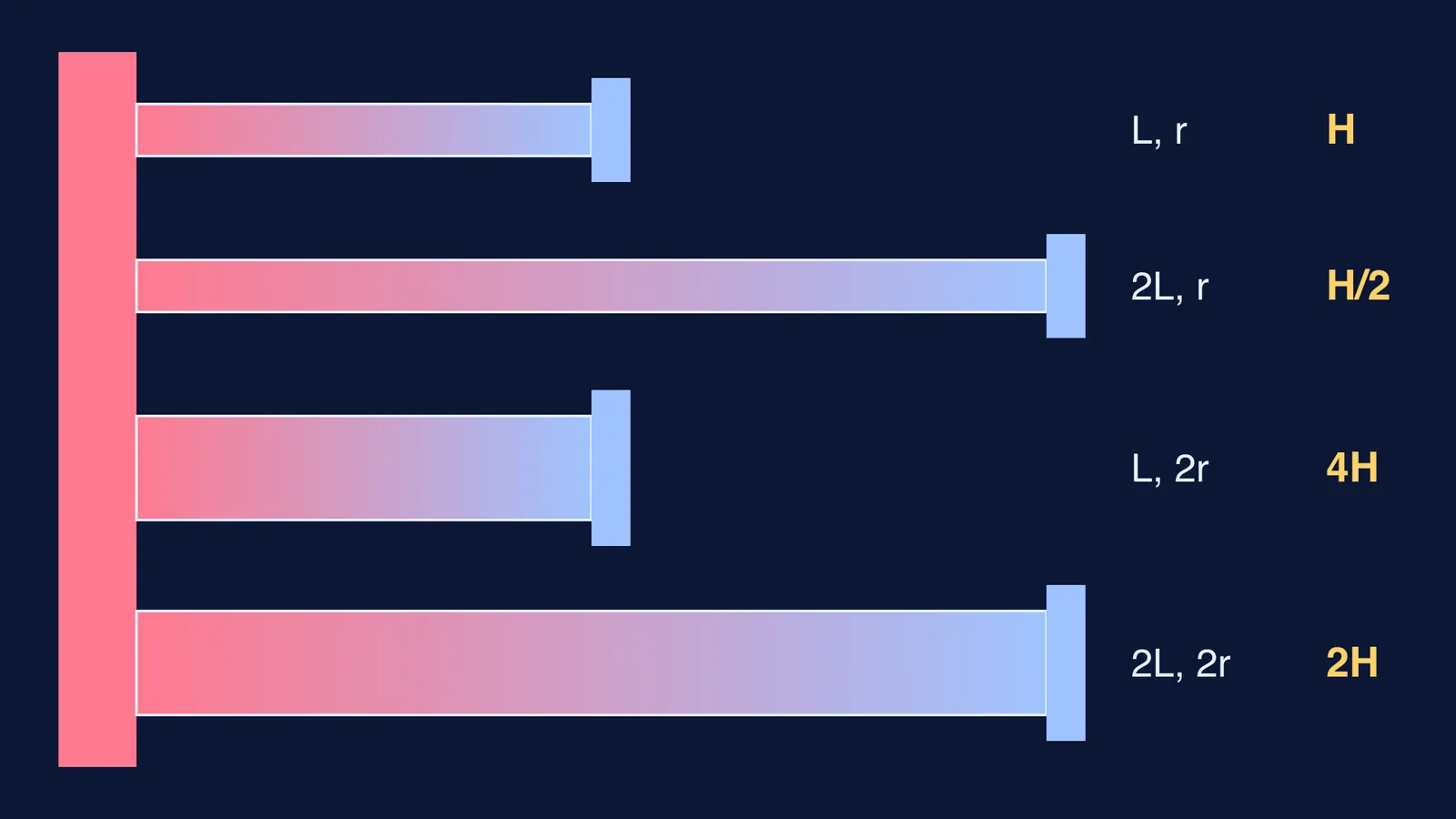
What happens to heat current if you double the length or the radius?
NCERT states the formula as a set of proportions: H is proportional to the temperature difference and to A, and inversely proportional to L (NCERT, Chapter 10). Since A = πr², H is proportional to r². With everything else fixed:
Double the length L: H becomes half.
Double the radius r (or the diameter): A becomes 4 times, so H becomes 4 times.
Double both length and radius: 4 ÷ 2, so H becomes 2 times.
Double the temperature difference: H becomes 2 times.
Use a material with double the K: H becomes 2 times.
Worked example: a copper rod and a steel rod
Take a copper rod 0.50 m long with a radius of 1.0 cm. One end sits in boiling water at 100 °C and the other in ice at 0 °C, so the temperature difference is 100 K. Use K = 385 W m^-1 K^-1 for copper (NCERT, Table 10.6).
Convert to metres: r = 0.010 m, so A = π(0.010)² = 3.14 × 10^-4 m².
Substitute: H = 385 × 3.14 × 10^-4 × 100 / 0.50.
Work it out: H ≈ 24.2 W.
Now change one thing at a time:
Length doubled to 1.0 m: H ≈ 12.1 W.
Radius doubled to 2.0 cm: H ≈ 96.8 W.
Both doubled: H ≈ 48.4 W.
Same size, but steel (K = 50.2 from the same table): H ≈ 3.2 W, about 7.7 times less than copper.
That gap is why some cooking pots have a copper coating on the bottom: NCERT notes that copper, being a good conductor, spreads heat over the bottom of the pot for uniform cooking (NCERT, Chapter 10).
If you set up the problem right but lose marks in the arithmetic or a unit, work through a similar problem in the Fermi Problem Library. Its step-by-step solver explains the reasoning rather than printing an answer, so you can see where a factor of 4 went missing.
Why does a rod behave like a resistor?
Rearrange the formula as H = ΔT / (L/KA). The quantity L/KA acts as a thermal resistance, so a longer, thinner or less conductive rod resists heat flow more, just as a longer, thinner wire has more electrical resistance. ΔT plays the part of voltage and H the part of current.
When two rods are joined end to end, the same heat current passes through both in steady state, so their resistances add like resistors in series. NCERT's Example 10.6, a steel rod joined to a copper rod, is solved by setting the heat current equal in both parts (NCERT, Chapter 10).
Which mistakes cost marks in heat conduction questions?
Check these before you finalise an answer:
Did you square the radius? Doubling r changes H by a factor of 4, not 2.
Did you convert cm² to m²? 1 cm² is 10^-4 m².
Did you use the difference between the end temperatures? A 1 °C difference equals a 1 K difference.
Was the rod reshaped? If it is stretched to twice its length at constant volume, its area halves too, so H drops to one quarter.
In a compound rod, did you keep H the same in every segment?
If thermal resistance or steady state still feels shaky, the Fermi Concept Library gives every physics concept its own lesson and its place in the concept map. Then try the ratio shortcut on three past-paper questions this week.


