On this page
Stretch cling film over a glass bowl of leftover dal and it stays put with no glue or tape. Tear the next sheet carelessly and it folds into a tangle you cannot undo. Both come from the same physics: unrolling leaves the film charged, and the film is thin enough to get extremely close to a surface, where weak attractions between molecules add to the pull.
Why does cling film stick to bowls?
Static charge is the main explanation. The unrolled film keeps its charge, and over an insulator such as glass, 'the electrostatic charge induces an opposite charge in the other surface and the two stick together', explains BBC Science Focus.
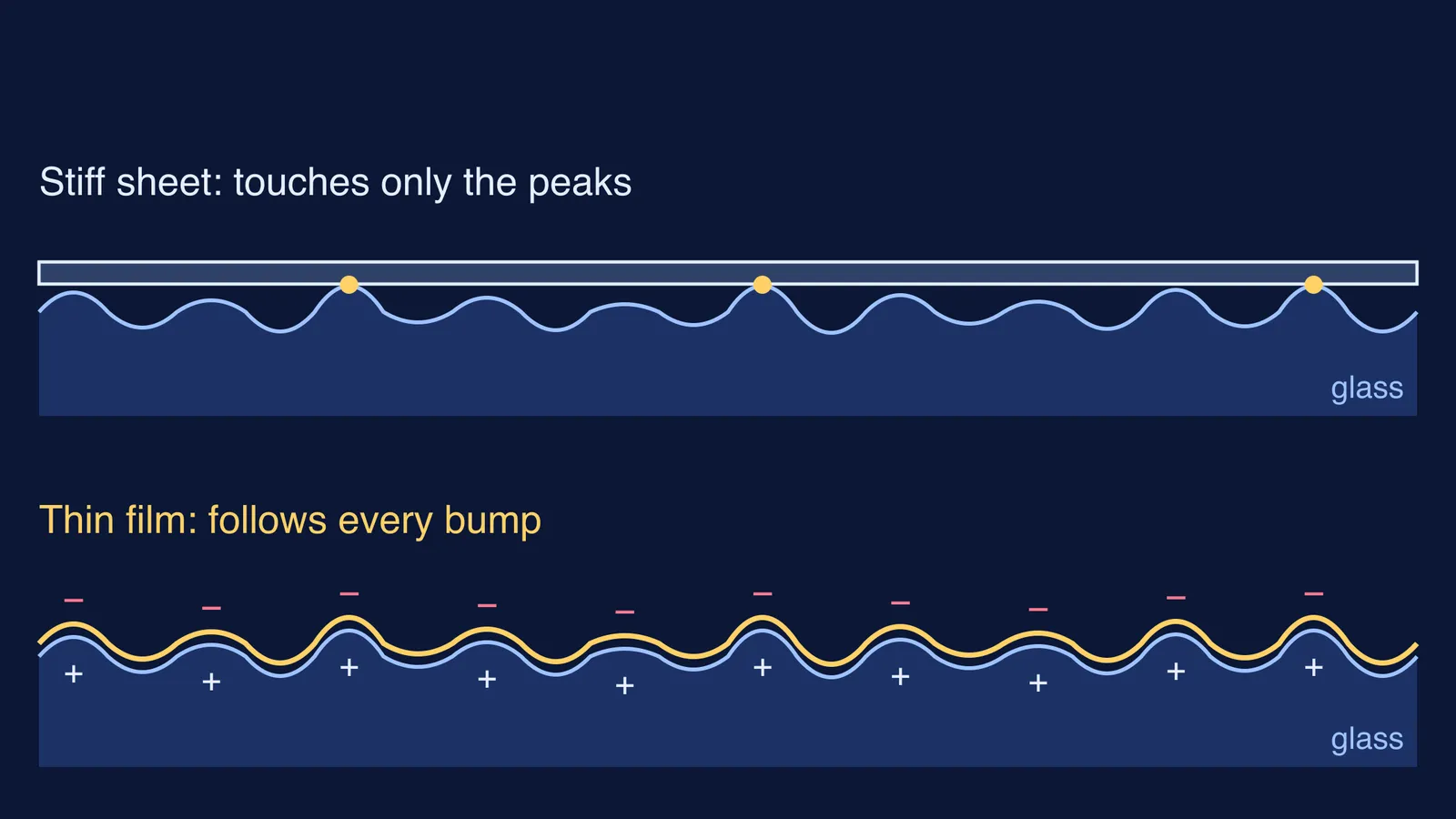
How thin the film is matters too. One PVC food wrap sold to caterers is listed as 8 micrometres thick, according to this product page from the supplier Tingstad. Its long, coiled-up polymer molecules give it some stretch, as How It Works explains, so when you pull it over a rim it can bend down towards the tiny hills and valleys that even smooth-looking glass has.
That closeness helps. Intermolecular forces are attractions between atoms and molecules that come from electrostatic effects, and they 'become significant only when the molecules are very close', according to the OpenStax Chemistry 2e chapter on intermolecular forces.
One kind acts between all molecules: the London dispersion force. A brief, uneven spread of electrons in one molecule creates a temporary dipole, which induces a dipole in its neighbour, and the two attract. Fritz London first explained it in 1928; our profile of Fritz London and dispersion forces tells that story.
Each attraction is weak. In the OpenStax example, overcoming the intermolecular forces in one mole of liquid HCl takes only about 17 kJ, while breaking the H–Cl bonds takes about 430 kJ, roughly 25 times more (OpenStax). A thin film lying close to the bowl over a wide area adds up many small pulls; a stiff sheet would rest only on the highest bumps, as the diagram at the top sketches.
Why does cling film stick to itself?
Unrolling the film charges it. As one layer peels off another, some electrons are pulled from one surface onto the other, leaving patches of positive and negative charge, explains BBC Science Focus. Because the plastic is a good insulator, the charge persists. This is the triboelectric effect, which we explain in how rubbing creates static charge. Two layers of film are well matched: both thin, both flexible, both freshly charged.
Some films also contain a tackifier. A US patent on stretch and cling films, US5114763, defines cling as 'the force in grams required to partially peel apart two strips of film', and describes earlier films in which a tackifier such as polyisobutylene is added and migrates to the film's surface, or 'blooms'. The patent covers stretch films, not kitchen wrap, so treat this as one possible ingredient, not a rule for every roll.
Why doesn't cling film stick to metal bowls?
Glass is an insulator, so the film's charge induces an opposite charge in the bowl and the two attract. On a conductor such as metal, the charge is dispersed and the film won't stick, according to BBC Science Focus. Close-range attractions still act on metal, but alone they seem too weak to hold it well.
A greasy rim or a rough surface can also get in the way, because both stop the film lying close to the bowl. Damp air can let charge leak away, too, which is one reason static shocks are more common in dry winter weather.
Try it: a kitchen test you can do tonight
Take a glass bowl and a steel bowl of about the same size.
Predict for each: will the film hold, sag or slide off?
Cover both with fresh film from the same roll, tap each bowl and note what happens.
Wipe the glass rim with a drop of cooking oil and cover it again.
Hold a freshly torn strip near small bits of paper and watch whether they jump towards it.
For each result, name the cause: static charge, close contact and intermolecular forces, or both.
How do you explain this in an exam answer?
A three-mark answer can give one point per mark:
Unrolling charges the film by friction; the charged film induces opposite charge in the insulating glass, and the two attract.
The thin, flexible film comes into very close contact with the glass, following its tiny surface bumps.
At such small distances, weak London dispersion (van der Waals) forces between the molecules of the film and the glass add to the hold.
Add one line on metal if you have space: a conductor lets the charge spread out, so the film clings poorly.
Temporary dipoles and induced charges are easier to see than to read: the Fermi Simulation Lab has interactive simulations for such ideas. If a term such as polarisability is the sticking point, the Fermi Concept Library gives each concept its own lesson.
Next time the film wins the fight with you, you will know which force to blame.