

On this page
If you spend winter dodging doorknobs and flinching when you hand someone a pen, you are experiencing one of the oldest principles of physics in action.
Static electricity builds up when two different materials rub together, transferring electrons from one to the other—a process called the triboelectric effect. But why does this result in painful sparks in January, while the exact same carpet and shoes do nothing in July?
The answer is water, and how heating our homes in winter removes it from the air.
The insulating power of dry air
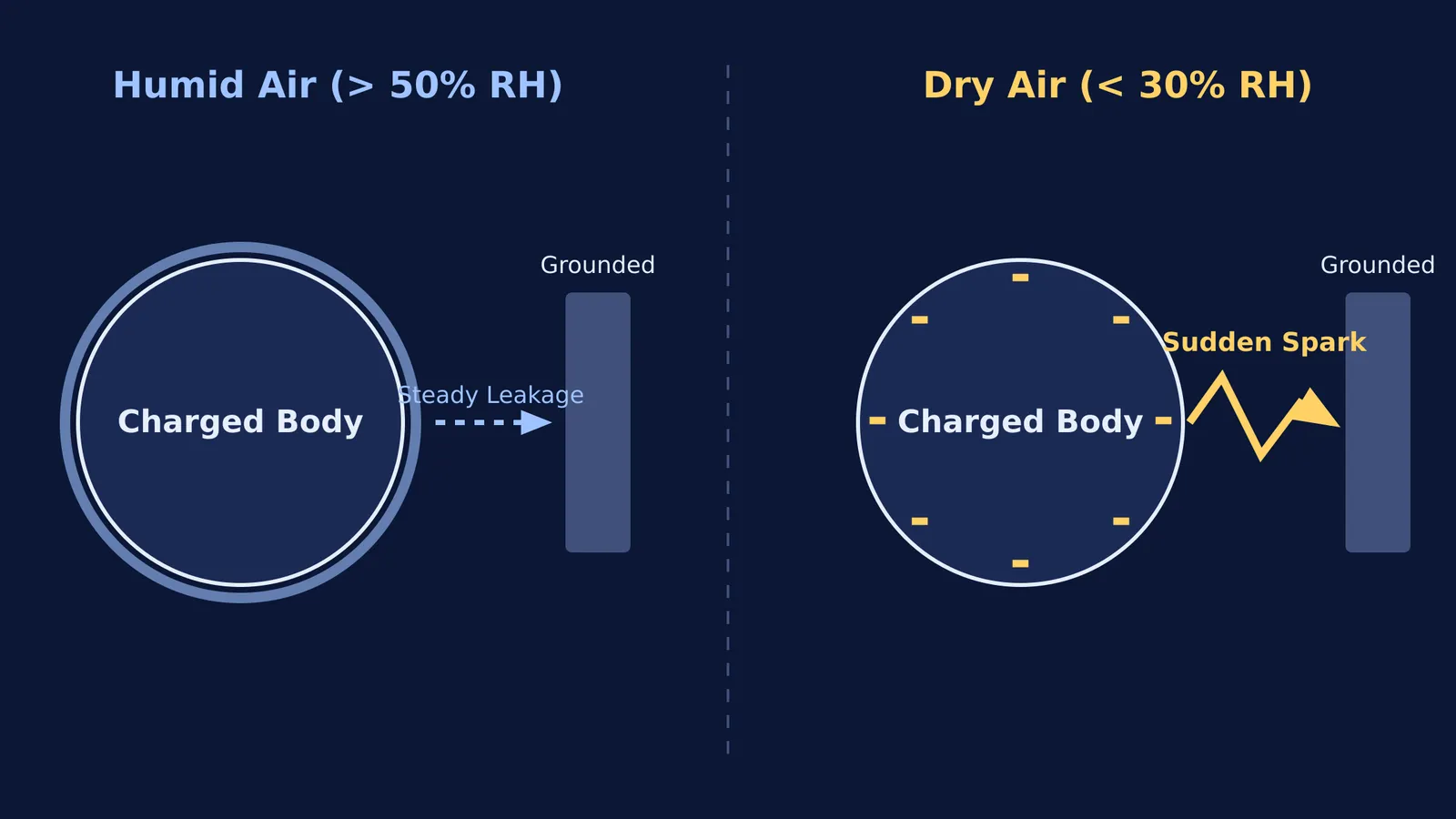
In humid weather, a microscopic, invisible layer of water molecules coats almost every surface around you, including your skin and clothes. Because this water contains trace amounts of dissolved minerals and ions, it is slightly conductive.
As you walk and generate static charge, this moisture layer allows the excess electrons to continuously leak away into the ground and the surrounding air. The charge never builds up enough to cause a spark.
In dry winter air, this leakage path vanishes. The air and your skin act as electrical insulators, trapping the electrons. Because they have nowhere to go, your body can accumulate a high electrical potential. When you finally touch a grounded conductor—like a metal doorknob or a car door—all those trapped electrons jump the air gap in a single, sudden spark.
Why does heating your home cause the problem?
Cold outdoor air physically cannot hold as much water vapour as warm air. When you take winter air that is at freezing and heat it to room temperature inside your house, you increase its capacity to hold water without adding any actual moisture.
This causes the relative humidity—the percentage of how much water the air holds compared to its maximum capacity—to plummet. It is common for indoor humidity in heated winter homes to drop to very low levels, making your living room intensely dry.
What the physics research tells us
Scientists have measured exactly how humidity controls this charge buildup. A 2017 study published in the Royal Society of Chemistry journal *Soft Matter* investigated the triboelectric charging of polymer spheres under varying humidity (Schella et al., 2017).
The researchers found a stark threshold: below 30% relative humidity, the materials became highly charged. However, when humidity rose above 80%, the charge accumulation dropped to near zero. The thin film of surface water completely changed the electrical properties of the materials.
Visualising how charges accumulate on insulators and jump to conductors is often easier than reading about it. If you want to experiment with these effects in real time, the Fermi Simulation Lab offers interactive simulations for the ideas that are easier to see than to read. (For solving textbook problems on this topic, such as earthing concentric charged shells or calculating electric fields from potential gradients, step-by-step methods apply).
How to stop static shocks this winter?
To solve the problem, you need to either stop the charge from building up or give it a safe way to leave. The US Environmental Protection Agency (EPA) recommends maintaining indoor relative humidity between 30% and 50% year-round (EPA). Keeping your home in this range will eliminate most static sparks.
If you cannot control the humidity, you can manage the discharge:
Check your humidity: Aim for the 30% to 50% range. Going above 60% can encourage mould growth on cold windows.
Change your materials: Synthetic fabrics like polyester, and natural insulators like wool, are highly prone to triboelectric charging. Cotton is more neutral.
Discharge safely: If you know you are charged, touch a metal object with a key or a coin first. The spark will jump from the metal object, not your skin, so you will not feel the painful current concentrated on a tiny point on your finger.


