

On this page
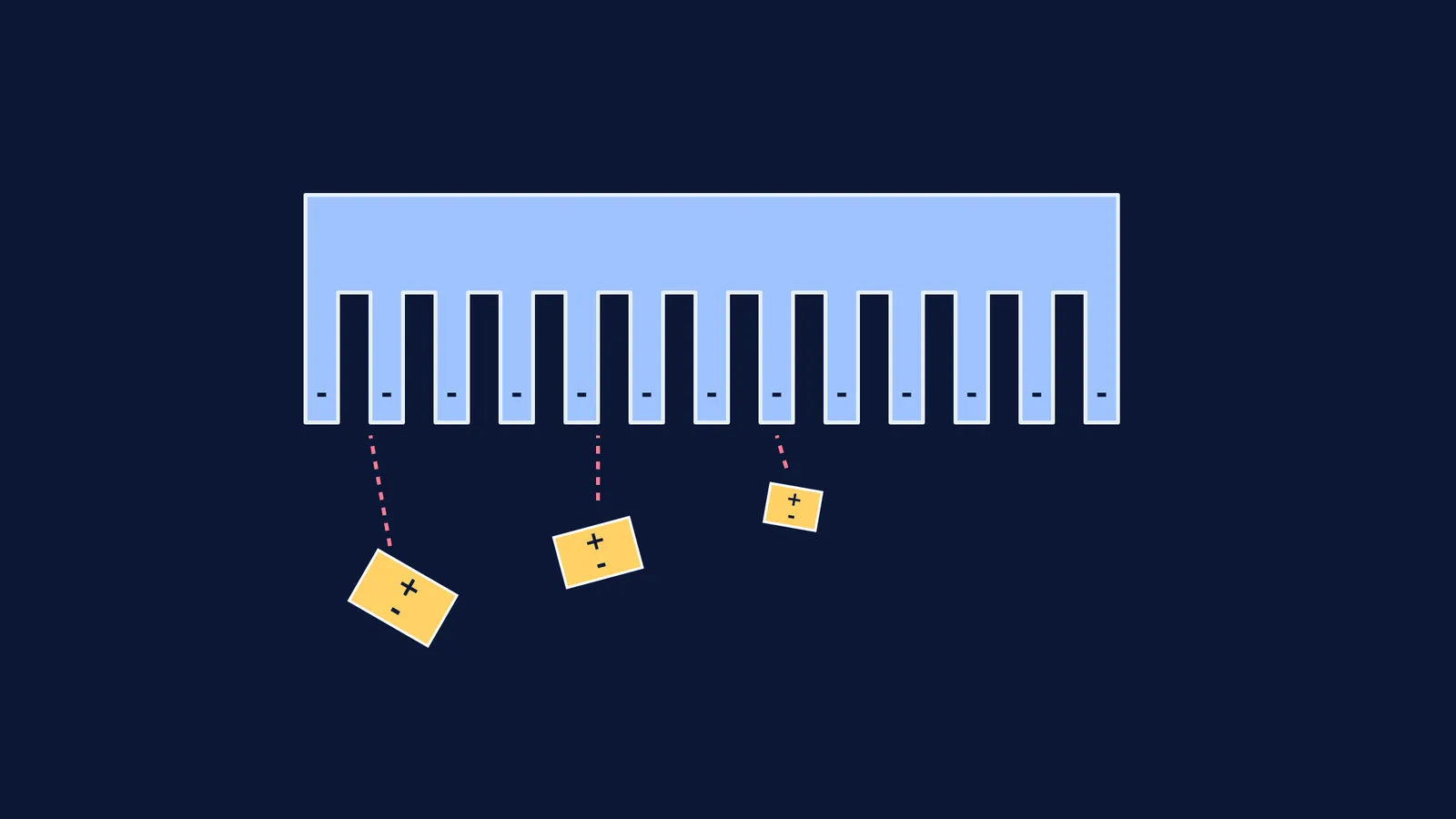
When you rub a plastic comb through your hair, the comb can pick up small bits of paper. This happens because the rubbing action transfers invisible, negatively charged electrons from your hair to the comb.
How does rubbing create static charge?
At the atomic scale, everything in our world is made of atoms, which consist of a heavy, positively charged nucleus surrounded by a light cloud of negatively charged electrons. When two different materials come into contact, their surface atoms get close enough to interact. Because different materials hold onto their electrons with different strengths—a property known in chemistry and physics as electron affinity—electrons will naturally jump from the material with a weaker grip to the one with a stronger grip.
When you pull the two materials apart, the one that gained electrons is left with a net negative charge, while the one that lost electrons has a net positive charge. This physical process of charge transfer through contact and separation is called the triboelectric effect. In conductors like copper or iron, these transferred electrons would instantly flow back and neutralise the charge. However, in insulators like plastic, rubber or glass, the transferred electrons are trapped exactly where they land, creating a "static" charge that stays put until it finds a path to discharge.
If you are unsure why an insulator behaves differently from a conductor, you can read the Fermi Concept Library explanation of charge mobility to understand how electrons move through different materials.
What causes the triboelectric effect?
For centuries, the exact reason why rubbing drives such a strong transfer of charge remained a puzzle for physicists. Simple contact seemed insufficient to explain the large amounts of static electricity generated.
In 2019, a study published in *Physical Review Letters* by researchers at Northwestern University offered a clear explanation. The researchers found that when two materials are rubbed together, the friction forcefully bends the microscopic bumps, or asperities, on the material surfaces. This physical bending creates tiny, intense local voltages—a phenomenon known as flexoelectricity. These flexoelectric voltages are strong enough to push electrons across the gap from one material to the other, even between two pieces of the exact same material.
Which materials gain and lose electrons?
Scientists rank materials in a list called the triboelectric series. The triboelectric series ranks materials by their tendency to lose or gain electrons during contact.
Materials located at the highly positive end of the list, such as human hair, dry skin, rabbit fur and glass, have a weak hold on their outer electrons and tend to lose them easily. Materials positioned at the negative end, like silicon, PVC, Teflon and rubber, have a strong affinity for electrons and tend to pull them away from other surfaces.
When you rub two materials together, the further apart they are on the triboelectric series, the greater the static charge they will build up. For example, rubbing Teflon with rabbit fur will create a much larger static spark than rubbing two closely related plastics together.
How can you test the triboelectric effect?
You can test this effect yourself at home. Try rubbing different materials together and holding them near a gentle stream of tap water or small bits of paper to see which combination creates the strongest attractive pull:
The plastic comb and hair: Rub a plastic comb against dry hair or a wool sweater for a few seconds. The comb becomes negative and your hair becomes positive. Bring the comb near small torn bits of paper; the paper will polarise and jump to the comb.
The glass rod and silk: Rub a glass rod with a silk cloth. The glass loses electrons and becomes positive, while the silk becomes strongly negative.
The rubber balloon: Rub an inflated rubber balloon against your clothes and press it to a wall. The balloon gains a negative charge from the fabric and sticks to the neutral wall by repelling the wall's surface electrons, creating an induced positive charge on the wall itself.
Next time you feel a sudden static shock after walking across a carpet and touching a metal doorknob, you will know exactly how those charges built up on your shoes.
Read more:


