

On this page
Walk into your kitchen on a crisp morning and pick up a wooden spoon and a steel spoon. The wood feels neutral, perhaps even slightly warm, while the steel feels strikingly cold. Yet if they have been sitting in the same 18°C room all night, they are at the exact same temperature.
This illusion exposes a fundamental truth about human perception: your skin does not act like a thermometer.
Why doesn't your skin measure absolute temperature?
A healthy human body maintains an internal core temperature around 37°C, with the skin typically resting at 33°C to 34°C. Because your skin is significantly warmer than the room, heat naturally flows from your hand into whatever you touch.
Embedded in your skin are specialized molecular sensors, primarily the TRPM8 receptors, which act as your body's thermostat. These receptors do not measure the absolute temperature of the spoon. Instead, they activate when the local temperature of your skin drops below a threshold, typically around 25°C to 28°C.
Whether you feel "cold" depends entirely on how fast the object you are touching can drain heat from your skin.
Why does thermal conductivity make steel feel colder?
The difference between the two spoons lies in their thermal conductivity. Stainless steel is an excellent conductor, transferring heat at roughly 15 W/(m·K). Oak wood, by contrast, is an insulator with a much lower conductivity of 0.15 W/(m·K). Steel moves heat 100 times faster than wood.
When you grasp the wooden spoon, it acts like a thermal bottleneck. The very thin surface layer of the wood quickly absorbs enough heat to match your skin temperature, and because wood cannot transport that heat away efficiently, the transfer slows to a crawl. Your skin temperature barely drops, keeping your TRPM8 receptors quiet.
When you touch the steel spoon, it acts as a thermal pipeline. It rapidly pulls heat away from the contact point and distributes it throughout the handle. The metal at your fingertips stays cool, maintaining a steep temperature gradient that continuously siphons thermal energy out of your hand.
How do you calculate the contact temperature?
To prove this, physicists use a property called thermal effusivity (e = √(k·ρ·c_p)), which measures a material's ability to exchange thermal energy with its surroundings. It combines thermal conductivity (k), density (ρ), and specific heat capacity (c_p) into a single value that dictates how the material feels to the touch.
When your skin (effusivity e ≈ 1000 J/(m²·K·s¹/²)) at 34°C touches an 18°C object, the immediate contact temperature (Tc) is determined by their competing effusivities:
Tc = (e_skin × T_skin + e_obj × T_obj) / (e_skin + e_obj)
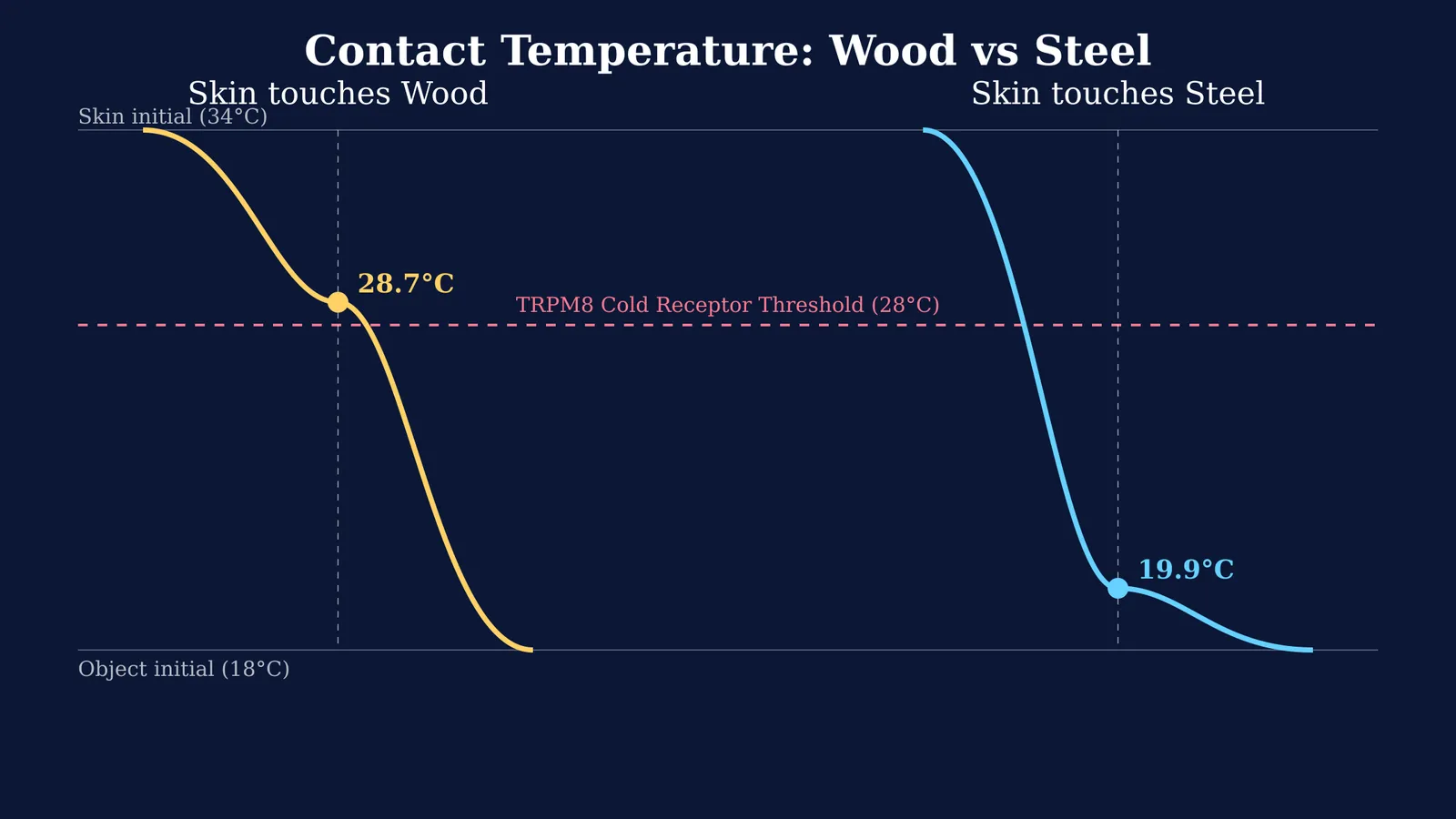
Wood has a low effusivity (e ≈ 500). Plugging the numbers in, the contact temperature between your skin and the wooden spoon settles at 28.7°C. This is safely above the threshold for your cold receptors.
Steel has an enormous effusivity (e ≈ 7230). The math changes dramatically: the contact temperature crashes to 19.9°C. This sharp drop in your skin's local temperature immediately triggers the TRPM8 receptors, sending a blaring "cold" signal to your brain.
See the math in action
Thermal gradients are one of those ideas that are notoriously difficult to grasp just by staring at a textbook page. Students often memorize Fourier's law of heat conduction for exams without building an intuition for how heat actually flows. If you are preparing for competitive exams, comparing thermal properties is just as crucial as understanding how energy bands: conductors, semiconductors and insulators compared govern electricity, or why work is zero in the free expansion of an ideal gas.
When a concept is harder to picture than to read, the Fermi Simulation Lab provides the interactive simulations you need. Rather than just handing you the formula and expecting you to blindly apply it, Fermi's AI tutor works out what you already know, builds a plan for the session, and teaches through it — drawing the figure, running the simulation, and checking your understanding as it goes. You can place different materials in a virtual room, touch them with a heat source, and watch the temperature gradients form in real time.


