

On this page
Why does a dissolved solute depress the freezing point?
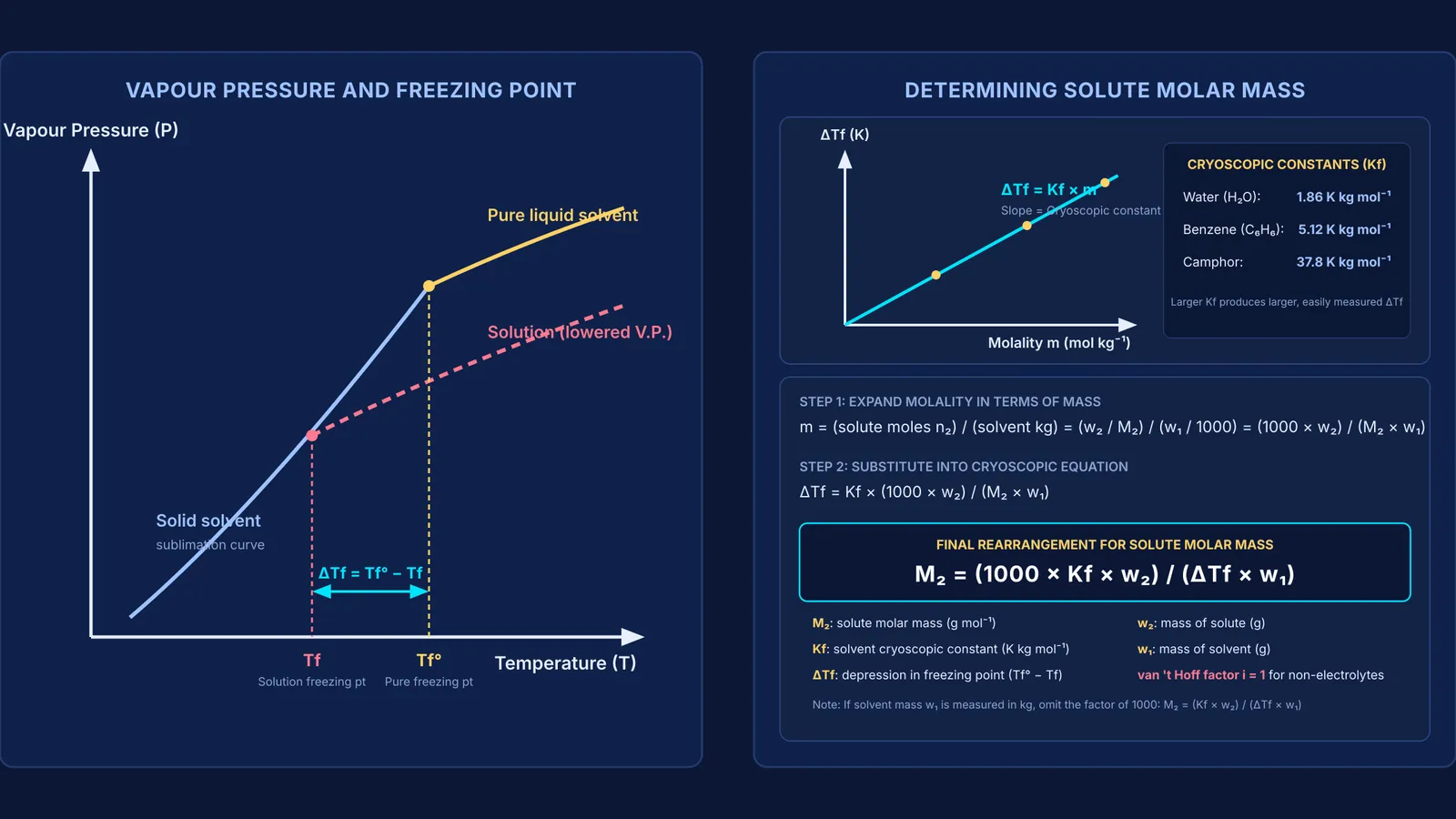
When you cool a pure liquid, it freezes at the temperature where its liquid and solid phases exert identical vapour pressure and exist in dynamic equilibrium. Adding a non-volatile solute lowers the solvent's vapour pressure in accordance with Raoult's law for ideal solutions. Because the liquid solution now has a lower vapour pressure at every temperature, its vapour pressure curve intersects the sublimation curve of the solid solvent at a lower temperature than the pure liquid does. According to Chemistry LibreTexts on Colligative Properties/13%3A_Properties_of_Solutions/13.05%3A_Colligative_Properties), solute particles physically obstruct solvent molecules from joining the crystal lattice, meaning the system must lose additional thermal kinetic energy before solidification can occur.
The difference between the freezing point of the pure solvent (Tf°) and that of the solution (Tf) is the depression in freezing point:
ΔTf = Tf° − Tf
This temperature drop is a colligative property: for dilute solutions, it depends solely on the number of dissolved solute particles per unit mass of solvent, not on their chemical identity. The quantitative relation is:
ΔTf = Kf × m
Here, m represents molality in mol kg⁻¹, while Kf is the molal depression constant, also called the cryoscopic constant, expressed in K kg mol⁻¹ as detailed in OpenStax Chemistry 2e on Colligative Properties. Pure water has a cryoscopic constant of 1.86 K kg mol⁻¹, whereas benzene has a value of 5.12 K kg mol⁻¹.
How do you rearrange ΔTf = Kf m to find molar mass?
To extract the molar mass of an unknown substance, express molality through its fundamental definitions of mass and amount of substance. Under the IUPAC Gold Book definition of molar mass, the molar mass M₂ equals solute mass w₂ divided by moles n₂.
Molality m is the number of moles of solute dissolved in 1 kilogram of solvent:
m = n₂ / (w₁ in kg) = (w₂ / M₂) / (w₁ / 1000 g kg⁻¹)
m = (1000 × w₂) / (M₂ × w₁)
Substitute this molality expression directly into the cryoscopic equation:
ΔTf = Kf × (1000 × w₂) / (M₂ × w₁)
Now multiply both sides by M₂ and divide by ΔTf to isolate the unknown molar mass:
M₂ = (1000 × Kf × w₂) / (ΔTf × w₁)
Where:
M₂ is the solute molar mass in g mol⁻¹.
Kf is the solvent's cryoscopic constant in K kg mol⁻¹ (or °C kg mol⁻¹).
w₂ is the mass of the solute in grams.
w₁ is the mass of the solvent in grams.
ΔTf is the measured depression in freezing point in K or °C.
When numericals mix units between grams, kilograms, and Kelvin, the Fermi Problem Library has worked problems with a step-by-step solver that explains the reasoning rather than printing an answer.
How do you calculate molar mass for urea and glucose in water?
Aqueous cryoscopy is commonly used to confirm the molecular weights of neutral water-soluble compounds. Because these compounds do not ionise or associate in water, their van 't Hoff factor is 1.
Consider a solution prepared by dissolving 3.00 g of urea in 100.0 g of pure water. Pure water freezes at 0.00 °C (273.15 K). If the solution freezes at −0.93 °C, the freezing point depression is:
ΔTf = 0.00 °C − (−0.93 °C) = 0.93 °C = 0.93 K
Using water's cryoscopic constant Kf = 1.86 K kg mol⁻¹, solve for M₂:
M₂ = (1000 × 1.86 K kg mol⁻¹ × 3.00 g) / (0.93 K × 100.0 g)
M₂ = 5580 / 93.0 = 60.0 g mol⁻¹
This closely matches the standard molar mass of urea, 60.06 g mol⁻¹, documented in the PubChem compound summary for urea.
Next, examine a solution where 9.00 g of D-glucose is dissolved in 250.0 g of water, causing the freezing point to drop by 0.372 K. Applying the rearranged formula:
M₂ = (1000 × 1.86 K kg mol⁻¹ × 9.00 g) / (0.372 K × 250.0 g)
M₂ = 16740 / 93.0 = 180.0 g mol⁻¹
The calculated value corresponds to the accepted molar mass of 180.16 g mol⁻¹ reported in the PubChem summary for D-glucose. Similar procedures apply when mixing and diluting solution concentrations before running temperature assays.
How do you find the molar mass of an unknown solute in benzene?
Non-aqueous solvents often provide sharper experimental readings because their cryoscopic constants are significantly larger than water's. Benzene has a normal freezing point of 5.5 °C (278.65 K) according to the PubChem compound record for benzene and a cryoscopic constant of 5.12 K kg mol⁻¹ as documented in OpenStax Chemistry 2e. This means that 1 mole of solute particles produces nearly three times the freezing depression in benzene as it does in water.
A classic laboratory benchmark involves dissolving 1.00 g of an unknown non-electrolyte solute in 50.0 g of benzene. The measured depression in freezing point is 0.40 K.
Substitute the measured variables into the rearranged formula:
M₂ = (1000 × 5.12 K kg mol⁻¹ × 1.00 g) / (0.40 K × 50.0 g)
M₂ = 5120 / 20.0 = 256 g mol⁻¹
The unknown compound has a molar mass of 256 g mol⁻¹. Notice that if this compound were an organic acid that dimerises in benzene, the apparent molar mass would double, requiring a van 't Hoff correction factor.
While cryoscopy is well suited for small organic molecules, determining the molar mass of high polymers and biomolecules requires finding molar mass from osmotic pressure due to the negligible temperature change produced by dilute macromolecular solutions. To explore how vapour pressure lowering connects to freezing and boiling points across physical chemistry, the Fermi Concept Library covers every concept in physics, chemistry, biology, mathematics and computing, each with its own lesson and its place in the map.


