

On this page
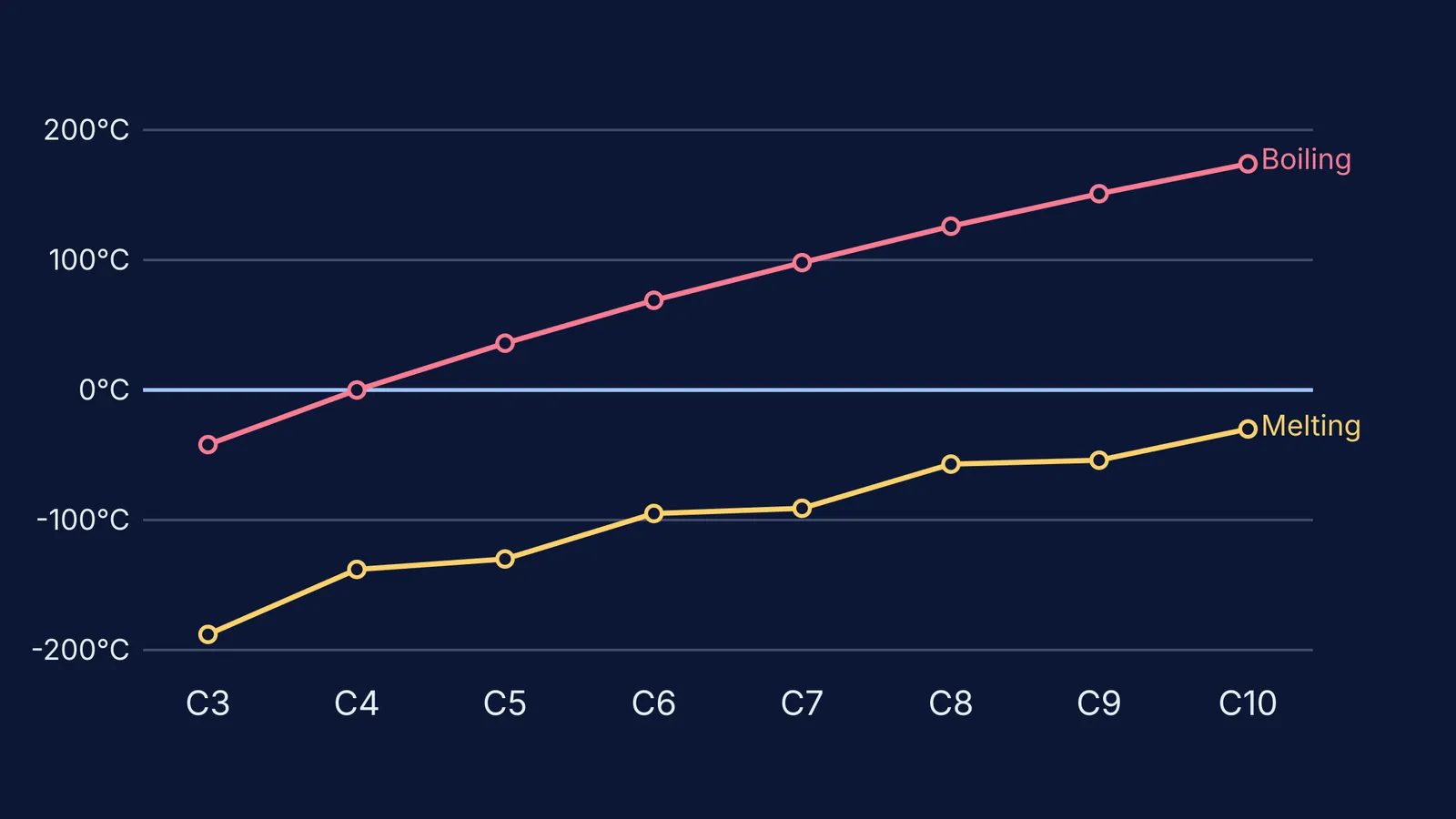
Graphing the physical properties of alkanes reveals that boiling points rise smoothly as the carbon chain lengthens, but melting points tell a different story. Plotting them reveals a distinct sawtooth pattern, known as the even-odd effect.
Why do alkane boiling points rise smoothly?
Boiling point depends mostly on a molecule's surface area. As you add a carbon atom, the molecule gets larger, creating stronger London dispersion forces—a type of temporary dipole attraction. When molecules are liquid, they are constantly moving, tumbling, and sliding past one another in a disordered arrangement.
Since liquid molecules are already disordered, the heat required for boiling depends almost entirely on the raw strength of these temporary London dispersion forces. According to Wikipedia, propane (C3) boils at -42 °C and butane (C4) at 0 °C. The curve from C3 to decane (C10) at 174 °C is a steady uphill climb. Each additional -CH₂- unit adds a consistent surface area, meaning a consistent stickiness to overcome.
What is the even-odd effect in alkane melting points?
Unlike boiling, melting involves breaking a highly ordered solid crystal lattice. Before an alkane can melt into a liquid, the thermal energy added must overcome the specific structural arrangement of the solid. It turns out that alkanes with an even number of carbon atoms have a higher melting point than you would expect if you just drew a straight line from their odd-numbered neighbours.
For example, Wikipedia lists the melting point of propane (C3) at -188 °C. Moving up to the even-numbered butane (C4), the melting point jumps up by 50 °C to -138 °C. That is a massive leap. But adding one more carbon to get the odd-numbered pentane (C5) only raises the melting point by 8 °C to -130 °C. Moving to the next even alkane, hexane (C6), jumps the melting point by another 35 °C to -95 °C.
This alternating large-step, small-step pattern continues all the way up the carbon chain. If you plot these temperatures on a graph, the boiling points form a smooth arc, while the melting points create a visible, jagged sawtooth pattern.
Why do even-carbon alkanes pack better?
This zigzag comes down to symmetry and how efficiently the molecules fit into a solid crystal. Picture an alkane chain as a zigzagging line. In an even-carbon chain, the terminal methyl (-CH₃) groups at both ends point in opposite directions. This highly symmetrical shape makes the molecule a perfect building block that stacks cleanly and tightly.
In an odd-numbered alkane, both terminal methyl groups point in the same direction, creating an asymmetrical shape. When these molecules form a solid, their bent shape prevents them from getting as close, leaving microscopic gaps in the lattice.
The general rule for alkanes is that tighter packing in even-carbon chains leads to higher density and stronger dispersion forces. Since even-numbered molecules hold onto each other more tightly, it takes more thermal energy to shake them loose into a liquid. If you are struggling to picture these 3D structures, the Fermi Simulation Lab has interactive simulations for the ideas that are easier to see than to read.
When learning organic chemistry, looking at real data often helps you see the patterns that two-dimensional formulas hide. Whether you are looking at alkene stability using heat of hydrogenation, or exploring how to step up an alcohol by adding one carbon in the ascent of a series, drawing a quick graph often reveals the underlying geometry of the molecules.
How can you predict physical properties?
In exams like JEE or NEET, you are frequently asked to rank organic compounds by physical properties. When comparing melting or boiling points, follow this sequence:
Check the molecular mass: In general, more carbon atoms mean more mass and a larger surface area. This results in stronger London dispersion forces, leading to higher boiling and melting points. A five-carbon chain will almost always have a higher boiling point than a three-carbon chain.
Look for the even-odd effect: If you are comparing straight-chain alkanes specifically for their melting points, look closely at the number of carbons. Remember that even numbers pack better than odd numbers, giving them a relative boost.
Check for branching: For boiling points, highly branched isomers have less surface area (they are more spherical), which means weaker dispersion forces and lower boiling points. However, for melting points, symmetrical branching can sometimes increase the melting point drastically because perfectly spherical molecules can pack very efficiently into a crystal lattice, even better than long, straight chains.
Identify hydrogen bonding: If you are comparing an alkane to an alcohol or a carboxylic acid of similar mass, the molecules that can form hydrogen bonds will always have significantly higher melting and boiling points than the alkanes, which only rely on weak London dispersion forces.


