

On this page
The sine double-angle formula is usually written one way, sin 2x = 2 sin x cos x. cos 2x has three, and the usual reaction is to memorise them all and hope the right one turns up in the exam. It works better the other way round: look at what the problem already contains, then pick the form that matches.
What are the three forms of cos 2x?
The NCERT Class 11 chapter on Trigonometric Functions lists them as identity 14: cos 2x = cos²x − sin²x = 2cos²x − 1 = 1 − 2sin²x = (1 − tan²x)/(1 + tan²x).
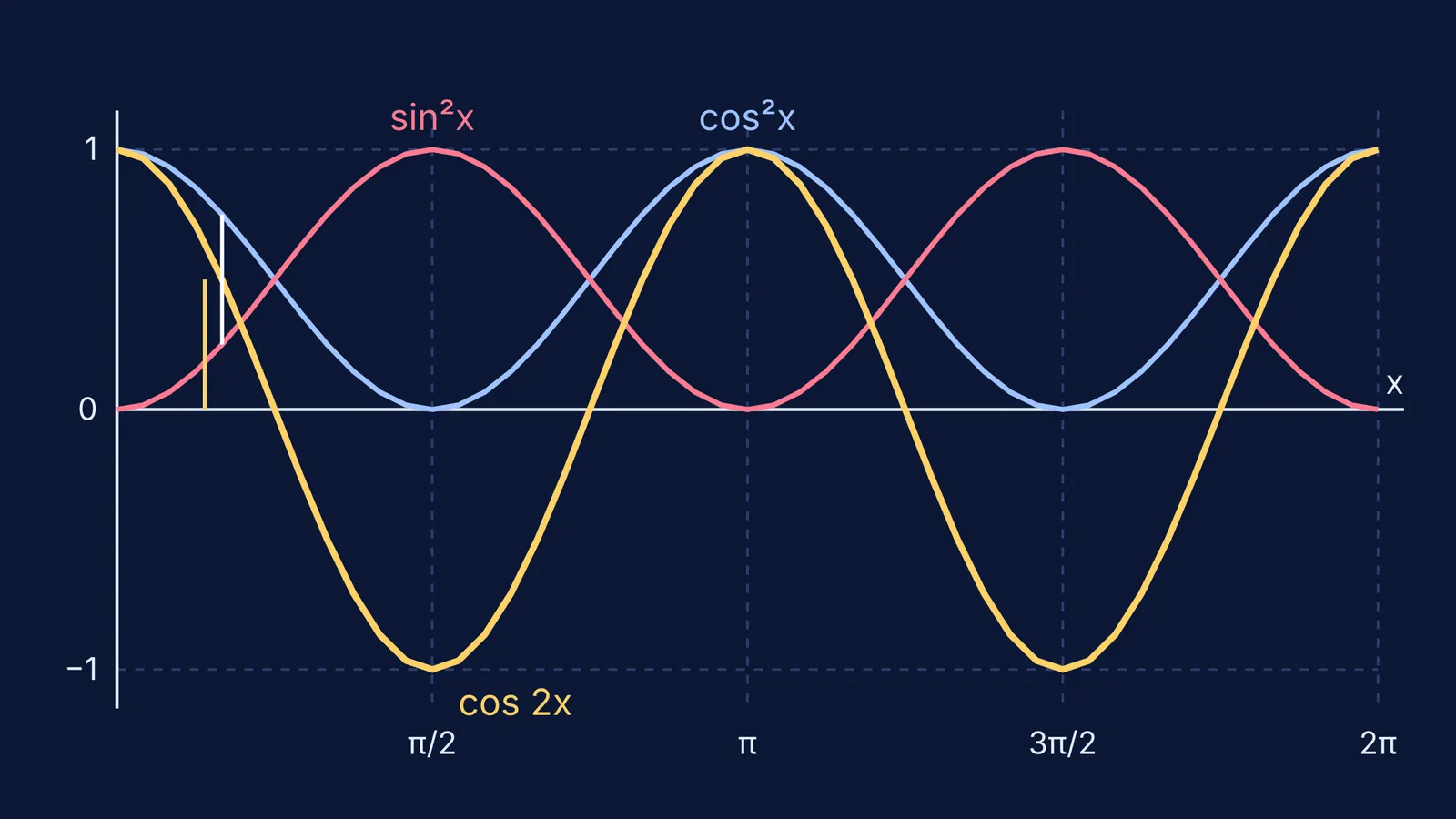
They are one fact. Put y = x in cos(x + y) = cos x cos y − sin x sin y to get cos²x − sin²x. Replace sin²x with 1 − cos²x to get 2cos²x − 1, or cos²x with 1 − sin²x to get 1 − 2sin²x. Forget one in the exam and you can rebuild it in a few lines.
Rearranging gives the pair you will use most: 1 + cos 2x = 2cos²x and 1 − cos 2x = 2sin²x, the power-reducing formulas in OpenStax Precalculus 2e.
How do you choose which form of cos 2x to use?
Ask one question: what else is in the problem? Then use this decision list.
The rest of the problem has only sin x → use 1 − 2sin²x. Everything becomes a polynomial in sin x.
The rest has only cos x → use 2cos²x − 1. Everything becomes a polynomial in cos x.
You see 1 + cos 2x → write 2cos²x. The 1 cancels and you are left with a single term.
You see 1 − cos 2x → write 2sin²x, for the same reason.
You see cos x − sin x or cos x + sin x → use cos²x − sin²x = (cos x − sin x)(cos x + sin x) and look for a factor to cancel.
The problem is written in tan x → use (1 − tan²x)/(1 + tan²x).
You need to integrate sin²x or cos²x → go the other way and replace the square with (1 ∓ cos 2x)/2.
How do you simplify expressions with cos 2x?
Example 1. Simplify (1 − cos 2x)/(1 + cos 2x).
Rules 3 and 4: the numerator is 2sin²x and the denominator is 2cos²x, so the answer is tan²x.
Example 2. Simplify sin 2x/(1 + cos 2x).
Write the numerator as 2 sin x cos x and the denominator as 2cos²x. Cancel 2 cos x and you get tan x, valid wherever cos x ≠ 0.
Example 3. Simplify cos 2x/(cos x − sin x).
Rule 5. The numerator is (cos x − sin x)(cos x + sin x), so the answer is cos x + sin x, valid wherever cos x ≠ sin x.
How do you solve equations with cos 2x?
The aim is a quadratic in one ratio. Choose the form that removes the other ratio.
Example 4. Solve cos 2x + 3 sin x = 2 for 0 ≤ x < 2π.
There is a sin x, so use 1 − 2sin²x: 1 − 2sin²x + 3 sin x = 2, which rearranges to 2sin²x − 3 sin x + 1 = 0. This factors as (2 sin x − 1)(sin x − 1) = 0, so sin x = 1/2 or sin x = 1. That gives x = π/6, 5π/6 and π/2. Check x = π/2: cos π + 3 = −1 + 3 = 2. It works.
Example 5. Solve cos 2x = cos x for 0 ≤ x < 2π.
Only cosines appear, so use 2cos²x − 1: 2cos²x − cos x − 1 = 0, which factors as (2 cos x + 1)(cos x − 1) = 0. So cos x = 1 or cos x = −1/2, giving x = 0, 2π/3 and 4π/3.
If you keep reaching for the wrong form, practise in the Fermi Problem Library, where the step-by-step solver explains the reasoning rather than printing an answer. If the gap is the cos(x + y) formula itself, start with its lesson in the Fermi Concept Library.
Where does cos 2x show up next?
Finding the exact values of sin 18° and cos 36° uses cos 2θ = 1 − 2sin²θ. Products like cos A cos 2A cos 4A fall to the doubling sine trick. In calculus, the power-reducing forms are the first step in integrating even powers of sin and cos.
Try this tonight: take five cos 2x questions from your textbook, write down which form you will use before solving, then check whether that choice held up.


