On this page
In 1908 the German mathematician Ernst Zermelo published a short list of rules for what is allowed to count as a set. Those rules sit quietly underneath Chapter 1 of your Class 11 maths book, and once you see them, the chapter's definitions stop looking arbitrary.
What are Zermelo's axioms of set theory?
Zermelo's paper, "Untersuchungen über die Grundlagen der Mengenlehre I", appeared in Mathematische Annalen, volume 65, pages 261-281, in June 1908. The Stanford Encyclopedia of Philosophy lists its seven axioms, which in plain words say:
Extensionality: a set is determined by the elements it contains.
Elementary sets: the empty set exists, and so do the sets {a} and {a, b}.
Separation: from a given set, you can separate out the elements that satisfy a definite property.
Power set: all the subsets of a set together form a set.
Union: the members of the members of a set form a set.
Choice: if a set is split into non-empty parts with no elements in common, some subset has exactly one element from each part.
Infinity: there is an infinite set.
Zermelo (1871-1953) was then at Göttingen, where in 1904 he had proved that every set can be well ordered, says his MacTutor biography.
Why did set theory need axioms?
As the historical note in NCERT's Class 11 chapter on sets puts it, set theory until then rested on the assumption that there is a set of all sets. That assumption breaks.
Bertrand Russell found the problem around 1901: think about R, the set of all sets that are not members of themselves. If R is a member of itself, it fails its own condition, so it is not. If it is not, it passes the condition, so it is. Russell wrote to Gottlob Frege about it on 16 June 1902. According to MacTutor, Zermelo had found a similar paradox himself but did not publish it.
His fix was separation. You may no longer say "the set of all x with property P". You must say "the set of all x in a set you already have, with property P".
Where do Zermelo's axioms appear in Class 11 sets?
The NCERT chapter credits Zermelo with the first axiomatisation of set theory, in 1908, and its definitions line up with his rules:
Equal sets (Definition 3: "exactly the same elements", so {1, 2, 3} = {2, 2, 1, 3, 3}) is extensionality.
The empty set φ and singleton sets {a} are elementary sets.
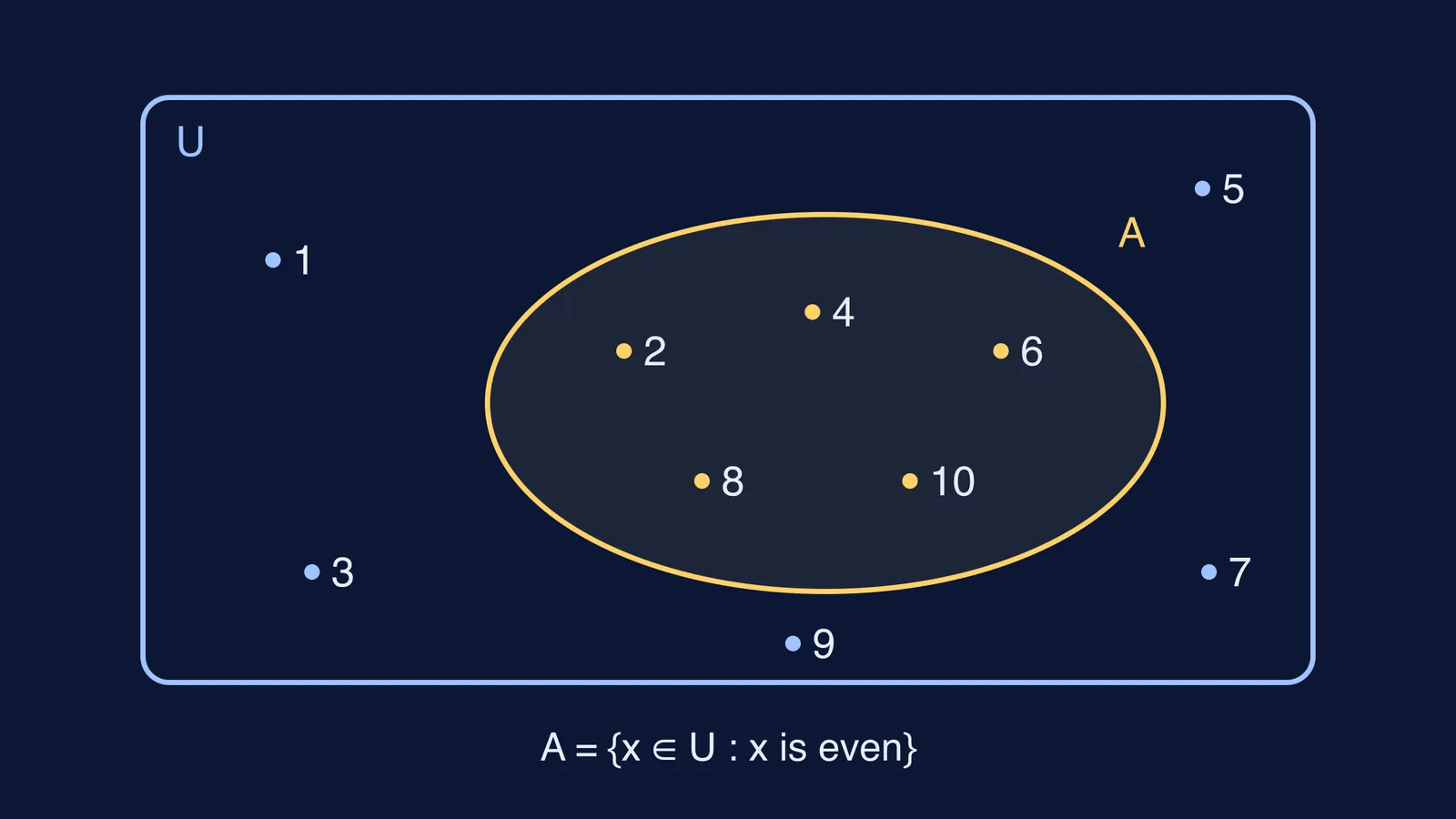
Set-builder form inside a universal set U is separation.
A ∪ B is the union axiom applied to the pair {A, B}.
N as an infinite set needs the axiom of infinity.
"Write down all the subsets of {1, 2, 3}" (Exercise 1.3) is the power set axiom at work.
Why is there no set of everything?
The Stanford Encyclopedia records Zermelo's proof that every set has a subset that is not one of its elements. Take any set A. Separation lets you form R = {x ∈ A : x ∉ x}.
Suppose R ∈ A.
Then R ∈ R exactly when R ∉ R, which is impossible.
So R ∉ A.
Because A was any set at all, no set contains every set. Russell's paradox has turned from a contradiction into a theorem. NCERT's note quotes Paul Halmos's book Naive Set Theory on exactly this: "nothing contains everything".
What changed after Zermelo?
The Stanford Encyclopedia records that Abraham Fraenkel and Thoralf Skolem independently proposed the replacement axiom in 1922, and that Zermelo accepted it in his 1930 axiomatisation. NCERT's note adds that John von Neumann introduced the axiom of regularity in 1925.
A five-minute check for any sets question
Use Zermelo's rules as a checklist when a set question feels slippery:
Name U first. Every set-builder set should read {x ∈ U : property}.
Test the property. It must answer yes or no for each element; NCERT's "five most renowned mathematicians" is not a set.
Compare elements, not appearance. Two sets are equal if they have the same elements, whatever the order or repetition.
Check for φ. {x ∈ N : 1 < x < 2} is empty, and the empty set is a subset of every set.
Keep ∈ and ⊂ apart. In NCERT's Example 11, {1} ∈ {{1}, 2}, yet {1} is not a subset of {{1}, 2, 3}, because 1 itself is not an element of it.
If ∈ and ⊂ still blur, the Fermi Concept Library has every concept in mathematics with its own lesson and its place in the map, so you can go back to subsets before moving on to relations and functions. For exercise questions, the Fermi Problem Library has worked problems with a step-by-step solver that explains the reasoning rather than printing an answer.
Next time you write {x : x is even}, ask yourself Zermelo's question: even numbers taken from which set?