

On this page
Pulling a bucket up a well looks like a W = mgh problem until the question adds one word: leaking. Now the bucket is lighter at the top than at the bottom, so your pulling force keeps falling and one multiplication no longer works. Here is the set-up, a worked example and the usual traps.
How do you find the work done lifting a leaking bucket from a well?
When a force changes with position, the work it does is the integral of that force over the displacement, W = ∫ F(x) dx (OpenStax Calculus Volume 1, section 6.5). Pulled slowly at a steady speed, the bucket gains no kinetic energy, so your pull equals its weight at every height.
The recipe:
Put y = 0 at the bottom, where the bucket starts, and y = h at the top.
Write the mass at height y. For a steady leak per metre, m(y) = m₀ − ky, where k is the mass lost per metre.
The force at height y is F(y) = m(y)g.
Integrate: W = ∫₀ʰ m(y)g dy.
An open calculus textbook from the University of Nebraska–Lincoln works this exact set-up for a 40-pound bucket in a 100-foot well, losing 0.1 pounds per foot, and gets 3,500 foot-pounds (UNL open calculus text, section 6.5). The same slicing idea runs through our post on the work needed to pull up a hanging chain.
Worked example: a 20 m well, step by step
Problem: a 1 kg bucket holds 15 kg of water at the bottom of a 20 m well. It is lifted slowly at constant speed and leaks steadily, so 5 kg of water is left when it reaches the top. The rope is light. Find the work done. Take g = 9.8 m/s² (the exact standard value is 9.80665 m/s², per NIST).
Starting mass: 1 + 15 = 16 kg. Final mass: 1 + 5 = 6 kg.
Mass lost per metre: k = (16 − 6) ÷ 20 = 0.5 kg/m.
Mass at height y: m(y) = 16 − 0.5y.
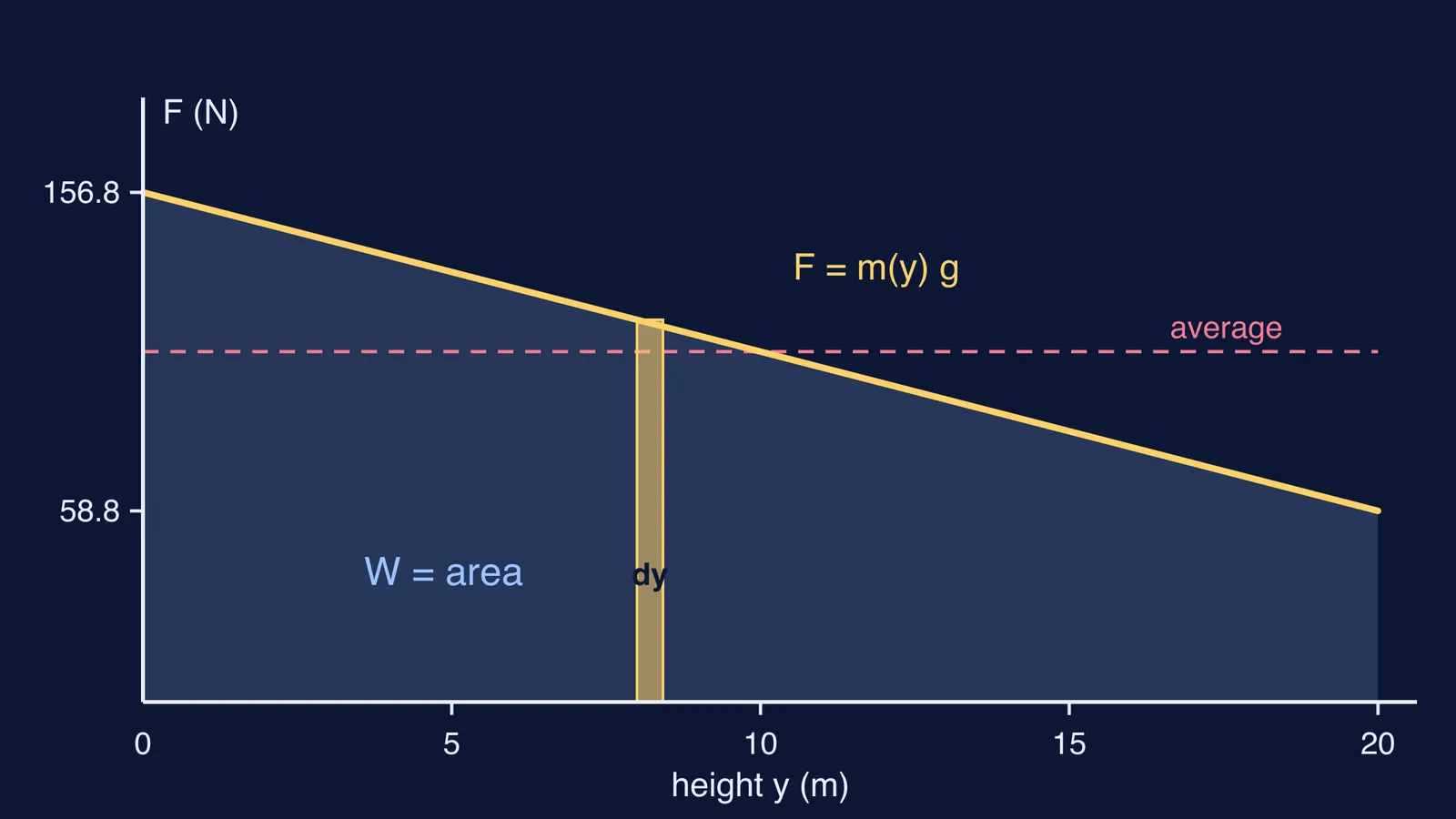
Work: W = ∫₀²⁰ 9.8(16 − 0.5y) dy = 9.8 [16y − 0.25y²]₀²⁰ = 9.8 × (320 − 100) = 9.8 × 220 = 2,156 J.
Why does the average-mass shortcut work?
The work integral is built as a limit of Riemann sums, thin strips of force times a small step in height (OpenStax Calculus Volume 1, section 6.5), so it equals the area under the graph of force against height. With a steady leak per metre, that graph is a straight line, so the area is a trapezium: the depth times the average of the first and last force.
The shortcut fails when the mass is not linear in height. If a question says the water leaks out at a rate proportional to the water left, the water's mass falls exponentially with height, and you have to integrate the real m(y).
What if the leak is given per second, or the rope has mass?
The definition does not change: work is the integral of force along the path (OpenStax University Physics Volume 1, section 7.1). Only m(y) changes.
Leak per second. Convert it to a leak per metre with the pulling speed: dm/dy = (dm/dt) ÷ v. If the bucket above leaked 0.2 kg/s while rising at 0.4 m/s, it loses 0.5 kg per metre, the same k. The climb takes 50 s, so 10 kg is lost, which matches.
Heavy rope. Add a second integral. Say the rope has 0.2 kg per metre. When the bucket is at height y, a length 20 − y still hangs below the top, with mass 0.2(20 − y). Rope work = ∫₀²⁰ 9.8 × 0.2(20 − y) dy = 9.8 × 0.2 × 200 = 392 J. The total is 2,156 + 392 = 2,548 J. The same slicing sets up the work to pump water out of a tank over its rim.
Which mistakes cost marks on this problem?
For a constant weight, gravity's work depends only on the change in height (OpenStax University Physics Volume 1, section 7.1). A leaking bucket's weight is not constant:
Using the starting mass all the way: 16 × 9.8 × 20 = 3,136 J, too big.
Using the final mass all the way: 6 × 9.8 × 20 = 1,176 J, too small.
Measuring y from the top but writing m(y) as if from the bottom.
Mixing a per-second leak rate with a per-metre integral.
Giving gravity's work (−2,156 J) when the question asks for the work done by the person pulling.
More traps: common mistakes in work-energy problems. If you cannot see where your answer went wrong, the Fermi Problem Library has worked problems with a step-by-step solver that explains the reasoning rather than printing an answer, so you can compare each step with your own set-up.
Next step: change the numbers (a 30 m well, a 2 kg bucket) and solve it with both the integral and the average mass.


