

On this page
If you need to lift a solid block of mass m by a height h, the work done is simply W = mgh. But if you are asked to calculate the work needed to pump water out over the top of a tank, that simple formula fails.
The water at the surface only needs to be lifted a short distance to clear the rim, while the water at the very bottom must be pumped up the entire height of the tank. Because each drop travels a different vertical distance, you cannot use a single height value. Instead, you must slice the water into infinitely thin horizontal layers and use a definite integral to sum the work done on each layer, a standard technique in university mathematics and the JEE syllabus.
Why can't we just use mgh?
When a force F moves an object over a distance d, the work done is W = F × d. For pumping a liquid, the force required to lift a volume of liquid is equal to its weight.
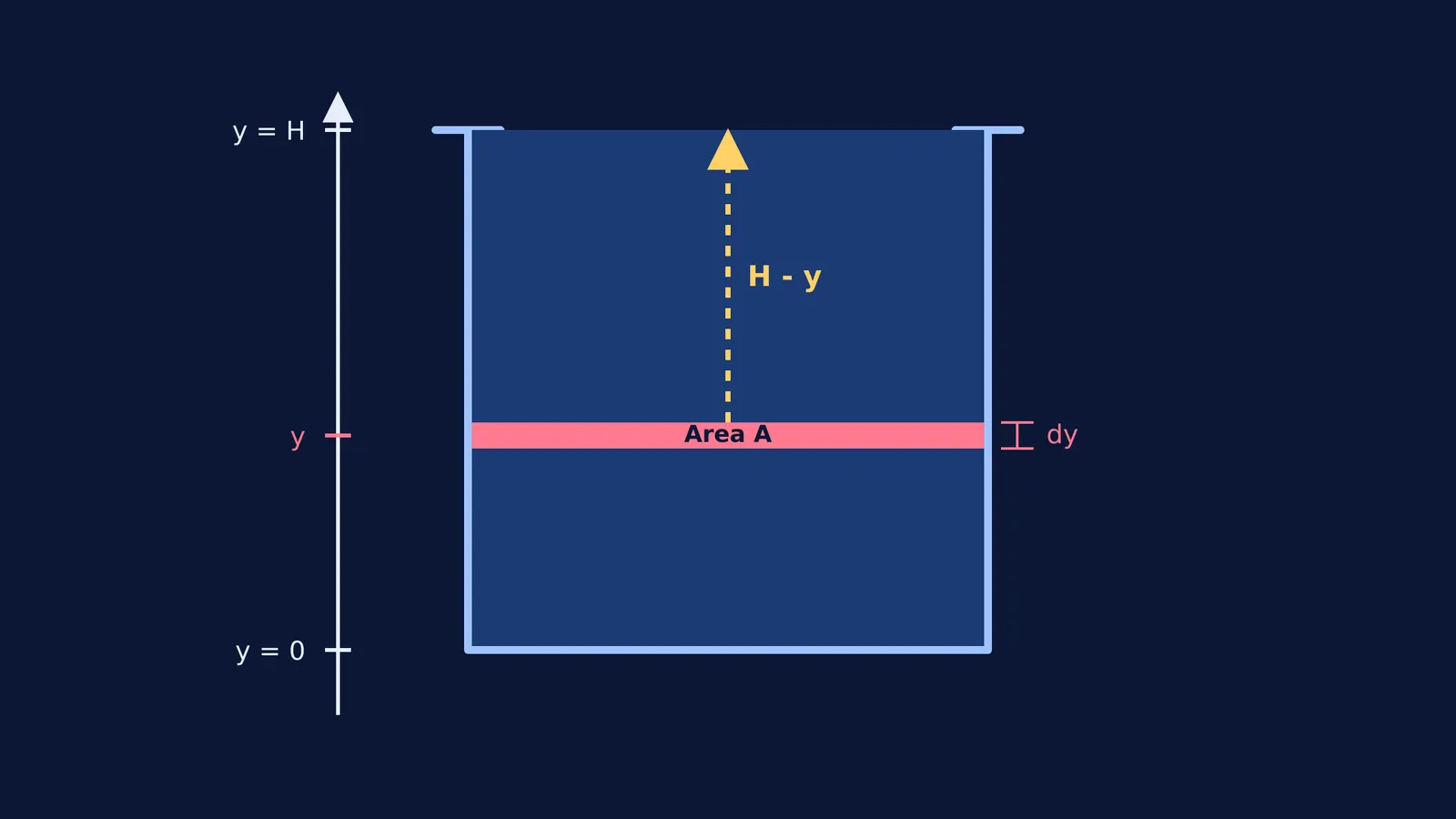
According to OpenStax Calculus Volume 2, water has a weight-density of 9800 N/m³, and we can model the liquid as a stack of horizontal layers. If a slice is thin enough (with thickness dy), all the water in that specific slice is at roughly the same depth and has to be lifted the same distance to reach the top. We can calculate the small amount of work (dW) needed to lift just that one slice, and then integrate from the bottom of the water to the top to find the total work.
How do you set up the integral for pumping water?
Let's set up a coordinate system. Place the bottom of the tank at y = 0 and the top rim of the tank at y = H.
For a thin horizontal slice of water at a height y:
Thickness: dy
Area: A (the cross-sectional area of the tank at height y)
Volume (dV): A × dy
Mass (dm): ρ × dV = ρ × A × dy, where ρ is the density of the liquid.
Force / Weight: dm × g = ρ × g × A × dy
Distance to the rim: To get over the rim at height H, a slice at height y must be lifted a distance of (H − y).
The incremental work dW to lift this single slice is its weight multiplied by the distance it travels: dW = ρ g A (H − y) dy
To find the total work, we integrate this expression over the range of heights where the water actually sits. If the tank is filled from the bottom (y = 0) up to a water level h, the integral is:
W = ∫ ρ g A (H − y) dy, evaluated from 0 to h.
For a tank with straight vertical walls (like a cylinder or a rectangular box), the cross-sectional area A is constant and can be pulled outside the integral. For a conical or spherical tank, A changes with height, so you must write A as a function of y before integrating.
Worked example: What is the work to pump out a cylindrical tank?
Suppose you have a cylindrical tank of radius R and height H. It is completely full of water. How much work does it take to pump all the water out over the top rim?
Area: The cross-section is a circle, so A = πR². This is a constant.
Distance: The water level is at y, and the rim is at H, so the distance is H − y.
Limits: The tank is full, so the water exists from y = 0 to y = H.
Set up the integral: W = ∫ ρ g (πR²) (H − y) dy, from 0 to H.
Pull the constants (ρ, g, π, R²) out of the integral: W = ρ g πR² ∫ (H − y) dy, from 0 to H.
Evaluate the integral using standard polynomial rules (much simpler than integrals of √(a² − x²) forms): ∫ (H − y) dy = [Hy − y²/2] evaluated from 0 to H. This gives (H² − H²/2) − (0) = H²/2.
Multiply by the constants to get the final answer: W = ρ g πR² (H² / 2)
Notice that ρ πR² H is the total mass of the water M. The result simplifies to W = Mg × (H/2). This makes physical sense: pumping the entire tank over the rim requires the same amount of work as lifting the entire mass of water concentrated at its centre of mass (which, for a uniform full cylinder, sits exactly halfway up at H/2).
How do you avoid common integration mistakes?
Setting up the integral is often harder than evaluating it. If you misidentify the limits of integration (for example, integrating to H when the tank is only half full) or write the distance backwards, the result will be wrong.
When you get stuck on the setup for an odd-shaped tank, the Fermi Problem Library provides worked problems with a step-by-step solver that explains the reasoning rather than printing an answer. If you are struggling with the underlying calculus of slicing continuous objects, you can explore the Fermi Concept Library, which covers every concept in physics, chemistry, biology, mathematics and computing, each with its own lesson and its place in the map.


