On this page
Tracheids and vessels both carry water up a plant, and both turn up in Class 11 biology and NEET-UG. The difference comes down to one idea: a tracheid is a single long cell, while a vessel is a pipe built from many short cells joined end to end.
What are tracheids and vessels in xylem?
Both are the water-conducting cells of xylem, and both are dead at maturity, as OpenStax Biology 2e explains in its chapter on stems. With the living contents gone, what is left is an empty channel for water.
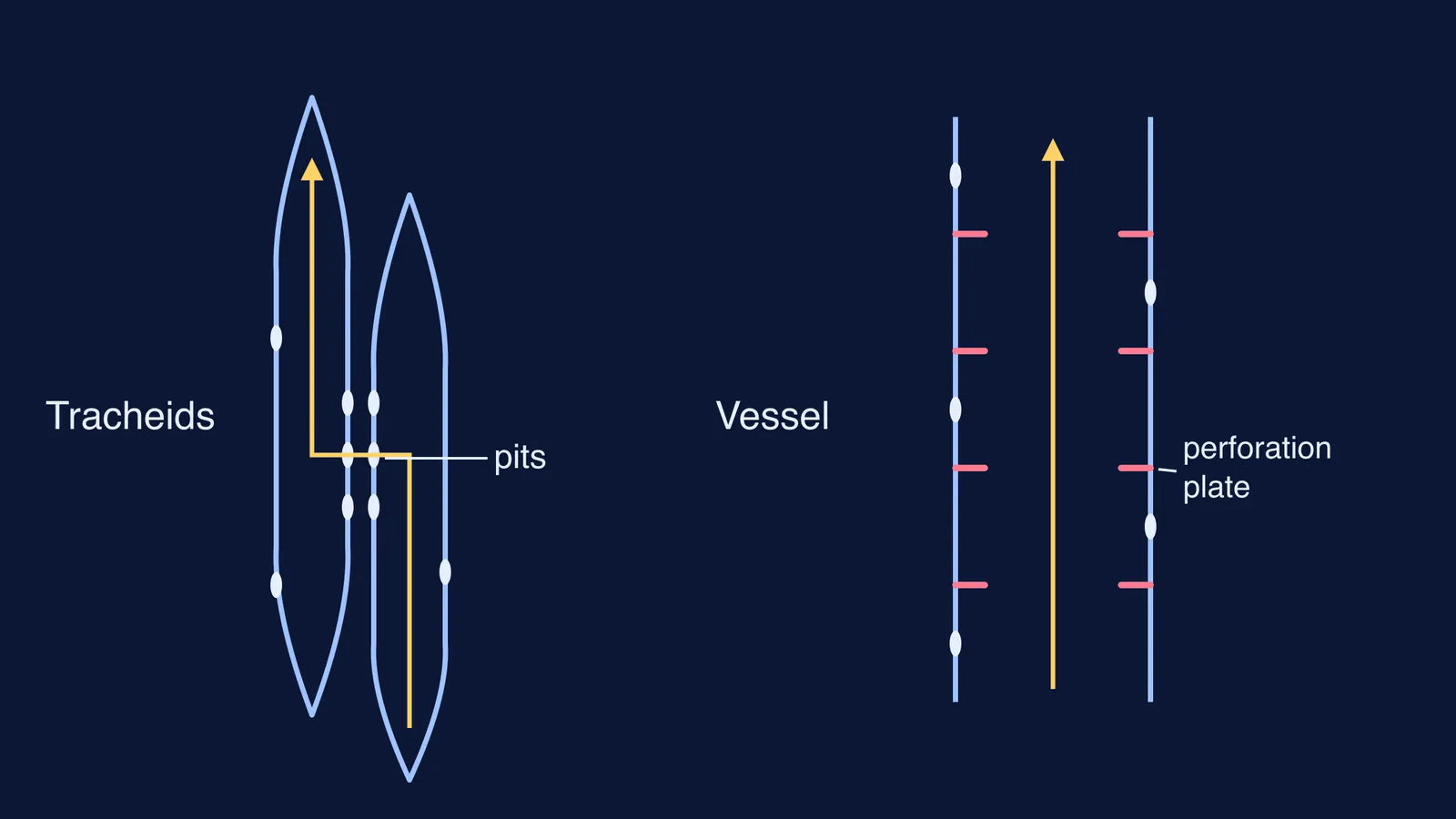
A tracheid is a xylem cell with thick, lignified secondary walls, and water passes from one tracheid to the next through pits in the side walls, where the secondary wall is absent (OpenStax Biology 2e).
A vessel element is a xylem cell with thinner walls that is shorter than a tracheid, joined to the next element through a perforation plate in its end wall, so a row of them works as one long tube called a vessel (OpenStax Biology 2e).
What is the difference between tracheids and vessels?
Most points come from OpenStax; the shape comes from Botany online, a university botany text from the University of Hamburg, which describes tracheids as "thin, elongated cells" and the cells of vessels as "short" with "a wide lumen".
Unit: a tracheid is one cell; a vessel is many cells (vessel elements) joined in a row.
End walls: tracheids have no perforation plates; vessel elements have perforation plates at their end walls.
Route of water: in tracheids, water crosses into the neighbouring cell through pits in the side walls; in a vessel, it travels up through the perforation plates.
Shape: tracheids are long and narrow; vessel elements are shorter and wider.
Walls: tracheid walls are thick and lignified; vessel element walls are thinner.
Which plants have vessels, and which have only tracheids?
Botany online states that tracheids are typical of most pteridophytes and gymnosperms, while vessels are typical of angiosperms and of "well-developed gymnosperms, like the Gnetales" (University of Hamburg, Botany online).
There are three exceptions to keep apart:
Gymnosperms with vessels: the Gnetales. If a question says "all gymnosperms lack vessels", that is the trap.
Flowering plants without vessels: a study in the International Journal of Plant Sciences measured branch wood from 19 vesselless angiosperms, including *Amborella trichopoda* and 16 species of the family Winteraceae (Hacke and colleagues, 2007).
Ferns with vessels: Botany online notes vessels "of another origin" in the bracken fern *Pteridium* and the horsetail *Equisetum*.
Botany online adds that "good proof exists" that vessels arose from tracheids. If you are revising how water-conducting tissue first appeared on land, our explainer on why pteridophytes are the first vascular land plants sets up this chapter well.
Are vessels always better than tracheids?
Wider, open tubes are often described as the faster route. A 2019 paper in the Journal of Experimental Botany notes that the evolution of vessels from tracheids "is put forward as a key innovation" that boosted water conduction in flowering plants (Trueba and colleagues, 2019). But in the same paper, the team compared 12 rain forest species from New Caledonia: five vesselless species and seven whose vessels have ladder-like (scalariform) perforation plates. Despite large differences in conduit width, they found similar water conduction and similar vulnerability to drought-induced embolism (air blockage in the conducting cells) (Trueba and colleagues, 2019).
So for exams, "vessels conduct water more efficiently" is the expected line, but that study shows the advantage is not automatic, at least among these rain forest plants.
How to write the answer in an exam
For a "distinguish between" question, write it as two matching lists, one for tracheids and one for vessels, in this order:
Single cell, or a row of cells joined end to end.
No perforation plates, or perforation plates in the end walls.
Water moves through pits in the side walls, or up through the perforation plates.
Long and narrow, or short and wide elements.
Found in most pteridophytes and gymnosperms, or typical of angiosperms (plus Gnetales).
If you draw the two side by side, as in the diagram above, label the pits on the tracheids and the perforation plate on the vessel, since those are the features that tell them apart. The idea of old, dead xylem also returns in another chapter: see how plants get rid of waste through vacuoles, old xylem and leaves.
If xylem still feels like a list of words, the Fermi Concept Library gives every concept in biology its own lesson and its place in the map, so you can see how xylem connects to the ideas around it. Fermi's AI tutor works out what you already know and draws the figure as it teaches, which helps when you need to see the tube instead of reading about it.