

On this page
Plants make waste just as you do. Respiration releases carbon dioxide, and other reactions leave by-products the cells cannot use. But a neem tree has no kidneys and no bladder, and it cannot walk away from anything. So where does the waste go? This is a regular Class 10 question, and the answer is neater than it first looks.
How do plants get rid of waste products?
NCERT's Class 10 Science textbook (Chapter 5, Life Processes, section 5.5.2) says plants "use completely different strategies for excretion than those of animals" (NCERT, Life Processes). The same chapter describes these routes, which we have numbered here:
Gases. Oxygen made in photosynthesis "can be thought of as a waste product", and carbon dioxide from respiration leaves too; at night, when there is no photosynthesis, getting rid of carbon dioxide is the main gas exchange.
Excess water, lost as vapour from the aerial parts of the plant by transpiration.
Cell vacuoles, where many waste products are stored.
Old xylem, where other wastes are stored as gums and resins.
Falling leaves, which carry stored waste away when they drop.
The soil, into which plants excrete some waste substances.
The idea behind routes 3 to 5 is in NCERT's own words: plants use the fact that "many of their tissues consist of dead cells, and that they can even lose some parts such as leaves". An animal has to carry its waste out of the body. A plant can park it somewhere harmless, or drop the whole container.
Where do plants store waste inside their cells?
The vacuole is the plant cell's storeroom. NCERT's wording is "Many plant waste products are stored in cellular vacuoles" (NCERT, Life Processes). For how the vacuole and its membrane work, read our explainer on the tonoplast and what the plant vacuole does.
One well-studied substance that specialised plant cells lay down as crystals is calcium oxalate. A review in the Annual Review of Plant Biology reports calcium oxalate crystals in photosynthetic organisms "from small algae to angiosperms and giant gymnosperms" (Franceschi and Nakata, 2005). The review notes that oxalic acid is "often thought of as a toxin or end product of metabolism", yet it names calcium regulation and protection against animals that eat the plant among the crystals' major functions.
Why are gums and resins stored in old xylem?
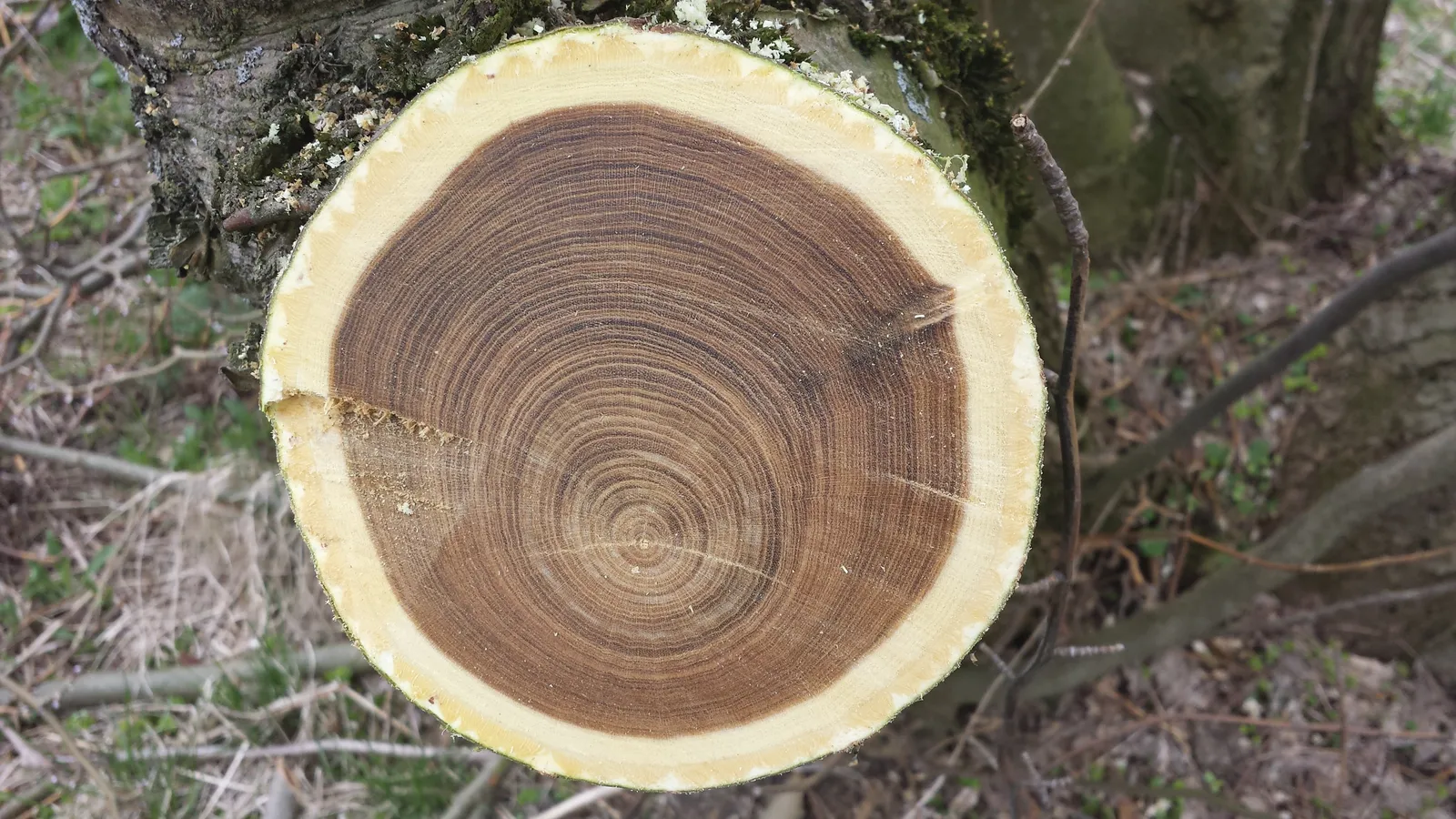
As a tree grows wider, its inner wood, the heartwood, stops carrying water. Penn State Extension states: "All cells in the heartwood are dead and movement of liquids does not occur" (Penn State Extension, What is heartwood). The same page names the polyphenols involved, including oils, resins, gums, tannins, and aromatic and colouring substances, and explains that heartwood turns dark because, as its parenchyma cells die, these compounds diffuse into the wood and oxidise.
That is why old xylem makes a safe store: nothing living is left there to poison. Look at the cut log at the top of this page. The dark core is heartwood; the paler outer ring is sapwood. Old vessels can also be plugged in other ways, which our post on tyloses in heartwood explains.
How do falling leaves remove waste?
NCERT puts it in one line: "Waste products may be stored in leaves that fall off" (NCERT, Life Processes). When the leaf drops, everything stored in it leaves the plant too, with no organ needed. If you want the mechanism behind the drop, our guide to the abscission layer and why leaves fall walks through it.
How should you write this answer in a board exam?
NCERT's in-text question asks: "What are the methods used by plants to get rid of excretory products?" (NCERT, Life Processes). Here is a plan for a short answer.
Open with one line: plants use completely different strategies for excretion from those of animals.
Gases: oxygen and carbon dioxide diffuse out, mainly through stomata.
Water: excess water is lost by transpiration.
Storage: wastes are stored in cell vacuoles, and as gums and resins in old xylem.
Loss: wastes stored in leaves are removed when the leaves fall.
Soil: some wastes are excreted into the soil around the plant.
To remember the order, use G-W-V-X-L-S: Gas, Water, Vacuole, Xylem, Leaves, Soil. Check your answer for these slips:
Writing "phloem" instead of "old xylem" for gums and resins.
Describing plant excretion as if it worked like an animal's.
Forgetting the soil route, which is easy to drop.
Leaving out the dead-cells idea, which explains why storage works.
If plant and animal excretion keep blurring together, the Fermi Concept Library covers every concept in biology, each with its own lesson and its place in the map.
Next time you pass a cut log by the roadside, look for the dark heartwood: that is a plant's waste store you can see.


