

On this page
In autumn in the Himalayan hills, and late in the dry season in the teak forests of central India, trees drop their leaves. The tree cuts each leaf loose along a line at the base of the leaf stalk (the petiole). This is abscission, and it hides an exam trap: the hormone named after it is not the main trigger.
What is the abscission zone at the base of a leaf?
The abscission zone is a band of small, tightly packed cells with dense cytoplasm, 2 to 50 cell layers deep in typical dicot plants, according to a 2025 review in Annals of Botany.
The review splits abscission into four stages: initiation, competence, separation and sealing. In plain words:
Initiation: a zone of small cells is laid down at the leaf base.
Competence: those cells become able to respond to the signal to shed.
Separation: enzymes called polygalacturonases break down the middle lamella, the layer that glues neighbouring cell walls together, so the cells come apart.
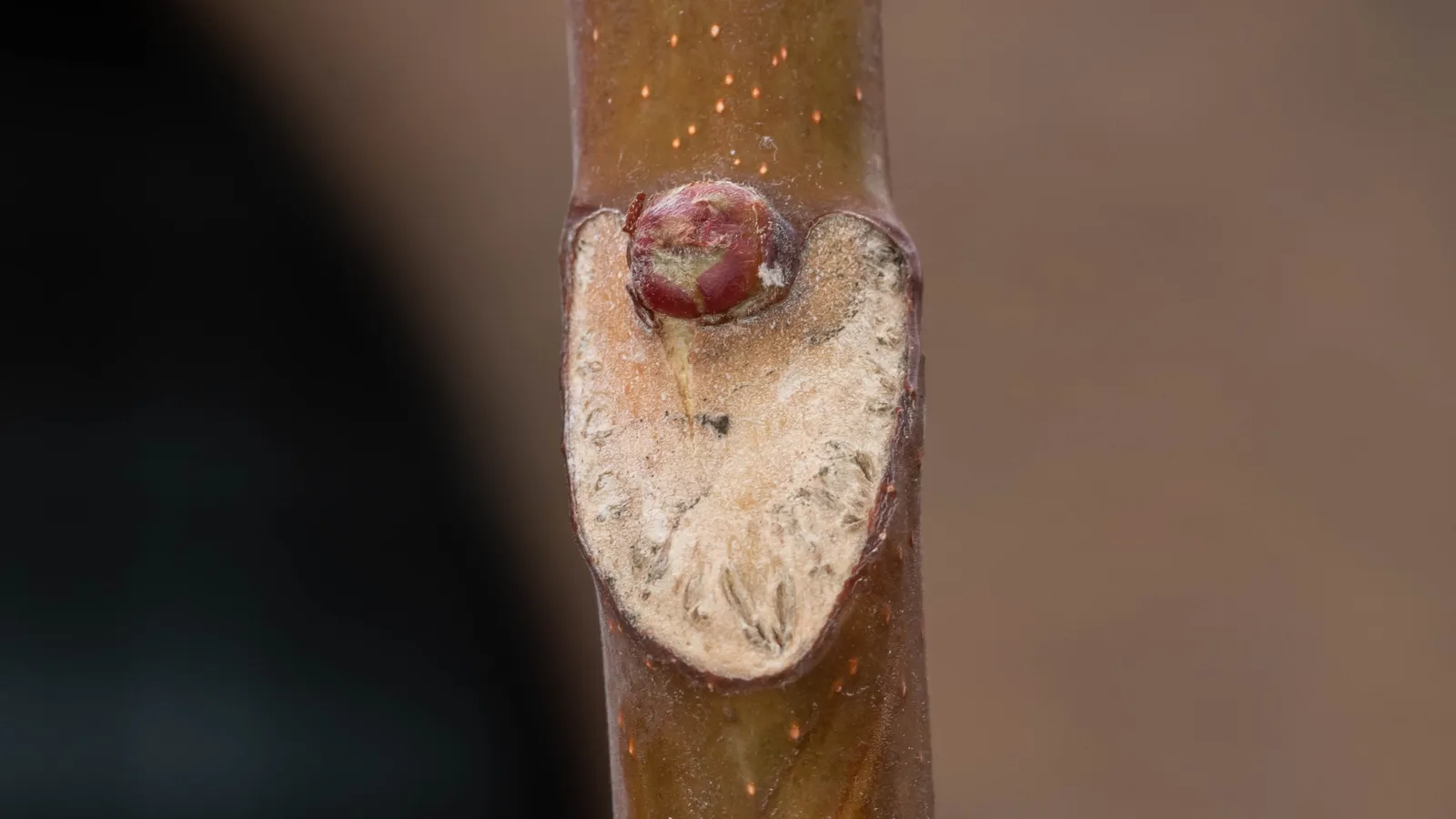
Sealing: a new epidermis forms over the exposed surface to protect it from water loss and infection.
That sealed patch is the leaf scar you can see on a bare twig, often with a bud sitting just above it.
Which hormones make leaves fall: ethylene, auxin or abscisic acid?
Think of a brake and an accelerator. The Annals of Botany review describes auxin as a negative regulator: a steady flow of auxin prevents shedding, and when it declines, the abscission zone becomes sensitive to ethylene. Ethylene is the accelerator that promotes cell separation.
The NCERT Class 11 chapter on plant growth and development puts it in exam language. Auxins help prevent fruit and leaf drop at early stages but promote the abscission of older mature leaves and fruits. Ethylene promotes senescence and abscission of plant organs, especially leaves and flowers. For more on ethylene's other jobs, see our post on ethylene, fruit ripening and ethephon.
Abscisic acid (ABA) has a more tangled story. In 1963, K. Ohkuma, F. T. Addicott and colleagues isolated a substance they called abscisin II from young cotton fruit, and reported in Science that it accelerated abscission in amounts as low as 0.01 micrograms per abscission zone. NCERT notes that inhibitor-B, abscisin II and dormin, reported by three independent groups, proved to be one chemical: abscisic acid. ABA was first seen as the main trigger of shedding, but was later found to promote abscission by raising ethylene levels, the 2025 review explains. Its better-known job is closing stomata, covered in our post on abscisic acid, the stress hormone.
Why do deciduous trees shed their leaves at all?
A leaf costs water. In cold climates, water in the tree can freeze, and the leaves stop working and can be damaged by ice crystals, as University of Tasmania researcher Matilda Brown explains in The Conversation. In the tropics, many deciduous trees drop their leaves when the rainy season ends and water will be scarce for months.
Teak is the Indian example to remember. Its large leaves, about 30 by 20 cm, are shed for 3 to 4 months during the later half of the dry season, according to the World Agroforestry useful-trees sheet on teak. Our post on deciduous vs evergreen trees compares the two strategies.
The tree doesn't throw the leaf away full. Before shedding, it pulls nutrients back into the stem and roots. A global meta-analysis of 86 studies in Ecological Monographs found that plants take back on average 62.1% of the nitrogen and 64.9% of the phosphorus from their leaves before they fall.
How do you write leaf fall in a five-mark answer?
Use this six-step order, one or two lines each.
Define: abscission is the shedding of an organ, such as a leaf, along a zone at its base.
Structure: the abscission zone is a band of small, densely packed cells at the base of the petiole.
Signal: the auxin level falls, so the zone becomes sensitive to ethylene.
Action: ethylene promotes separation; enzymes dissolve the middle lamella between cells.
Seal: a protective layer covers the wound, leaving a leaf scar.
Purpose: the tree saves water through a cold or dry season and recovers nutrients first.
Before you submit, check for these four common slips:
Writing that wind or the leaf's weight simply tears it off, with no separation layer.
Saying ABA alone causes leaf fall.
Forgetting that auxin prevents early leaf drop.
Skipping the sealing step and the leaf scar.
If auxin, ethylene and ABA still blur together, the Fermi Concept Library covers every concept in biology, each with its own lesson and its place in the map, so you can revisit each growth regulator in turn. To practise, the Fermi Problem Library has worked problems with a step-by-step solver that explains the reasoning rather than printing an answer.


