On this page
When you look at India's forests, the most obvious difference is the canopy. Some forests stay lush all year, while others turn bare and brown before the monsoon. This difference is not just about looks—it is a brilliant survival strategy built around water. Understanding this adaptation is key to mastering botany and geography for your exams, but it also reveals how perfectly nature balances resources.
What is the difference between deciduous and evergreen trees in India?
The defining difference lies in how trees handle their leaves across the seasons.
Tropical evergreen forests thrive in areas receiving heavy rainfall, typically more than 200 cm annually, such as the Western Ghats and the Andaman and Nicobar Islands (Testbook). Because there is no long dry season, these trees do not have a set time to shed their leaves, keeping the forest green year-round. Common evergreen species include rosewood, ebony and mahogany.
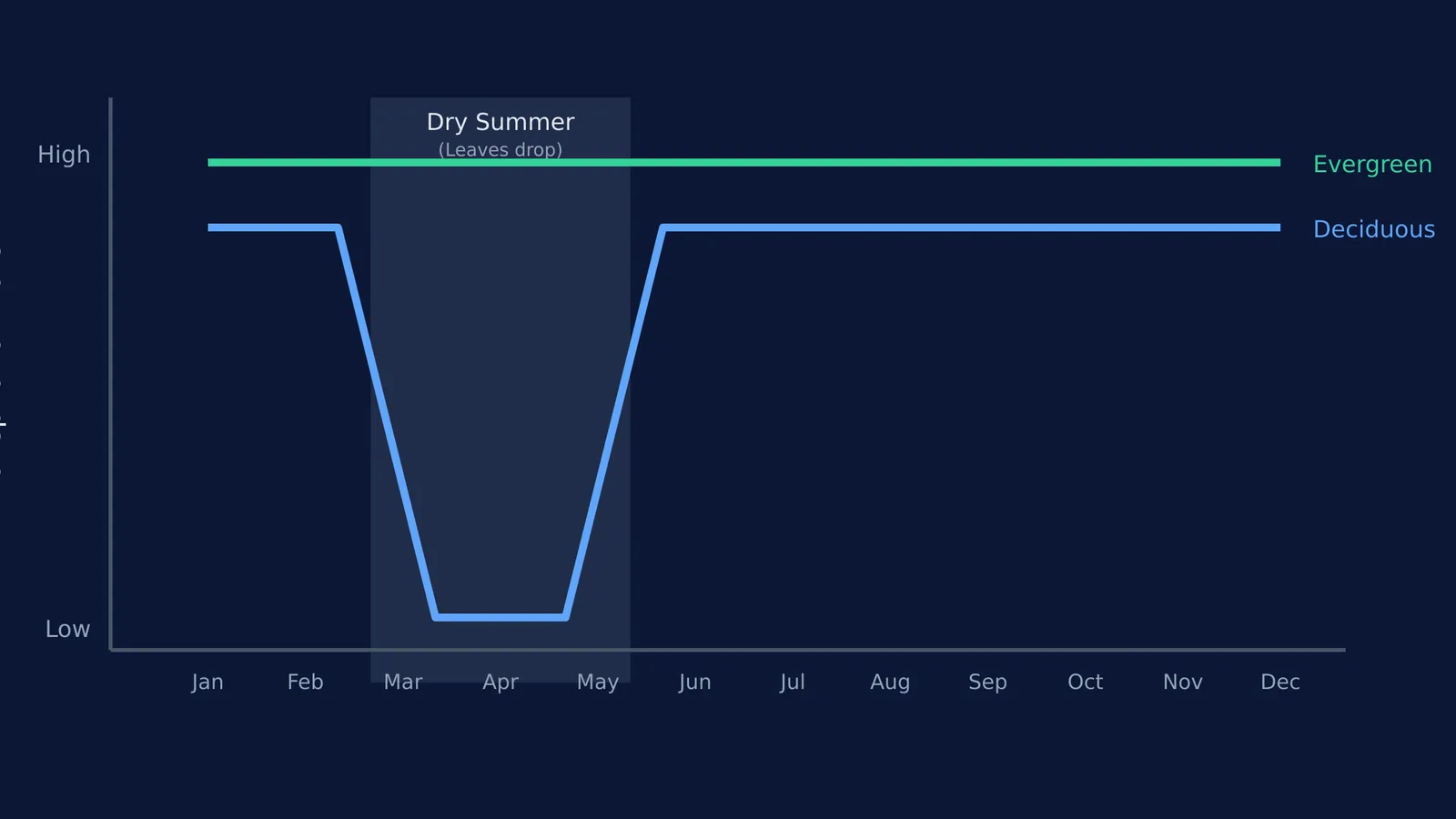
Tropical deciduous forests, also known as monsoon forests, grow in regions receiving between 70 cm and 200 cm of rain. To survive the severe dry summer, deciduous trees shed all their leaves for a concentrated period of 6 to 8 weeks (BYJU'S). These are the most widespread forests in India, stretching across the central and eastern states, and include commercially vital trees like teak, sal, peepal and neem.
How does dropping leaves save water?
Trees lose water to the atmosphere through microscopic pores in their leaves called stomata, a process known as transpiration. During the growing season, this transpirational pull draws water and nutrients up from the roots to the canopy. However, this same process acts like a massive leak when soil moisture is critically low.
According to the National Oceanic and Atmospheric Administration, a single large tree such as an oak can transpire up to 40,000 gallons of water per year. Almost all of this loss happens while the tree is fully leafed out.
When the hot Indian summer arrives and groundwater dwindles, deciduous trees face a survival crisis. If they kept their broad leaves, the dry air would continue pulling moisture out of the tree faster than the roots could replace it from the parched earth. By dropping their leaves, trees effectively shut down the transpiration pump. The water loss drops to near zero, allowing the tree to conserve its internal moisture securely within its trunk and branches until the monsoon rains return.
Where are these forests found in India?
Because rainfall dictates forest types, you can predict what kind of trees grow in a region simply by looking at a weather map.
Evergreen forests require constant moisture. You will find them clustered on the rain-soaked western slopes of the Western Ghats, in the upper parts of Assam, and across the Andaman and Nicobar Islands. Because they never face a sustained water shortage, the thick canopies of closely spaced trees remain lush and block sunlight from reaching the forest floor even during the day.
Deciduous forests, on the other hand, are the most widespread forests in India. They cover the vast central peninsula, the eastern slopes of the Western Ghats, and the foothills of the Himalayas. These regions experience a distinct wet monsoon followed by a long, dry summer. Trees like teak and sal are perfectly adapted to this cycle. Their thinner canopies allow more sunlight to reach the ground, and their ability to drop leaves ensures they survive the hottest months unscathed.
Bringing geography and biology together
If you are struggling to picture how stomata open and close or how water travels up the xylem, the Fermi Concept Library holds a lesson for every concept in biology, showing you exactly how these mechanisms work.
Understanding why trees drop their leaves is a great example of crossing subject boundaries. You are not just memorising forest types; you are seeing how plants adapt to their physical environment.
A quick checklist for your exam notes
When comparing these two forest types, make sure your revision notes cover these four points:
Rainfall: Note the > 200 cm threshold for evergreens (Testbook) versus the 70–200 cm bracket for deciduous forests.
Shedding season: Remember the specific 6 to 8 weeks in summer for deciduous trees (BYJU'S).
Mechanism: Link leaf fall directly to halting transpiration and preventing desiccation.
Indian examples: Pair evergreens with the Western Ghats and rosewood, and deciduous forests with central India and teak.
Once you understand how the climate affects the canopy, you can explore other ways plants respond to their environment. For instance, you can look into how stems and roots grow towards light and water by studying tropic movements in Class 10, or see how tissues elongate by comparing arithmetic vs geometric growth in plants. You might also trace where new leaves eventually sprout from by locating the meristems—apical, intercalary and lateral.