

On this page
What is the tonoplast in a plant cell?
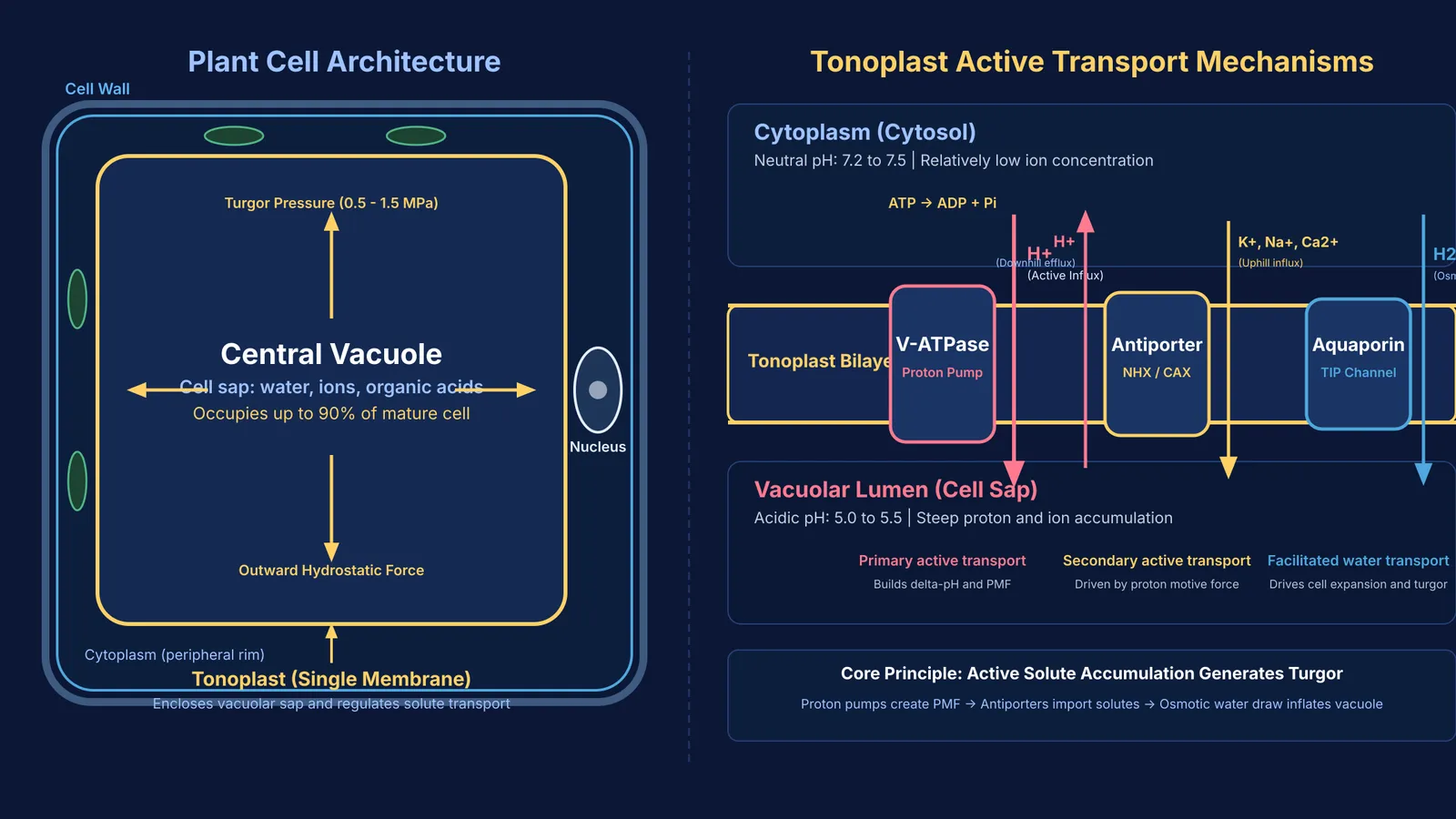
In plant biology, the tonoplast is the semi-permeable single membrane enclosing the central vacuole, separating the acidic vacuolar sap from the neutral cytoplasm. While organelles like chloroplasts and mitochondria have double membranes, the vacuole is bounded by a single lipid bilayer. Dutch botanist Hugo de Vries coined the term tonoplast in 1885 from the Greek *tonos* (tension) and *plastos* (formed) during plasmolytic experiments on cellular turgor. His findings laid the groundwork for quantitative osmotic studies, including Wilhelm Pfeffer and the first measurement of osmotic pressure.
The enclosed vacuolar sap contains water, mineral ions, organic acids, sugars, enzymes, and secondary metabolites such as anthocyanins. Rather than acting as an inert reservoir, the tonoplast is an active metabolic boundary embedded with carrier proteins, ion channels, and Tonoplast Intrinsic Proteins (aquaporins). As explained in guides on The cell membrane: fluid mosaic model and transport and Cell: the unit of life for NEET, this selective barrier regulates cell volume, sequesters nutrients, and isolates metabolic wastes.
How does the tonoplast pump ions against a concentration gradient?
A defining function of the tonoplast is transporting ions and solutes against steep concentration gradients. In mature plant cells, concentrations of nitrate, potassium, and calcium are significantly higher inside the vacuolar lumen than in the cytoplasm. This uphill accumulation is driven by electrochemical proton gradients across the tonoplast.
Primary active transport relies on two proton pumps: the vacuolar H⁺-ATPase (V-type ATPase) and the vacuolar H⁺-translocating pyrophosphatase (V-PPase), as detailed by Masayoshi Maeshima (2001). Both pumps hydrolyze energy sources (ATP and inorganic pyrophosphate, respectively) to pump H⁺ ions from the cytoplasm into the vacuole. This maintains an acidic lumen pH between 5.0 and 5.5 against a neutral cytosolic pH between 7.2 and 7.5.
This activity creates a proton motive force with a steep pH gradient (ΔpH of 1.5 to 2.0 units) and an inside-positive membrane potential. Secondary active transporters use this gradient to accumulate solutes:
Cation/H⁺ antiporters (such as NHX for Na⁺ or K⁺, and CAX for Ca²⁺) import cations into the vacuole while exporting protons downhill.
Anion channels and carriers accumulate chloride, nitrate, and malate to balance charge and osmolality.
The Fermi Concept Library maps every concept in physics, chemistry, biology, mathematics and computing, each with its own lesson and its place in the map.
Why does the central vacuole occupy up to 90 percent of a plant cell?
In mature plant cells, the central vacuole frequently expands until it occupies up to 90 percent of total cell volume, as reviewed by Francis Marty (1999). This volume dominance is an energetic strategy that underpins plant support and growth.
Without a bony skeleton, plants rely on hydrostatic turgor pressure. By concentrating solutes, the tonoplast lowers the osmotic potential (solute potential, Ψₛ) of the vacuolar sap, drawing water inward through aquaporins. This influx creates hydrostatic turgor pressure (typically 0.5 to 1.5 MPa, as reviewed by Sebastian Wolf and colleagues (2012)) that presses the cytoplasm against the rigid cell wall, providing mechanical firmness to leaves and herbaceous stems.
The vacuole also enables fast cell enlargement at minimal metabolic expense. Synthesizing protein-rich cytoplasm and organelles requires high amounts of ATP. Instead, an expanding cell inflates its vacuole with water and inorganic salts, multiplying volume tenfold without costly protein synthesis. This expansion compresses the cytoplasm into a thin peripheral rim, shortening diffusion distances for carbon dioxide and oxygen between the cell wall and chloroplasts.
What is the difference between contractile and food vacuoles?
Beyond plants, single-celled eukaryotes rely on specialized, transient vacuoles:
Contractile vacuoles: In freshwater protists like *Amoeba* and *Paramecium*, contractile vacuoles manage osmoregulation and excretion. Because freshwater is hypotonic, water continuously enters by osmosis. The contractile vacuole collects excess intracellular water via collecting canals and the spongiome, swells during diastole, and expels fluid through periodic systole, as shown by Richard D. Allen and Yutaka Naitoh (2002)15015-7). Without this pumping cycle, the cell would swell and lyse.
Food vacuoles: Formed by phagocytosis when a cell engulfs food particles. In *Paramecium*, acidosomes fuse rapidly with nascent food vacuoles to drop the internal pH to approximately 3.0 before lysosomes deliver digestive hydrolases, as documented by Richard D. Allen and Agnes K. Fok (1983). Digested nutrients pass into the cytosol, and residues exit at the cytoproct.
To solve exam questions on vacuole classification, apply this 4-step checklist:
Identify cell type: Distinguish between plant cells, freshwater protists, and prokaryotes.
Check membrane structure: Plant vacuoles have a single tonoplast; protist vesicles arise from membrane invagination; bacterial gas vesicles lack a lipid bilayer.
Determine primary role: Contrast turgor and nutrient storage (plant vacuole) with osmoregulation (contractile vacuole) and digestion (food vacuole).
Trace solute flow: Confirm whether ions are concentrated into the lumen against a gradient (tonoplast) or hypotonic fluid is expelled outward (contractile vacuole).
The Fermi Problem Library offers worked problems with a step-by-step solver that explains the reasoning rather than printing an answer.


