

On this page
If you look at the cross-section of an old tree trunk, you will notice that the dark, central wood is completely dead and no longer carries water. The reason it stops conducting water comes down to a microscopic barricade: tyloses.
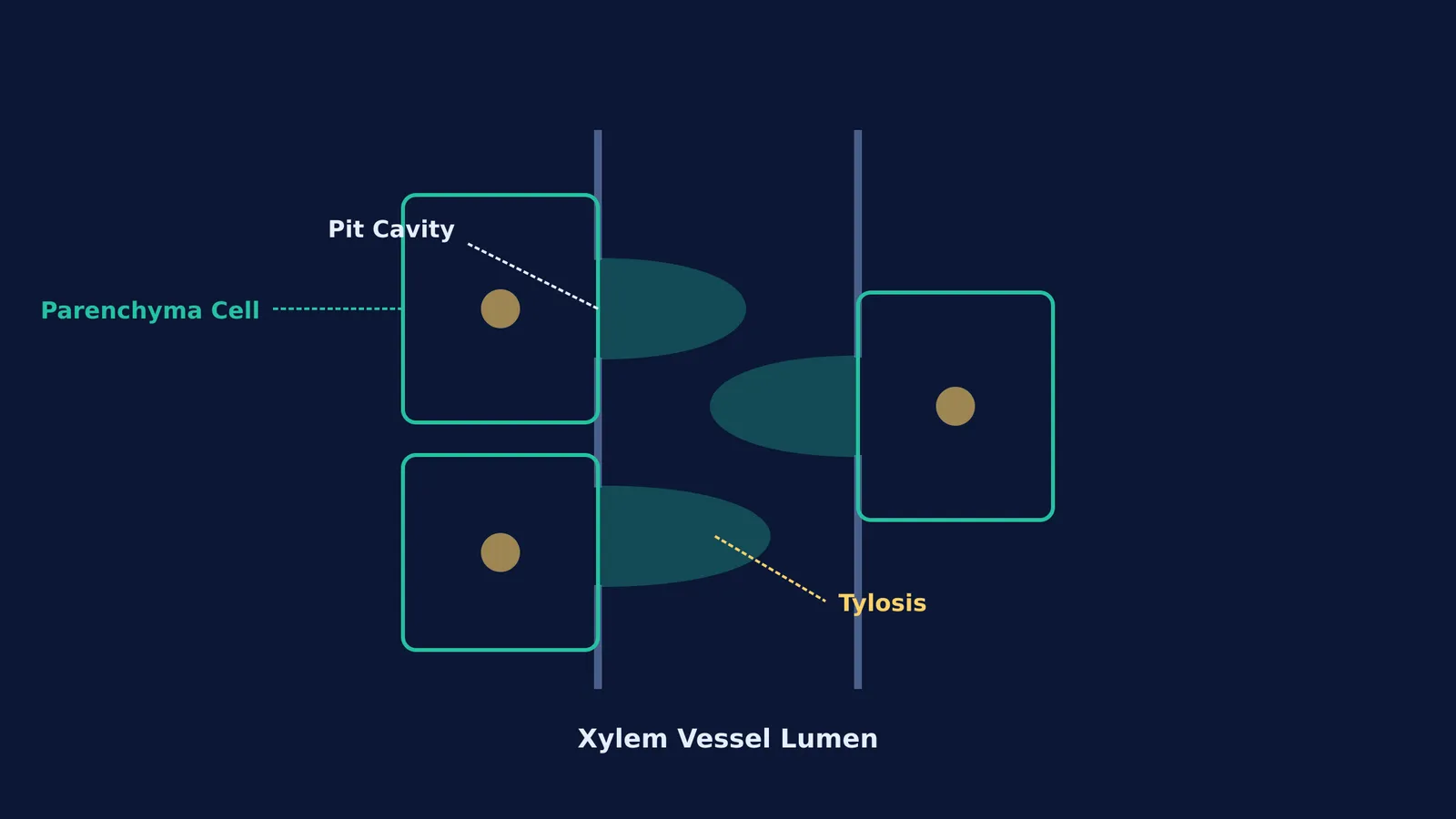
Tyloses (singular: tylosis) are balloon-like outgrowths of living parenchyma cells that bulge into the empty cavities of adjacent xylem vessels). By physically plugging the tree's internal plumbing, they seal off the older wood, turning it into durable, rot-resistant heartwood.
What are tyloses in heartwood?
In woody plants, the xylem tissue acts as a system of microscopic pipes—specifically the vessels and tracheids—that pull water and dissolved minerals up from the roots to the leaves. Beside these conducting pipes sit living storage cells called axial and ray parenchyma.
As a tree grows outward, it forms new functional xylem near the bark. The inner layers of sapwood eventually retire from water transport and become heartwood. During this transition, the parenchyma cells expand like inflating balloons through small openings in the vessel walls, which are called pit cavities. They push their way into the hollow vessel lumen. These ingrowths are the tyloses.
Once inside, tyloses pack the vessel tightly. Over time, their cell walls can thicken with lignin and accumulate a variety of chemical compounds, including resins, gums, and tannins. This process solidifies the plug, making the heartwood substantially denser, darker, and more durable than the surrounding sapwood.
If you are revising plant anatomy for your biology exams and struggling to picture these microscopic structures, or tissue regions like apical, intercalary and lateral meristems, the Fermi Concept Library places every biological concept in a map with its own detailed lesson.
How do tyloses form?
Tylose formation is usually a natural part of aging in trees, but it can also be triggered as a rapid emergency response. The primary trigger for their formation is a sudden drop in pressure inside the xylem vessel.
When a vessel is active, the column of water inside it is under high tension as transpiration pulls it upward. If the vessel becomes inactive due to age, or if an air bubble breaks the water column during a severe drought (an event known as cavitation), the internal pressure changes. The neighbouring living parenchyma cell senses this pressure change. Its protoplast—the living contents of the cell—swells and pushes the flexible pit membrane out into the empty vessel.
This rapid ballooning is a critical defence mechanism. If a tree's trunk is wounded by a woodpecker or a boring insect, pathogens such as fungi can easily enter the open vessels. By rapidly forming tyloses, the tree compartmentalises the damage, successfully blocking the fungal spores from travelling up or down the trunk. This protective adaptation is as vital to the tree's survival as stem modifications like thorns and rhizomes.
Why does heartwood stop conducting water?
Heartwood does not transport water because its vessels are completely occluded by tyloses and the resins deposited with them. While this sacrifices the inner wood's ability to conduct sap, it gives the tree massive structural and ecological advantages. The plugged vessels make the heartwood exceptionally strong and resistant to decay, providing a sturdy spine that holds the heavy canopy aloft against strong winds and storms.
This biological quirk has a massive impact on how we use timber. White oak (*Quercus alba*) heartwood is packed so densely with tyloses that it is entirely watertight. This is exactly why white oak is the global standard for "tight cooperage"—the making of wooden barrels that hold wine and whiskey for decades without leaking a single drop. In contrast, red oak lacks these dense tyloses, meaning it has open pores that allow liquids to leak through the grain, rendering it unsuitable for tight cooperage.
How do you distinguish heartwood from sapwood in exams?
In botany exams, questions often ask you to contrast sapwood (alburnum) with heartwood (duramen). Use this quick checklist to structure your answer:
Location: Sapwood is the outer, lighter region of the wood; heartwood is the central, darker core.
Function: Sapwood actively conducts water and minerals from the roots; heartwood mainly provides mechanical support to the tree.
Living cells: Sapwood contains living parenchyma cells; heartwood cells are entirely dead.
Vessels: Sapwood vessels are open and clear; heartwood vessels are heavily blocked by tyloses.
Durability: Heartwood is highly resistant to microbes and insects due to deposited tannins and resins; sapwood is much more susceptible to decay and fungal attacks.
When learning complex plant physiology, memorising lists of terms is rarely enough. Fermi's AI tutor can help you connect these facts by teaching the "why" behind them, pausing to check your understanding of how a cell's structure dictates its function before moving on to the next topic.


