On this page
If the plant kingdom chapter feels like a list of names, pteridophytes are where the story turns. Mosses stay small and close to damp ground; ferns, horsetails and their relatives grow internal plumbing. Here is what the plumbing is, why it earns pteridophytes the "first vascular plants" label, and how to place Equisetum, Selaginella and ferns without mixing them up.
What makes a plant vascular?
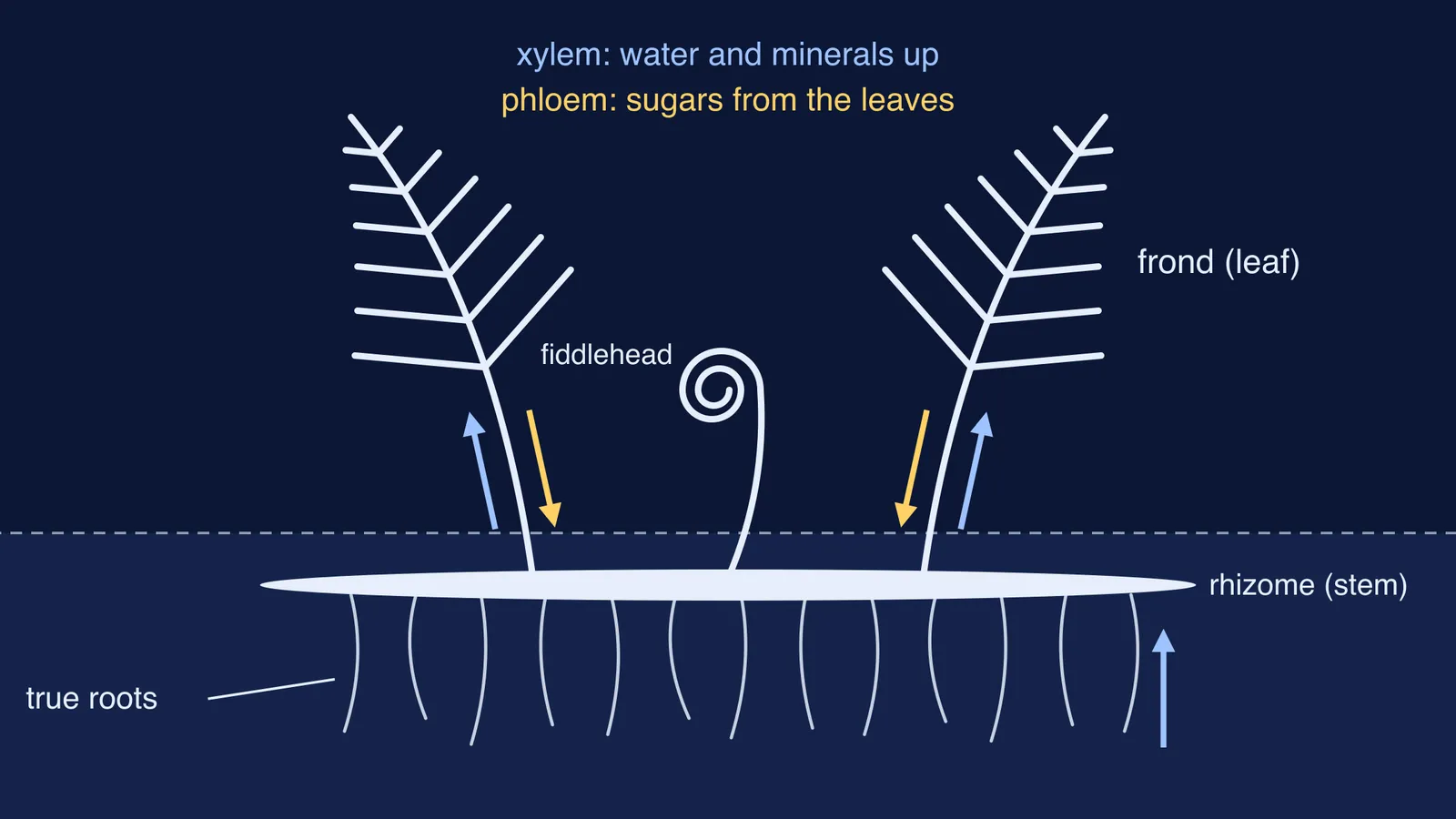
A vascular plant has two transport tissues running through its body. The OpenStax Biology 2e chapter on seedless vascular plants defines xylem as "the tissue responsible for the storage and long-distance transport of water and nutrients". Phloem, the same chapter says, "transports sugars, proteins, and other solutes throughout the plant".
Xylem's conducting cells, called tracheids, have lignin in their walls. Lignin is waterproof and stiff, so the cells that carry water also hold the plant up. OpenStax notes that these rigid cells let plants "achieve impressive heights".
Why are pteridophytes called the first vascular land plants?
Without vascular tissue, mosses and liverworts move water slowly from cell to cell, which keeps them short and tied to wet places (see why bryophytes are called the amphibians of the plant kingdom). Pteridophytes are the oldest living group to carry xylem and phloem. OpenStax dates vascular tissue in the fossil record to about 430 million years ago, in the Silurian period, and calls the club mosses "the earliest group of seedless vascular plants".
Three things follow from having vascular tissue:
True roots. Roots with a vascular core take water and minerals from the soil and anchor the plant. Bryophytes have only rhizoids.
True stems. Xylem in the stem lifts water to leaves held well above the ground.
True leaves. Leaves with veins. Microphylls are small leaves with a single vein, as in lycophytes; megaphylls are larger leaves with many veins, like fern fronds.
The other big change is which generation you see. In mosses the green plant is the gametophyte. In pteridophytes the plant you see is the diploid sporophyte, which OpenStax calls "the dominant phase of the life cycle".
Where do Equisetum, Selaginella and ferns fit?
Living pteridophytes are a big group. The 2016 Pteridophyte Phylogeny Group classification counts an estimated 11,916 species of lycophytes and ferns, in 337 genera and two classes (PPG I, Journal of Systematics and Evolution). Lycophytes form one line; ferns, including horsetails, form the other.
Selaginella (spike moss), a lycophyte. Small single-veined leaves, with sporangia packed into cone-like strobili. It is heterosporous: it makes small microspores and large megaspores, a step towards seeds explained in how heterospory in Selaginella leads to the seed habit.
Equisetum (horsetail). A jointed stem with leaves and branches in whorls at each node. The needle-like leaves do little photosynthesis; the green stem does most of it. Silica in the cell walls makes the stem rough to the touch. OpenStax describes Equisetum as the single surviving genus of a once large group and places horsetails in the same phylum as ferns.
Ferns. Large compound leaves called fronds, which unroll from a coiled fiddlehead. The stem is often an underground rhizome with adventitious roots. Spore cases sit in clusters called sori under the frond; this guide to the brown dots under fern leaves shows how to see them.
Older textbooks split these plants into more classes, with horsetails in a class of their own. Use the names your syllabus uses in the exam, but keep the modern picture in mind: horsetails are close relatives of ferns.
How do you place a plant in the right group?
Run this check from the top and stop at the first match:
No xylem and phloem? Bryophyte.
Makes seeds? Gymnosperm or angiosperm, not a pteridophyte.
Small one-veined leaves, sporangia in strobili, two sizes of spore? Selaginella-type lycophyte.
Jointed, ribbed green stem with whorls of tiny leaves at each node? Equisetum.
Large fronds, fiddleheads, sori under the leaf? Fern.
Worked example question: "Selaginella is called a spike moss. Why is it placed with pteridophytes and not bryophytes?"
A full answer in four lines:
Selaginella has xylem and phloem; bryophytes do not.
Its main plant body is the sporophyte, with true roots, stem and leaves (microphylls).
In bryophytes the gametophyte is dominant and has rhizoids, not roots.
It still needs water for fertilisation and makes no seeds, so it is a pteridophyte, not a seed plant.
Notice the shape: one feature per line, each set against the other group. Short answers reward the contrast, not just the definition.
If xylem, sporophyte or heterospory still feels shaky, the Fermi Concept Library gives every biology concept its own lesson and its place in the map, so you can see how vascular tissue connects to roots, stems and seeds. For practice, the Fermi Problem Library has worked problems with a step-by-step solver that explains the reasoning rather than printing an answer.
Next time you see a fern on a damp wall, find the fiddlehead and the sori, then look at the stem: that is the xylem-and-phloem body plan seed plants later built on.