On this page
Turn over a fern frond in a garden pot or on a damp wall in the monsoon and you will often find rows of brown or golden dots. They are the fern's spore factories, and you can watch them work with a hand lens and white paper.
What are the brown dots under fern leaves?
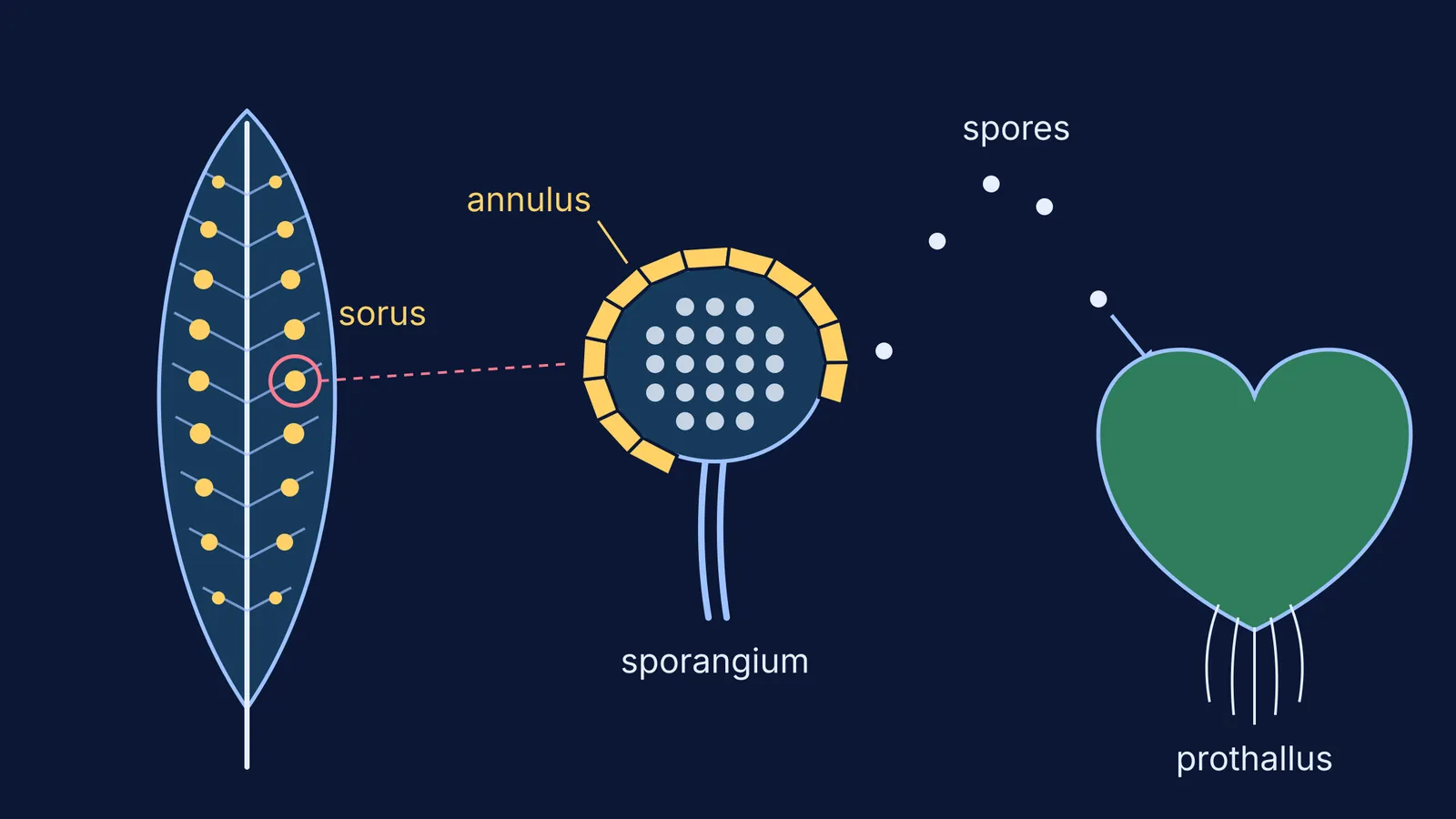
Each dot is a sorus (plural sori), a cluster of sporangia, according to the University of Auckland's NZ Plants guide to fern sporangia. The same guide says the spores form inside these spore sacs, which usually sit on the underside of the fronds. In many ferns an umbrella-like cover called the indusium hides each sorus while it develops.
The shape and position of the sori are important for identifying ferns, notes the Science Learning Hub's labelled fern underside. It also gives the key number: most ferns produce 64 spores in each sporangium.
In NCERT terms, ferns are pteridophytes. The Class 11 Biology chapter Plant Kingdom says the main fern plant is a sporophyte, which bears sporangia on leaf-like sporophylls, and the sporangia make spores by meiosis. For the wider map, see our guide to the plant kingdom, from algae to gymnosperms.
Are the brown spots on my fern a disease or pests?
Usually not, though scale insects also form brown bumps. Blake Layton, an extension entomology specialist, points out in a Mississippi State University Extension note on bumps on fern leaves that scale insects are never neatly arranged and spaced the way sori are.
A quick check:
Pattern: sori follow the leaf's design, often in matching rows on either side of the midrib. Scale insects are not neatly arranged and spaced like this.
Lens test: under a hand lens, a ripe sorus looks like a tight cluster of tiny round capsules.
Still unsure? Take a clear photo to a local nursery or your state agriculture department's extension office.
How does a fern shoot out its spores?
Each sporangium has a crest of cells called the annulus. As it dries, it contracts and slowly rips the spore sac open, then the two halves snap back together and throw the spores out, the Auckland guide explains.
A 2016 paper in the Journal of the Royal Society Interface by Llorens and colleagues (doi:10.1098/rsif.2015.0930) describes the annulus of leptosporangiate ferns as a row of 12 to 25 cells. They found that bubbles forming inside the drying cells (cavitation) trigger the snap, which launches spores at about 10 m/s. That is roughly 36 km/h.
What happens after a spore lands?
According to NCERT's Plant Kingdom chapter, a fern spore germinates into a small, multicellular, free-living, mostly photosynthetic gametophyte called the prothallus. It needs cool, damp, shady places. It bears antheridia (male) and archegonia (female), and water is needed to carry the male gametes to the archegonium. The zygote then grows into a new sporophyte, the fern you recognise.
NCERT says this need for damp places and water is why pteridophytes are restricted to narrow geographical regions. For a closer look at this stage, read what a prothallus is and why it matters, and see how ferns fit among haplontic, diplontic and haplodiplontic life cycles.
If words like sporophyll, sporophyte and gametophyte start to blur, the Fermi Concept Library gives each concept its own lesson and shows its place in the map, so you can see how the stages connect.
How can you observe sori and spores at home?
This plan works for a school project or a weekend with a parent. Timings vary by species and conditions.
Pick a ripe frond. The American Fern Society's spore guide says to look for brown spots or lines on the underside, ideally a rich cinnamon brown.
Draw what you see. Under a hand lens, sketch the pattern of the sori and note whether each one has a flap (indusium).
Make a spore print. Lay the frond sporangia-side down on clean white paper, as Brooklyn Botanic Garden's guide to growing ferns from spores describes. The American Fern Society suggests a warm, dry, draught-free spot for about a week or two. The fine dust left stuck to the paper is the spores.
Look under a microscope. Tap a little dust onto a slide. Look for single spores and empty capsules with their annulus.
Grow prothalli. Sprinkle spores on damp, sterile soil and keep it covered. Brooklyn Botanic Garden says a translucent green film may appear within 4 to 14 days. The American Fern Society says small flat prothallia appear after 6 to 8 weeks and grow to about 3/8 inch across, with tiny ferns following after another 6 to 8 weeks.
When you are ready to test yourself, the Fermi Problem Library has worked problems with a step-by-step solver that explains the reasoning rather than printing an answer.
Next time you see those brown dots, turn the leaf over and start the experiment.