

On this page
If you look at a fern in the woods, you are seeing the sporophyte—the dominant, leafy phase of the plant. But ferns have a hidden, independent life stage called the gametophyte. In ferns, this gametophyte is called the prothallus.
The prothallus does not look like a typical fern. It is a tiny green flake on the soil, yet it plays an essential role in the plant's life cycle. Without this microscopic structure, ferns would not be able to reproduce sexually.
What is a fern prothallus?
A prothallus is the independent, haploid (n) gametophyte generation of a fern. It is a free-living, mostly photosynthetic plant that usually measures just 2 to 5 millimetres across.
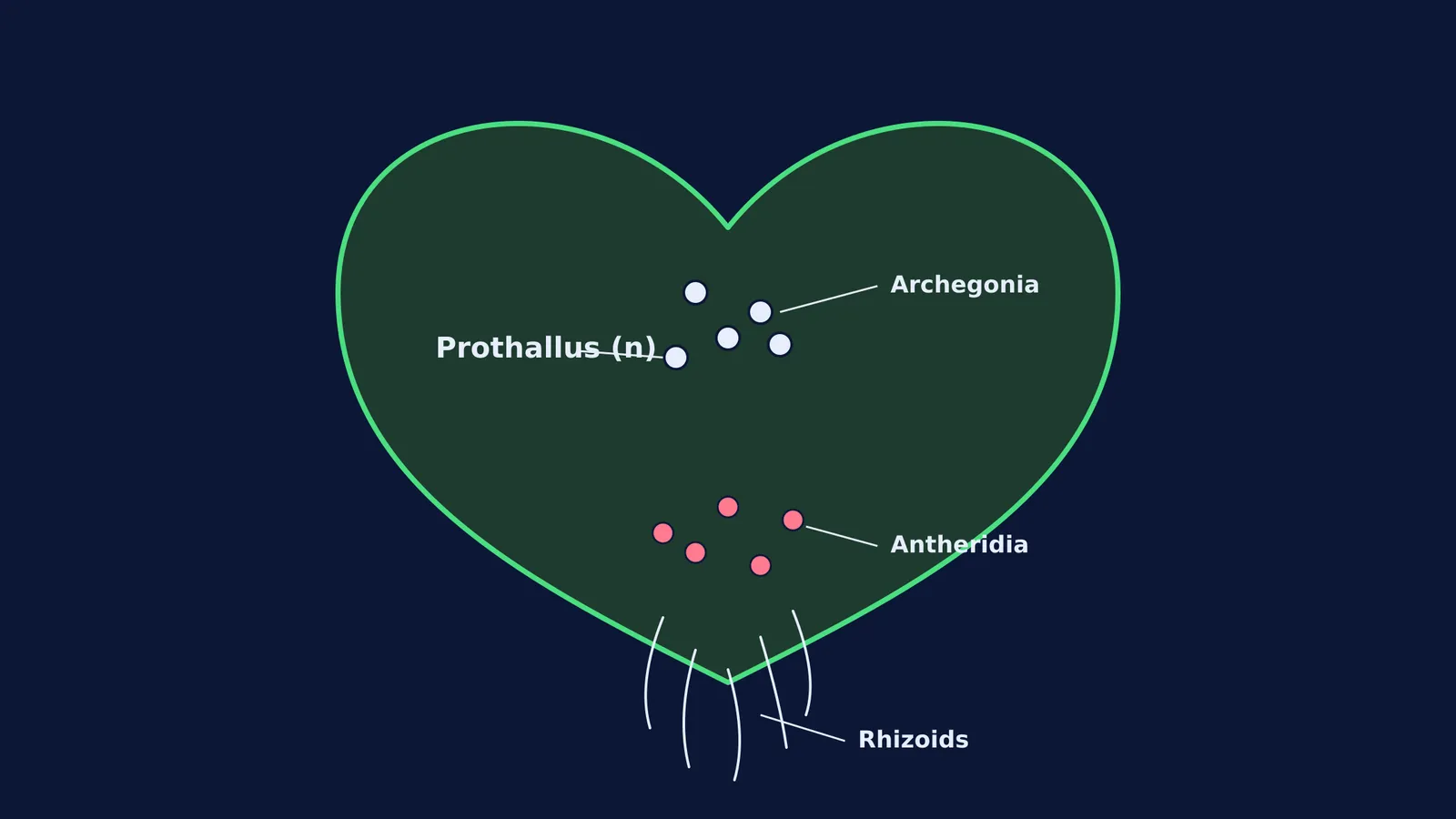
Because it is thalloid, it lacks true roots, stems and leaves. Instead, it is a flat, heart-shaped (cordate) structure. You will usually find it growing flat against damp, shaded soil. It absorbs nutrients directly from the moist ground beneath it.
If you are mapping out how different plants reproduce, you can use the Fermi Concept Library to see how the dominant phase shifts from the gametophyte in mosses to the sporophyte in ferns and seed plants.
What are the parts of a prothallus?
Despite its tiny size, the prothallus contains everything needed for sexual reproduction. Most fern prothalli are monoecious (or homothallic), meaning they carry both male and female reproductive organs on the same plant.
Rhizoids: These are unicellular, root-like hairs that anchor the prothallus to the soil and absorb water. They grow on the underside, usually clustered near the pointed bottom of the heart shape.
Antheridia: These are the male sex organs. They grow on the lower surface among the rhizoids and produce flagellated, swimming male gametes called antherozoids.
Archegonia: These are the flask-shaped female sex organs. They grow near the "notch" (the deep cleft at the top of the heart shape) and each contains a single egg at its base.
Why does a prothallus need a damp place?
If you have ever wondered why ferns are mostly restricted to cool, damp and shady environments, the answer lies in the prothallus. Because the antherozoids are flagellated, they must physically swim to reach the egg inside the archegonium.
Without a thin film of water on the surface of the prothallus, fertilisation simply cannot happen. The sperm would dry out or remain trapped in the antheridia. This strict reliance on water for fertilisation is a key reason why ferns cannot colonise dry habitats as easily as seed plants can.
(Millions of years later in evolutionary history, seed plants solved this exact problem by packing sperm inside pollen, freeing them from the need for external water. You can read exactly how they do this in our guide to microsporogenesis and the structure of a pollen grain.)
How does it fit into the life cycle?
The life cycle of a fern relies on a continuous alternation of generations, a concept central to botany (and first mapped clearly by Wilhelm Hofmeister). The prothallus represents the crucial halfway point between one leafy fern and the next.
Spores land: A mature, leafy fern releases haploid spores from sporangia on the underside of its leaves. If a spore lands on moist, suitable soil, it germinates and grows into a prothallus.
Fertilisation: The antherozoids swim through a film of water to the archegonia and fuse with the egg, creating a diploid (2n) zygote.
A new fern grows: The zygote begins dividing right there inside the archegonium. It develops into a young sporophyte, drawing its initial nutrition directly from the prothallus.
The prothallus dies: Once the young sporophyte grows its own true roots and its first green leaf, it becomes fully independent. Its job complete, the tiny prothallus withers away and dies.


