On this page
Mosses and liverworts grow on soil, rocks and tree bark, yet they cannot make a sporophyte without a film of water. That single fact gives them the nickname. If you are preparing for CBSE boards or NEET-UG, this is how to understand it and how to write it up.
Why are bryophytes called amphibians of the plant kingdom?
The official answer is one sentence in the NCERT Class 11 Biology chapter Plant Kingdom: bryophytes "can live in soil but are dependent on water for sexual reproduction." Amphibian animals follow a similar pattern. A frog spends much of its life on land, but it returns to water to breed, and its eggs develop there.
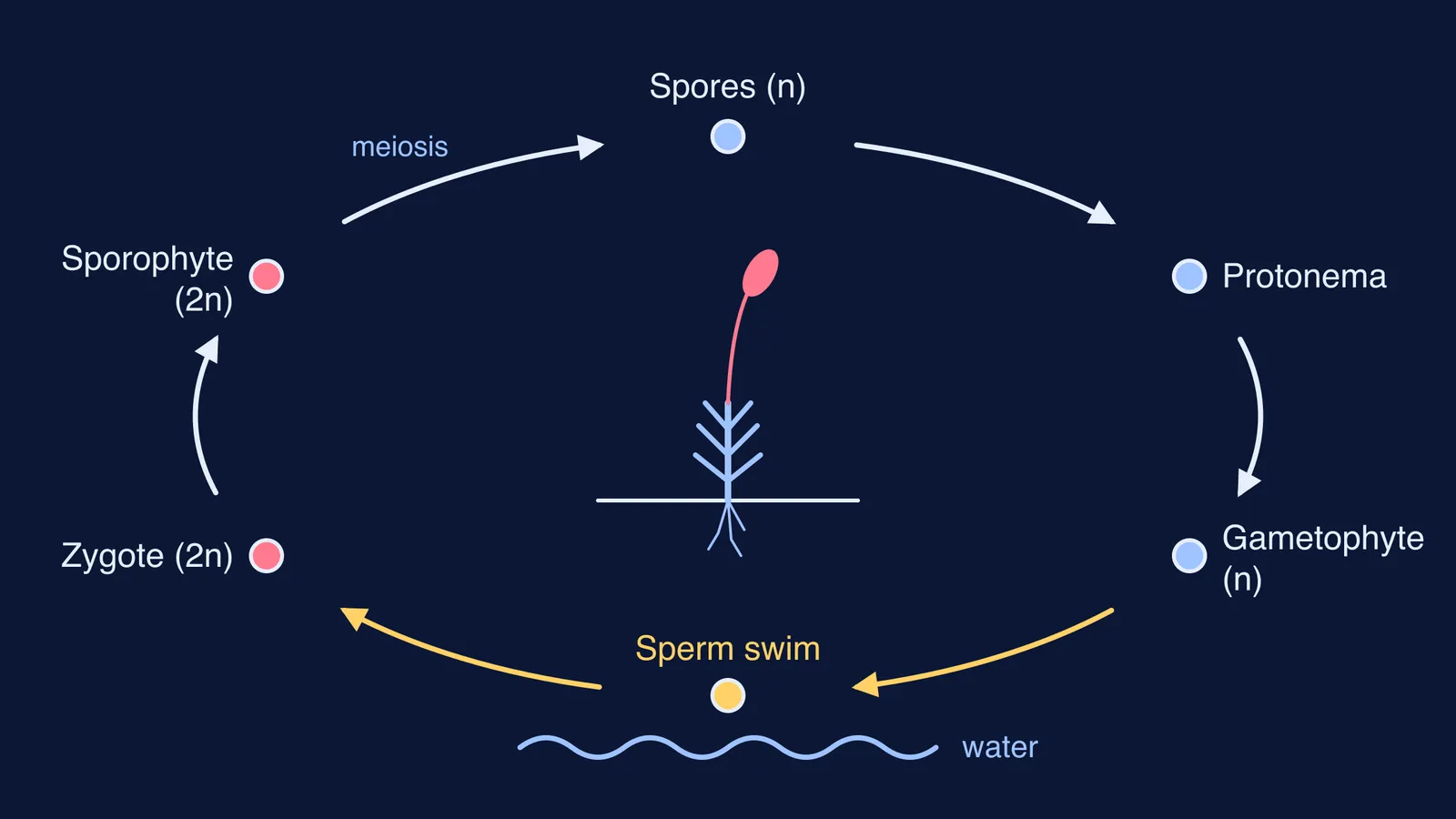
The water matters because of how the sperm travel. In bryophytes the male sex organ, the antheridium, produces biflagellate antherozoids, and the flask-shaped archegonium produces a single egg, according to the same NCERT chapter. The antherozoids are released into water, where they come into contact with the archegonium. One antherozoid then fuses with the egg to form the zygote.
What other features support the nickname?
The water rule is the core reason, but several other features from the NCERT text show that bryophytes sit between water and land:
Habitat: they usually occur in damp, humid and shaded places, such as moist shaded areas in the hills, stream banks and tree bark.
Body: the plant body is thallus-like, attached by rhizoids, with no true roots, stem or leaves. It is more differentiated than the body of an alga.
Land pioneers: mosses, along with lichens, are the first organisms to colonise rocks, and they break rock down so that higher plants can grow later.
Soil holders: moss mats reduce the impact of falling rain and help prevent soil erosion.
How does water fit into the bryophyte life cycle?
Walk through a moss such as Funaria, using the steps in the NCERT chapter:
A haploid spore germinates into the protonema, a creeping, green, branched thread.
A lateral bud on the secondary protonema grows into the leafy stage, the main plant you see, which bears the sex organs.
Antherozoids are released into water and swim to the archegonium. This is the water-dependent step.
Fertilisation gives a diploid zygote, which grows into a sporophyte made of a foot, a seta and a capsule.
The sporophyte stays attached to the gametophyte and gets its nourishment from it.
Cells in the capsule undergo meiosis to make haploid spores, and the cycle starts again.
Both the haploid gametophyte and the diploid sporophyte are multicellular, which is why this pattern is called haplo-diplontic; in bryophytes the gametophyte is the dominant stage. Our post on haplontic, diplontic and haplodiplontic life cycles compares all three. Ferns need water at the same step, as our post on the fern prothallus and its life stage shows.
How far can bryophyte sperm actually travel?
In a 2006 study in Science, Nils Cronberg, Rayna Natcheva and Katarina Hedlund showed that springtails and mites are attracted to fertile moss shoots and carry moss sperm, which enhances fertilisation (Cronberg et al., 2006). In the liverwort Marchantia polymorpha, Silvia Pressel and Jeffrey Duckett calculated that one antheridium produces over 200,000 spermatozoids. Assuming the sperm spread through surface water films, they estimated that spermatozoids can reach more than 20 m from the parent plants, in line with their finding of 100% fertilisation in female plants up to 19 m from the nearest males (Pressel and Duckett, 2019).
Neither finding breaks the nickname. Animals and surface water help the sperm move, but the sperm still need water to reach the egg. In exams, stick to the NCERT sentence.
How do you write this answer in an exam?
Use this four-line plan for a 2 or 3 mark question:
Definition: Bryophytes are called amphibians of the plant kingdom because they live in soil but depend on water for sexual reproduction.
Mechanism: Biflagellate antherozoids from the antheridium swim through water to reach the egg in the flask-shaped archegonium.
Supporting features: They grow in damp, shaded places and have rhizoids instead of true roots.
Example: Name one moss (Funaria, Sphagnum) and one liverwort (Marchantia).
Before the exam, check yourself against these common slips:
Writing "they live in water and on land". They live on land and need water only to reproduce.
Calling rhizoids roots.
Saying the sporophyte is free-living. In bryophytes it depends on the gametophyte.
Mixing up which phase is dominant. In bryophytes it is the gametophyte, and in pteridophytes it is the sporophyte.
If you mix up the plant groups, read our list of odd-one-out exceptions from algae to gymnosperms next. The Fermi Concept Library gives every concept in biology its own lesson and its place in the map, so you can see where bryophytes sit beside algae and ferns.