

On this page
Plant classification is built on defining characteristics that group countless species into a neat hierarchy. We learn that green algae rely on water for swimming gametes, ferns reproduce via a single type of spore, and gymnosperms dominate through naked seeds and pollen tubes.
But in biology, the exceptions often reveal the true evolutionary story. As plants transitioned from water to land, they didn't all move at the same pace. Some retained ancient aquatic features, while others prematurely evolved traits that wouldn't become standard until millions of years later. In competitive biology exams, these exceptions are consistently the most tested facts because they separate true understanding from superficial memorisation.
Instead of rote-memorising these anomalies, you can master them by understanding why they exist. The Fermi Concept Library covers every concept in biology, helping you see these exceptions not as random facts, but as vital evolutionary bridges between major plant groups.
Algae: Why do red algae lack flagella?
The defining feature of early aquatic plant life, such as green and brown algae, is their reliance on water for reproduction. This typically involves flagellated, motile spores (zoospores) or actively swimming gametes that propel themselves through the water to fertilise.
The exception: Red algae (Rhodophyta) completely lack flagella and centrioles in all stages of their life cycle.
Unlike other algae that have swimming reproductive cells, red algae form a distinct group that produces entirely non-motile spores and gametes (Wikipedia). They rely completely on passive water currents to carry the male gamete to the female reproductive organ. This total absence of motile stages is a defining anomaly that abruptly separates them from the rest of the algal groups.
Pteridophytes: Which ferns show heterospory?
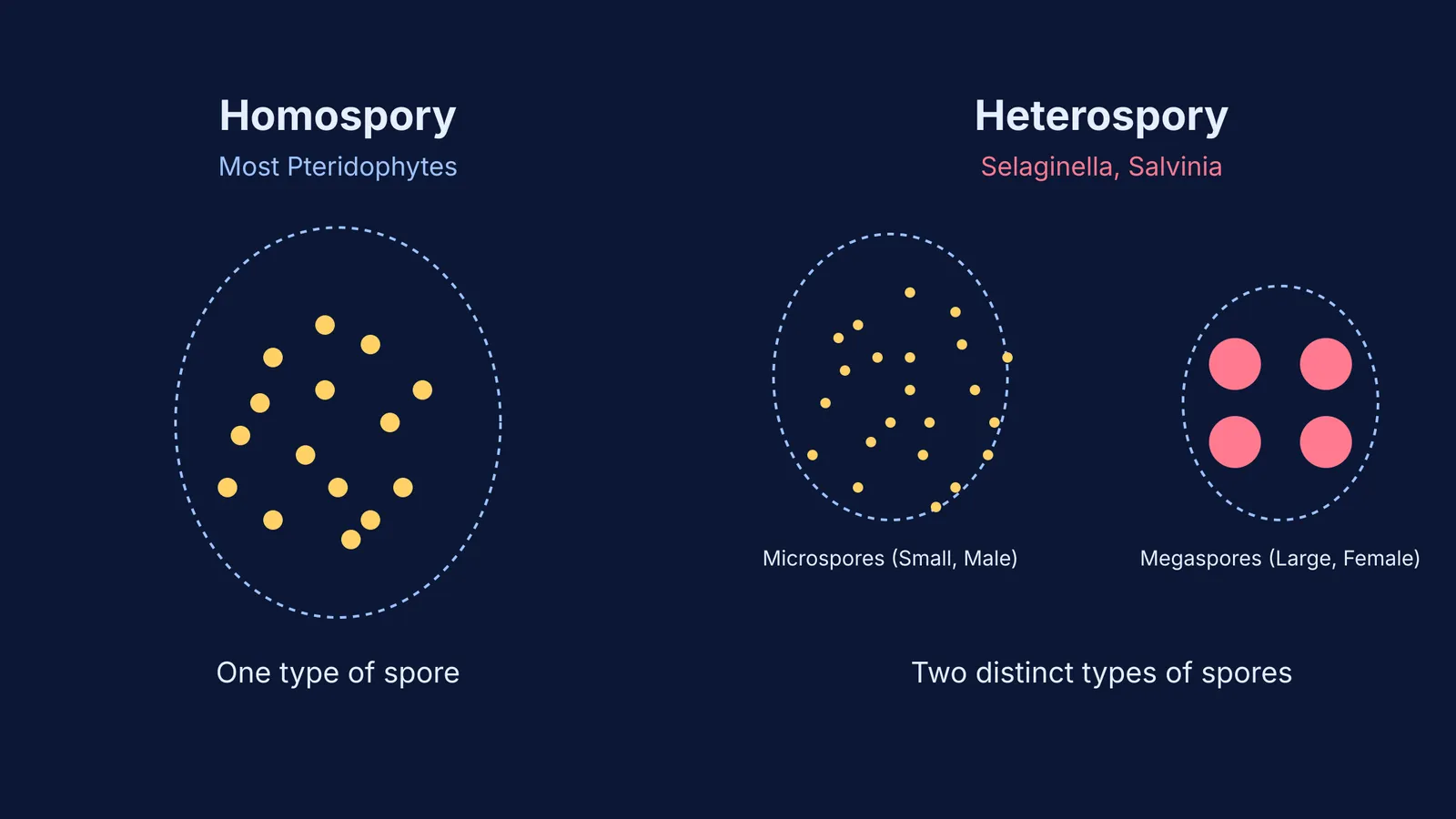
Pteridophytes, the group containing ferns and horsetails, were the first terrestrial plants to successfully develop vascular tissue (xylem and phloem) for water and food transport. The vast majority of them are homosporous, meaning they produce one uniform type of spore. This single spore type germinates into a tiny, independent gametophyte that produces both male and female sex organs.
The exception: A few genera, notably *Selaginella* and *Salvinia*, produce two distinctly different types of spores: large megaspores and small microspores.
This phenomenon, known as heterospory, is a crucial evolutionary leap (Evolution, 2017). The microspores develop into male gametophytes, while the megaspores develop into female gametophytes. Because the female gametophyte is retained on the parent sporophyte for a period of time, heterospory is considered the direct evolutionary precursor to the seed habit seen in all higher plants today.
Gymnosperms: Which gymnosperms retain motile sperm?
Gymnosperms are seed-producing plants that lack the enclosed ovary (fruit) of angiosperms. They are generally characterised by having non-motile sperm that is delivered directly to the egg via pollen tubes (siphonogamy), and by having a simpler wood structure composed entirely of water-conducting cells called tracheids.
However, this group harbours two of the most famous botanical exceptions, each pointing in a different evolutionary direction:
Exception 1 (Vessels): While almost all gymnosperms lack vessel elements in their xylem, the order Gnetales (which includes *Gnetum*, *Ephedra*, and *Welwitschia*) possesses them. Vessel elements are otherwise a hallmark characteristic of highly evolved flowering plants (angiosperms) (Wikipedia). This makes the Gnetales an odd bridge that hints at the vascular anatomy of angiosperms.
Exception 2 (Motile Sperm): While most seed plants have entirely non-motile sperm, *Cycas* and *Ginkgo* uniquely form highly multi-flagellated and large motile sperm within their pollen tubes. Research on *Cycas revoluta* in 2025 confirmed that these swimming sperm retain ancestral genetic characteristics found in lower plants, representing a rare transitional state from motile to non-motile male gametes (bioRxiv, 2025). They essentially use the advanced delivery system of a pollen tube, but retain the ancient, swimming sperm inside it.
How can you master these biological exceptions?
When exam questions target these facts, they often mix them together to test your precision. Use this simple checklist to confirm you know the vital exceptions:
Algae: Which group has zero motile stages? (Answer: Rhodophyta or red algae).
Pteridophytes: Which common genera show heterospory? (Answer: *Selaginella* and *Salvinia*).
Gymnosperms: Which genera retain motile sperm? (Answer: *Cycas* and *Ginkgo*).
Gymnosperms: Which genus contains angiosperm-like vessels in its wood? (Answer: *Gnetum*).
If you find yourself repeatedly mixing up these exceptions, Fermi's AI tutor can help. The tutor holds a line of reasoning across a session, notices where you are stuck, and builds a plan for the session. Rather than just handing you an answer key, it will ask you to explain the evolutionary advantage of a trait, testing your underlying understanding.
For more biological misfits that defy standard classification rules, read our guide on viruses, viroids and lichens.


