On this page
This question comes up in Class 11 calorimetry practicals, and the answer is short: copper gets out of the way. A good calorimeter takes as little heat as possible and matches the water's temperature when you read the thermometer.
What is a calorimeter made of?
NCERT's Class 11 Physics textbook says a calorimeter "consists of a metallic vessel and stirrer of the same material, like copper or aluminium", kept inside a wooden jacket filled with an insulating material such as glass wool (NCERT Class 11 Physics, Thermal Properties of Matter).
The method rests on one rule from the same chapter: heat lost by the hot body equals heat gained by the colder body, provided none escapes. The trap is that the calorimeter is one of the colder bodies. It warms up too, so its heat belongs in your equation.
Why are calorimeters made of copper?
Two properties decide it, and both values come from the NCERT tables (Tables 10.3 and 10.6).
Low specific heat, so the vessel takes a small share. Copper's specific heat capacity is 386.4 J/kg K, while water's is 4186 J/kg K. A gram of copper needs less than a tenth of the heat that a gram of water needs to warm by 1 degree, so most of the heat goes into the water, which is what you are measuring.
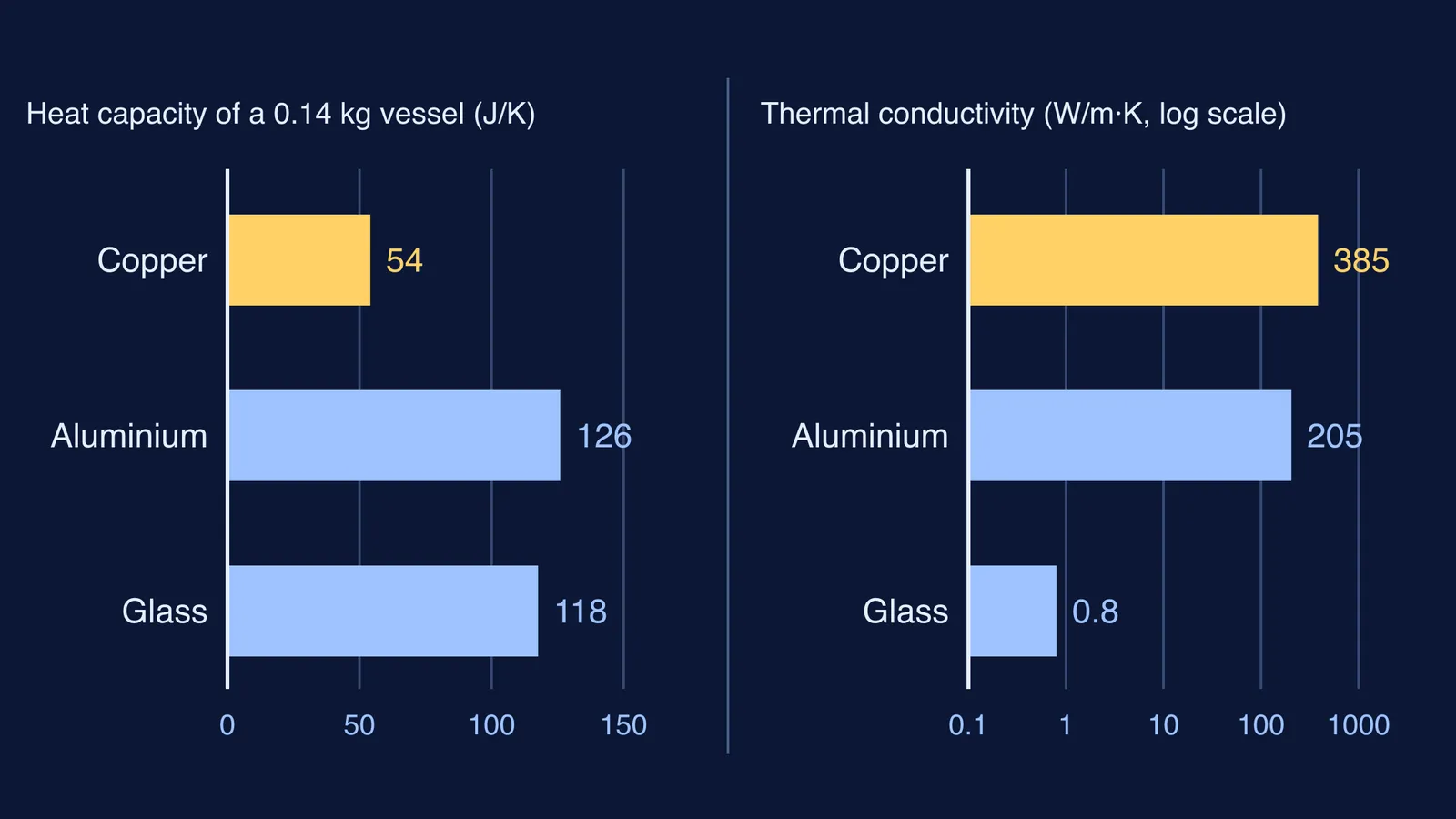
High thermal conductivity, so the vessel keeps up. Copper's thermal conductivity is 385 W/m K, while glass's is 0.8 W/m K, nearly 500 times lower. Heat crosses a thin copper wall quickly, so the vessel, the stirrer and the water settle at one temperature, and the thermometer in the water also tells you the vessel's temperature. A slow vessel would lag behind the water, and the longer you wait for it, the more heat leaks away.
Good conduction works in both directions, which is why the vessel sits in its jacket: glass wool's conductivity in the same table is 0.04 W/m K.
How much heat does a copper calorimeter actually take?
Take NCERT's own Example 10.3 (Class 11 Physics, Chapter 10). An aluminium sphere of 0.047 kg at 100 °C is dropped into a 0.14 kg copper calorimeter holding 0.25 kg of water at 20 °C. Everything settles at 23 °C. The book uses 4.18 x 10^3 J/kg K for water and 0.386 x 10^3 J/kg K for copper.
Heat capacity of the water: 0.25 x 4180 = 1045 J/K.
Heat capacity of the copper calorimeter: 0.14 x 386 = 54.0 J/K.
The calorimeter's share: 54.0 out of 1099 J/K, about 4.9% of all the heat gained.
Heat gained: 1099 x 3 = 3297 J. Heat lost by the sphere: 0.047 x s x 77. Setting them equal gives s = 911 J/kg K, NCERT's answer of 0.911 kJ/kg K.
Now leave the calorimeter out: s = 3135 / 3.619 = 866 J/kg K, about 5% too low.
Step 2 also gives the vessel's water equivalent: 54.0 / 4180 kg, about 12.9 g of extra water. Our guide to the water equivalent of a calorimeter shows how to use that number directly. If you keep mixing up step 2 and step 3, the difference between specific heat and heat capacity is the idea to fix first, and the Fermi Concept Library gives every physics concept its own lesson and its place in the map.
Why not aluminium, steel or glass?
The same NCERT tables answer this (Tables 10.3 and 10.6).
Aluminium: a good conductor at 205 W/m K, and NCERT lists it as an option. But its specific heat is 900 J/kg K, so a 0.14 kg aluminium vessel would take 126 J/K, more than twice the copper vessel's 54.
Steel: its conductivity is 50.2 W/m K, about one-eighth of copper's, so it is slower to catch up.
Glass: 0.8 W/m K and 840 J/kg K. It is slow to reach the water's temperature and it takes a bigger share of the heat.
What should you say in the practical and viva?
A one-line answer you can say out loud: "The calorimeter is made of copper because copper has a low specific heat, so it absorbs only a little heat, and a high thermal conductivity, so it quickly reaches the same temperature as the water."
Before you write your record, check these:
Weigh the empty calorimeter with its stirrer; both absorb heat.
Put a calorimeter term (mass x specific heat x temperature rise) on the heat-gained side.
Stir gently before every reading.
Keep the vessel in its jacket and move the hot solid in quickly.
Under sources of error, name heat lost to the surroundings and during the transfer.
For the full procedure, readings table and error analysis, see our walk-through of the method of mixtures for specific heat.
If you get stuck on a calorimetry numerical, the Fermi Problem Library has worked problems with a step-by-step solver that explains the reasoning rather than printing an answer.