On this page
Shine white light through a glass prism and it fans out into colours. Two quantities describe that fan: how wide it is (angular dispersion), and how strongly the material spreads colours compared with how much it bends light overall (dispersive power). Below are the definitions, where the formulas come from, and one crown glass prism worked from real catalogue numbers.
What is angular dispersion of a prism?
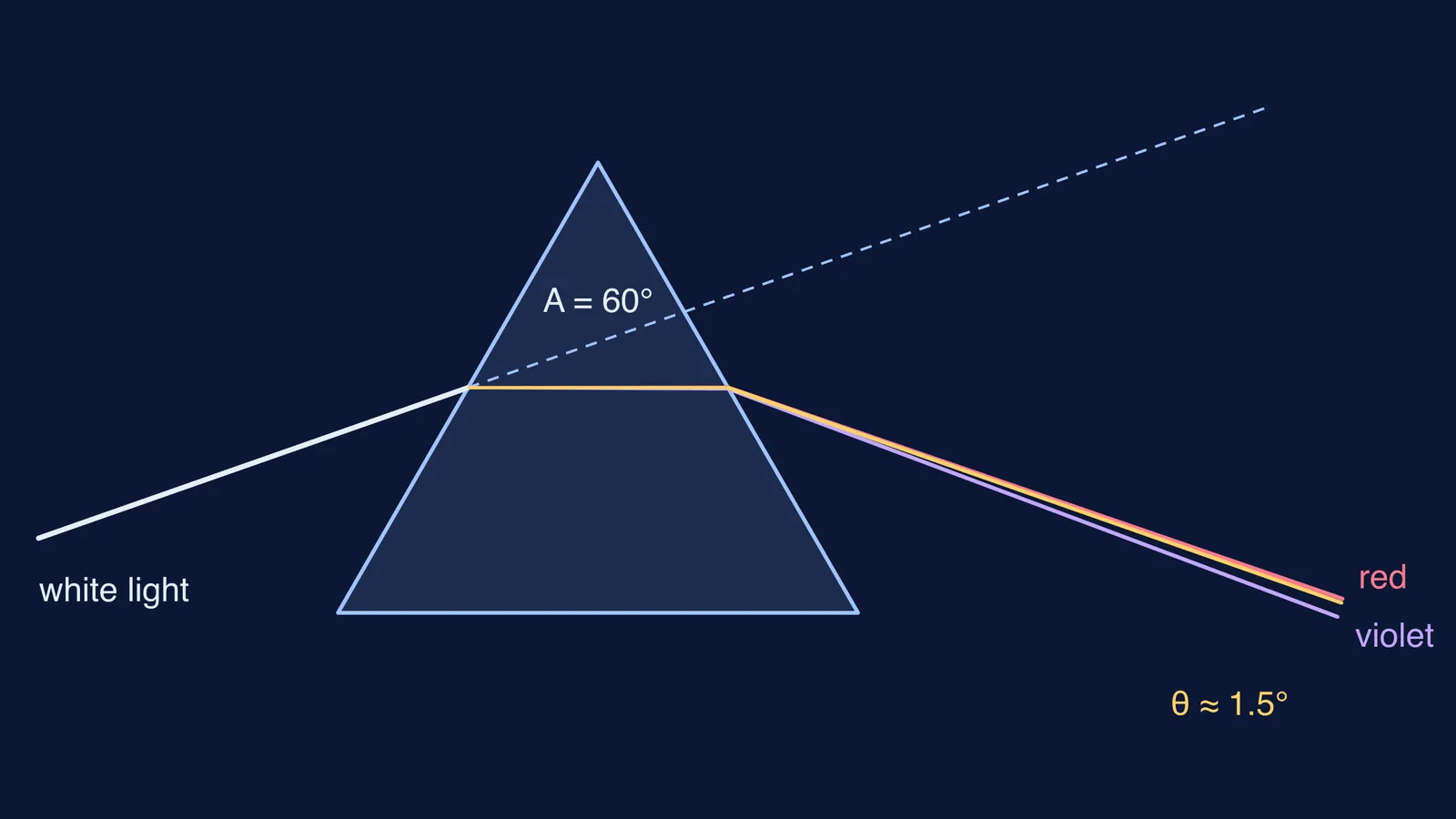
Start from deviation. The current NCERT Class 12 chapter on ray optics shows that for a thin prism of small angle A, the minimum deviation is D = (n − 1)A, which is why thin prisms do not deviate light much (NCERT Physics Part II, Chapter 9, section 9.6). The refractive index depends on colour, so each colour is deviated by a different amount: violet has the largest μ and bends most, red the least.
Angular dispersion is the angle between the emerging violet and red rays: for a thin prism, θ = δv − δr = (μv − μr)A (schoolphysics: achromatic prisms and lenses). It comes out in whatever unit A is in, and it grows as the prism angle grows.
What is dispersive power, and why does it not depend on A?
The deviation of the middle (yellow) colour is called the mean deviation, δy = (μy − 1)A. Dispersive power ω is angular dispersion divided by mean deviation: ω = (μv − μr)/(μy − 1) (schoolphysics). The A cancels, so ω describes the material, not the prism. It has no unit.
Glass makers use the same ratio upside down. The Abbe number is V = (nd − 1)/(nF − nC), using the F line at 486.1 nm, the d line at 587.6 nm and the C line at 656.3 nm (Abbe number, Wikipedia). Low-dispersion crown glasses have large Abbe numbers, which means small dispersive power.
How do you calculate dispersive power from μv and μr?
Take N-BK7, a borosilicate crown glass made by SCHOTT and used for lenses, prisms and windows. Its supplier's data sheet lists these refractive indices (PGO data sheet for N-BK7):
violet, 404.7 nm: μv = 1.53024
yellow, 587.6 nm: μy = 1.51680
red, 706.5 nm: μr = 1.51289
The problem: a thin prism of this glass has A = 5°. Find the deviation of violet and red, the angular dispersion and the dispersive power.
Violet deviation: δv = (1.53024 − 1) × 5° = 2.6512°.
Red deviation: δr = (1.51289 − 1) × 5° = 2.5645°.
Angular dispersion: θ = 2.6512° − 2.5645° = 0.0868°, about 5.2 minutes of arc.
Mean deviation: δy = (1.51680 − 1) × 5° = 2.5840°.
Dispersive power: ω = 0.0868 / 2.5840 ≈ 0.0336.
Check it in one line: ω = (1.53024 − 1.51289)/(1.51680 − 1) = 0.01735/0.51680 ≈ 0.0336.
Notice the sizes. The prism bends yellow light by about 2.6° but spreads violet and red apart by less than a tenth of a degree. That is why a thin prism of one glass gives a narrow spectrum, and why the ratio, not either angle alone, describes the glass.
Which mistakes cost marks in dispersion questions?
Dividing by the prism angle. ω = θ/δy, and the mean deviation is (μy − 1)A, not A.
Using μv or μr in the denominator. The denominator uses the mean (yellow) index, or the average if the question gives one.
Expecting a bigger prism to have a bigger ω. A bigger A gives a bigger θ; ω stays the same for the same glass.
Using δ = (μ − 1)A for a wide prism. It is a small-angle result (NCERT section 9.6); for a 60° prism you apply Snell's law at each face, as in the diagram at the top of this post.
How should you practise this before a test?
A short plan for one evening:
Without notes, derive θ = (μv − μr)A and ω = (μv − μr)/(μy − 1) from δ = (μ − 1)A.
Redo the worked example with A = 10°, using the same N-BK7 indices. θ doubles to about 0.17°; ω stays at 0.0336. If your ω changed, look for the mistake in the list above.
Then try a question that joins two prisms of different glass, such as a dispersion-without-deviation pair. It uses the same two formulas, written once for each prism.
If a step stops making sense, the Fermi Problem Library has worked problems with a step-by-step solver that explains the reasoning, so you can see exactly where your method went off. To go back over refraction and deviation from the start, the Fermi Concept Library covers every concept in physics, chemistry, biology, mathematics and computing.
Work the numbers once yourself, with a real glass, and the two formulas stop being things to memorise.