

On this page
Questions like "if one root is double the other, find the condition" look like they need you to solve the quadratic. They don't. Write what the condition says about the roots, link it to the coefficients through the sum and product, and let the unknown root cancel. Reciprocal roots, roots differing by 1 and roots in any ratio fall to the same three steps.
What do Vieta's formulas say for a quadratic?
For ax² + bx + c = 0 with a ≠ 0 and roots α and β, the sum of the roots is α + β = −b/a and the product is αβ = c/a, as derived in Section 2.3 of the NCERT Class 10 Mathematics chapter on polynomials.
These are Vieta's formulas, which, as Wolfram MathWorld puts it, "relate a polynomial's coefficients to symmetric sums of its polynomial roots". They are named after the French mathematician François Viète (1540–1603), according to Wikipedia's entry on Vieta's formulas.
Every condition question then follows one method:
Write both roots using a single unknown that already obeys the condition.
Write the sum equation and the product equation.
Eliminate the unknown. Whatever is left involves only a, b and c, and that is your condition.
If one root is double the other, how do you find the condition?
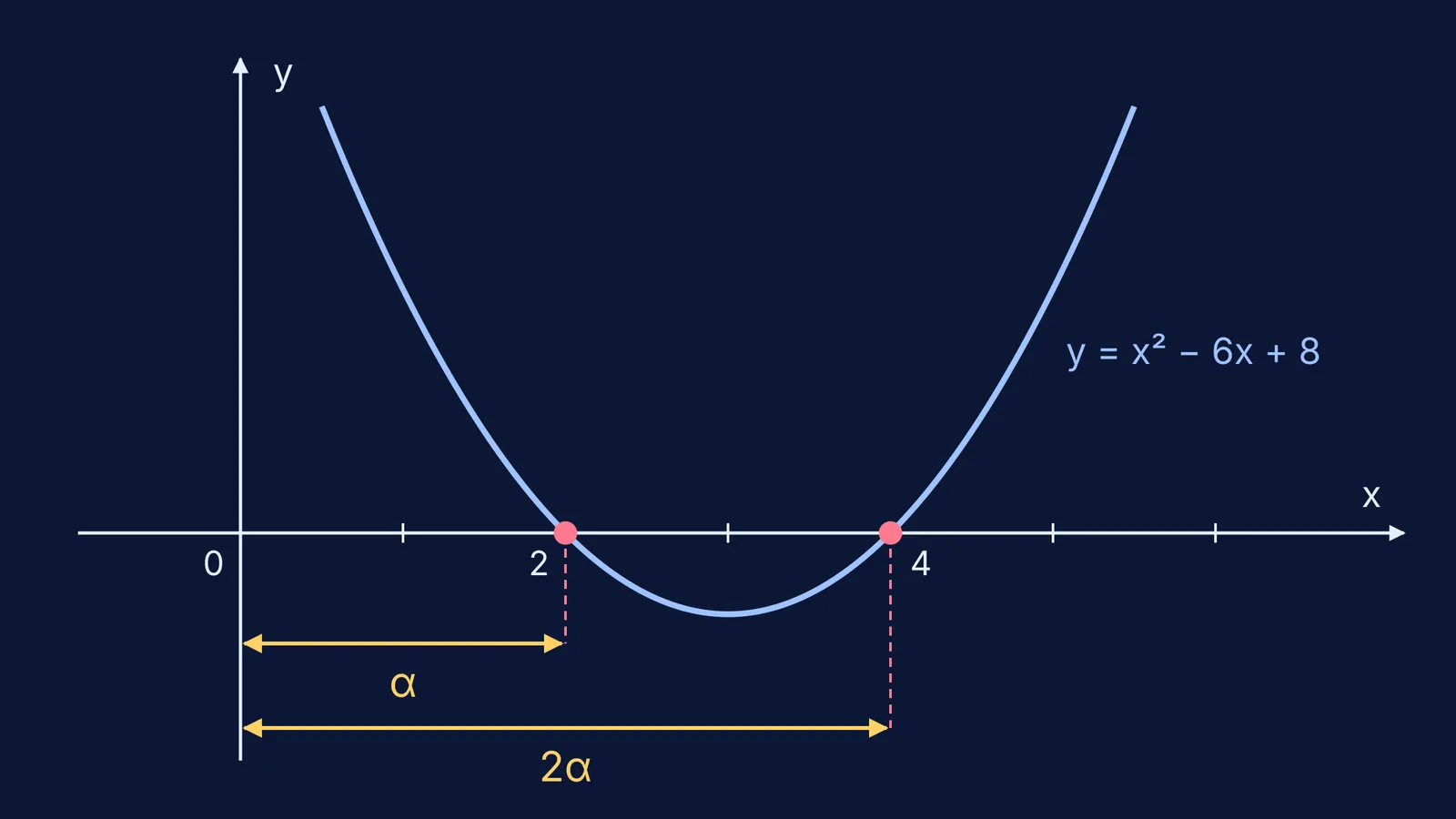
Let the roots be α and 2α. That choice builds the condition in.
Sum: α + 2α = 3α = −b/a, so α = −b/(3a).
Product: α × 2α = 2α² = c/a.
Substitute: 2 × b²/(9a²) = c/a. Multiply both sides by 9a² to get 2b² = 9ac.
Worked example: find k if x² − 6x + k = 0 has one root double the other. Here a = 1 and b = −6, so 2 × 36 = 9 × 1 × k, which gives k = 8. Check it: x² − 6x + 8 = (x − 2)(x − 4), and 4 is double 2.
The same steps with roots mt and nt give the general rule mnb² = (m + n)²ac for roots in the ratio m : n. Put m = 1 and n = 2 and you are back to 2b² = 9ac. We go through the general case in the condition for roots in a given ratio.
What is the condition if the roots are reciprocals of each other?
Let the roots be α and 1/α. Their product is 1, so c/a = 1, which means c = a. You do not even need the sum.
Worked example: for which k are the roots of 2x² − 5x + k = 0 reciprocals? Set k = a = 2. Check: 2x² − 5x + 2 = (2x − 1)(x − 2), with roots 1/2 and 2.
One caution: c = a guarantees the product is 1, not that the roots are real. If the question asks for real reciprocal roots, also check that b² − 4ac ≥ 0.
What if the roots differ by 1?
Here the sum and product do not give α − β directly, so use the identity (α − β)² = (α + β)² − 4αβ. Substituting Vieta's formulas, (α − β)² = b²/a² − 4c/a.
Set this equal to 1² and multiply by a² to get b² − 4ac = a². If the roots differ by any number k, the condition is b² − 4ac = k²a².
Worked example: find c if the roots of x² − 5x + c = 0 differ by 1. Then 25 − 4c = 1, so c = 6, and x² − 5x + 6 = (x − 2)(x − 3). This trick of building expressions from α + β and αβ is the same one used to find α⁵ + β⁵ without solving the quadratic.
Which root conditions should you recognise on sight?
All of these come from the same three steps. Derive each once, then keep this list for revision:
One root double the other: 2b² = 9ac
Roots in the ratio m : n: mnb² = (m + n)²ac
Roots reciprocal: c = a
Roots differ by k: b² − 4ac = k²a²
Roots equal in size, opposite in sign: b = 0, because the sum is zero
One root is zero: c = 0, because the product is zero
One root is the square of the other: b³ + a²c + ac² = 3abc
Equal roots: b² = 4ac, covered in how to find k for equal roots
Where do students usually go wrong?
Using two unknowns. Writing the roots as α and β and then adding β = 2α leaves you juggling three equations. Start with α and 2α.
Dropping the minus sign. The sum is −b/a, not b/a. Squaring hides the slip in the double-root case, but not in the square case.
Solving for the roots. If you reach for the quadratic formula, stop. The condition comes from eliminating α, not finding it.
If you get stuck at the elimination step, the Fermi Problem Library has worked problems with a step-by-step solver that explains the reasoning rather than printing an answer. If Vieta's formulas themselves feel shaky, the Fermi Concept Library gives each mathematics concept its own lesson, so you can rebuild the sum and product first.
Try this one now: find the condition for one root of ax² + bx + c = 0 to be three times the other. You should get 3b² = 16ac.


