

On this page
Ask a chatbot why a car can take a turn and you may get a neat answer with one extra arrow: “centrifugal force acting outwards”. In the ground frame, the frame you use unless a problem says otherwise, that arrow should not be there. Here is how to make an AI name the real force and catch it when it slips.
Which force gives the centripetal force?
None of its own. OpenStax University Physics defines it plainly: “Any net force causing uniform circular motion is called a centripetal force” (OpenStax University Physics, Volume 1, section 6.3). Its examples include the tension in a rope, Earth's gravity on the Moon, friction, and a banked roadway's force on a car.
So the useful question is never “what is the centripetal force?” but “which real force, or which component, points to the centre here?” Common cases:
Stone whirled on a string in a horizontal circle: tension in the string.
Car turning on a flat road: static friction from the road on the tyres, pointing towards the centre.
Car on a frictionless banked road: the horizontal component of the normal force.
Moon or satellite in orbit: gravity.
Conical pendulum: the horizontal component of the tension.
Charged particle moving at right angles to a uniform magnetic field: the magnetic force.
Bucket at the top of a vertical circle: weight plus tension, both pointing down.
For banked roads, the same OpenStax section gives the ideal angle with no friction as θ = tan⁻¹(v²/rg), so a faster or tighter turn needs a steeper bank.
Why does an AI chatbot add centrifugal force?
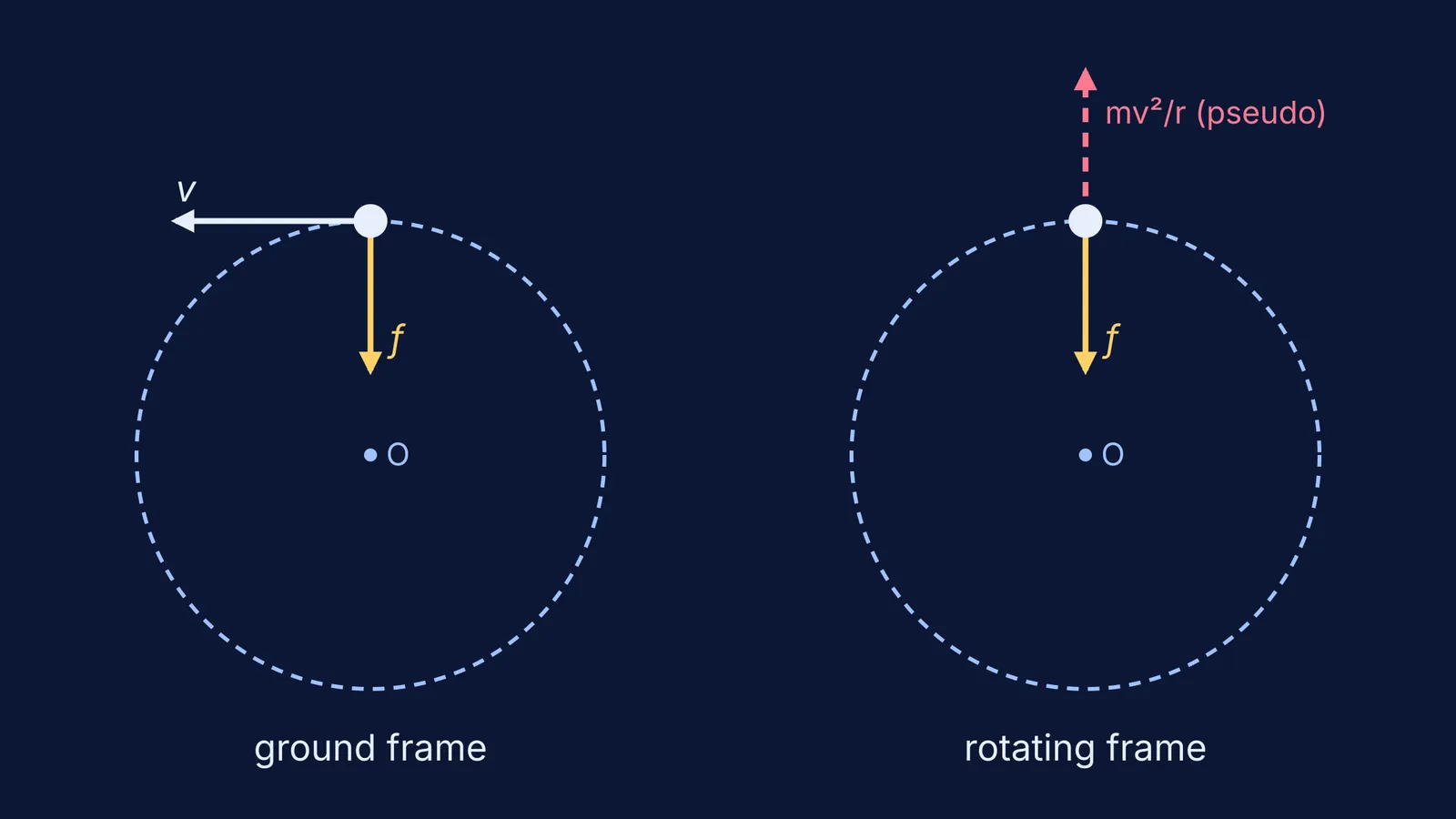
OpenStax states that centrifugal force “does not actually exist”: on a merry-go-round you hang on to counteract your own inertia, which people often call centrifugal force (OpenStax, section 6.3). In a rotating frame you may add a pseudo-force of size mv²/r pointing outwards; it balances the inward force, so the object looks at rest. The mistake is drawing the ground frame and adding the outward force anyway, which leaves zero net force and nothing to bend the path.
Language models can make beginner-style errors. Gerd Kortemeyer tested ChatGPT on assessment content from a calculus-based physics course and found it “would narrowly pass this course while exhibiting many of the preconceptions and errors of a beginning learner” (Kortemeyer, 2023, published in Physical Review Physics Education Research).
How do you make the AI name the real force?
Paste this before your doubt:
“Say which frame you are using: ground (inertial) or rotating.”
“List every force on the object, and for each one name the body that exerts it.”
“Tell me which force, or which component, points towards the centre. Do not treat centripetal force as a separate force.”
“Write Newton's second law along the radius: sum of inward forces = mv²/r.”
“If you used centrifugal force, tell me which rotating frame you are in, and remove it if we are in the ground frame.”
Step 2 does most of the work. Every real force has a source: the string, the road, the Earth. Centrifugal force has none, so a model that must name a source has to drop it or call it a pseudo-force. To check the AI's drawing as well, see our guide on catching mistakes in an AI's free-body diagram.
Worked example: what keeps a car on a flat turn?
A car of mass 1000 kg takes a flat curve of radius 50 m at 10 m/s. Take g = 10 m/s².
Frame: ground.
Forces: weight mg down (from the Earth), normal force N up (from the road), static friction f horizontal (from the road).
Vertical: N = mg = 10,000 N.
Radial: f = mv²/r = 1000 × 100 / 50 = 2000 N, towards the centre.
Friction needed: the coefficient of static friction must be at least f/N = 0.2.
There is no outward force in this list. If the AI writes “friction balances centrifugal force”, ask: “Which body exerts the centrifugal force on the car?” It cannot name one, which tells you it has switched frames without saying so. For why the friction here is static, not kinetic, read why a turning car relies on static friction.
What should you check before trusting the answer?
The frame is stated.
Every force has a named source.
The inward forces add up to mv²/r.
Centrifugal force appears only in a rotating frame, labelled as a pseudo-force.
In a vertical circle, the answer changes with position: at the top weight helps, at the bottom tension must exceed weight.
Our post on vertical circle motion with a simulation walks through it, and the Fermi Simulation Lab has interactive simulations for ideas that are easier to see than to read. Fermi's AI tutor draws the figure and checks understanding as it goes, so you can ask it to show the force diagram, not just state the answer.
Next time a chatbot explains a turn, ask it one question first: who is pushing?


