

On this page
Have you ever wondered what keeps a car from sliding sideways when you take a turn? As a passenger, you feel pushed outward—but the car stays on the road because of a force pushing inward. That force is friction.
But here is a detail that often confuses physics students: even if the car is travelling at a high speed, the friction holding it in the curve is *static* friction, not kinetic. How can friction be static when the car is clearly moving?
The answer lies in understanding what happens where the rubber meets the road.
Why is it static friction when the car is moving?
The key concept is rolling without slipping. Think about the tyre as it rolls forward. At any given instant, the specific patch of tread in contact with the road is planted firmly against the pavement. That patch is momentarily stationary relative to the ground.
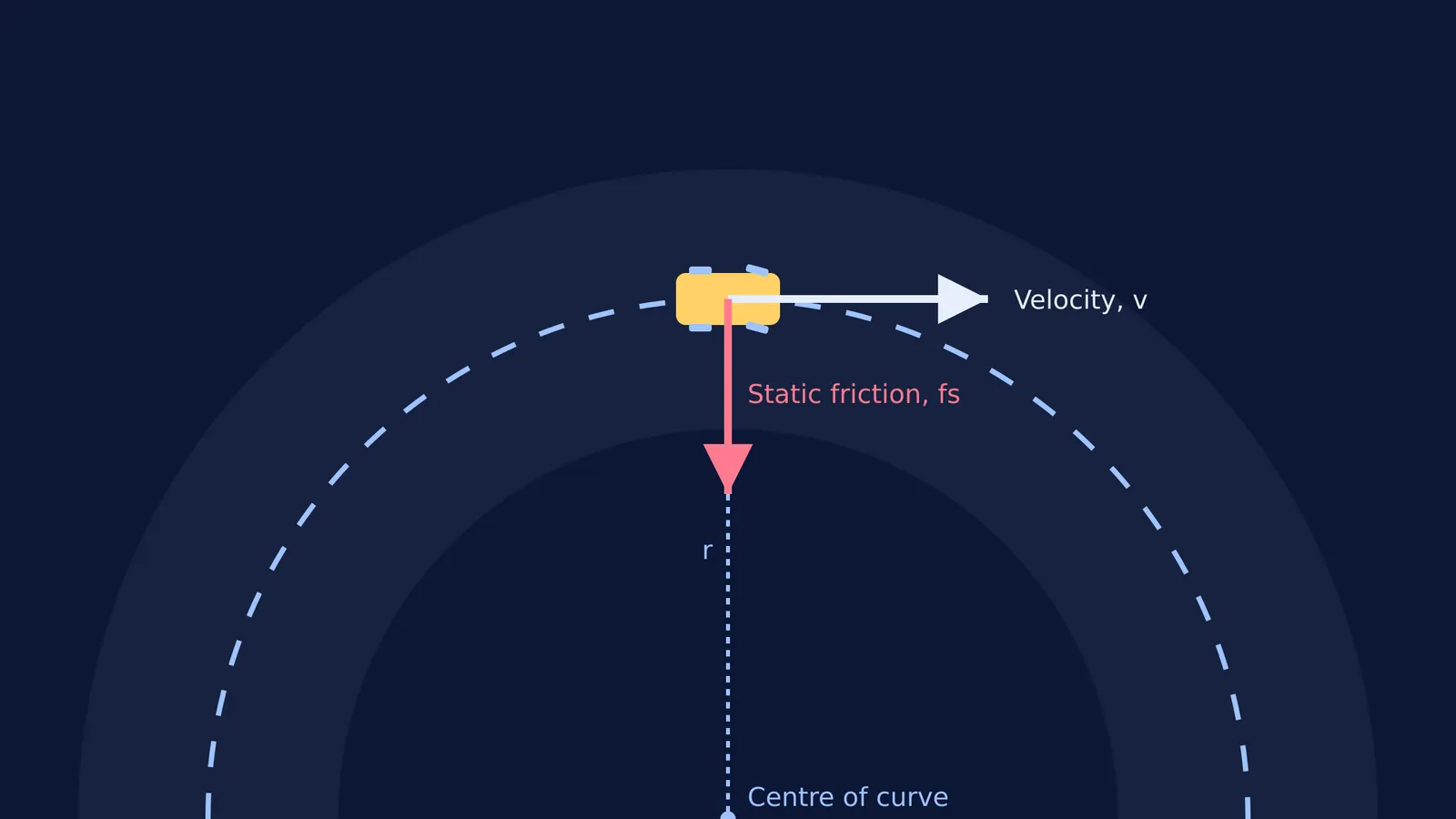
Because there is no sliding between the bottom of the tyre and the road surface, the frictional force is static. This static friction acts perpendicularly to the direction the car is travelling, pointing straight toward the centre of the curve. This inward pull provides the centripetal force required to keep the car moving in a circle.
As OpenStax *University Physics Volume 1* explains, static friction provides the necessary centripetal force for a car turning on a level road. The grip is static precisely because the tyre does not slide sideways or forwards. If you are learning how these forces interact, you can map out the vectors in the Fermi Concept Library, where every concept in physics has its own lesson showing why velocity and friction are perpendicular during uniform circular motion.
What happens to kinetic friction?
Kinetic friction only enters the picture if you push the car beyond its limits. If the turn is too sharp or the speed is too high, the required centripetal force will exceed the maximum static friction the tyres can provide.
When this happens, the tyres lose their static grip and begin to slide across the asphalt surface. At that exact moment, the acting force transitions from static friction to kinetic friction. If you study static vs kinetic friction, you know that kinetic friction is generally weaker than maximum static friction, so the gripping force pulling the car inward drops suddenly. This sudden loss of centripetal force is why a car skids outward, away from the intended circular path, and why regaining steering control during a skid is so challenging for the driver.
How do you calculate the maximum safe speed?
We can calculate exactly when this loss of grip will happen. For a car to negotiate a flat turn safely, the centripetal force (F_c = mv²/r) must be less than or equal to the maximum available static friction (f_s = μ_s N).
Since the normal force (N) on a flat road is equal to the car's weight (mg), the equation for the maximum safe speed becomes: v_max = √(μ_s r g)
This equation reveals a fascinating fact: the maximum safe speed is independent of the car's mass. Whether you are driving a lightweight hatchback or a heavy SUV, if you share tyres with the same coefficient of static friction (μ_s) and take the same curve (radius r), your maximum safe speed will be identical. According to OpenStax, this formula shows that the safe speed limit on a curved road applies equally to a small car and a large vehicle, assuming their tyre compounds offer the same grip. The heavier vehicle requires more centripetal force, but its greater weight pushes down harder on the road, increasing the available static friction by the exact same proportion.
Understanding this distinction is not just a common exam question—it is the physics that keeps you safe on the road every day.


