

On this page
Swing a ball on a string in a vertical circle and two facts decide what happens. Gravity slows the ball on the way up, and a string can pull but never push. A simulation lets you watch both at once, so here is what to predict before you press play.
What is the minimum speed at the top of a vertical circle?
At the top, tension T and weight mg both point down, towards the centre, so T + mg = mv²/R. A string cannot push, so T can shrink to zero but no further. Set T = 0 and you get the limit.
The minimum speed at the top of a vertical circle of radius R is √(gR), the speed at which tension is zero and gravity alone supplies the centripetal force (HyperPhysics, Georgia State University).
For R = 1 m and g = 9.8 m/s², that is √9.8, about 3.13 m/s.
Why must the bottom speed be √(5gR)?
From bottom to top the mass rises 2R, so conservation of energy gives v_bottom² = v_top² + 4gR, the same relation the HyperPhysics vertical circle calculator uses. Put v_top² = gR and the bottom speed must be at least √(5gR). For R = 1 m that is √49 = 7.0 m/s.
Tension is always at right angles to the motion, so it does no work and energy is conserved. Mass cancels from every term, so the rule depends only on g and R.
Where is the tension largest?
At the bottom. There, tension points up and weight points down, so T = mv²/R + mg: the string must supply the centripetal force and hold up the weight. At the top, weight helps, so T = mv²/R − mg. Combined with the energy relation, tension at the bottom is always 6mg more than tension at the top, whatever the speed (HyperPhysics). Schoolphysics gives the same top and bottom equations and notes that tension is greatest at the bottom and least at the top.
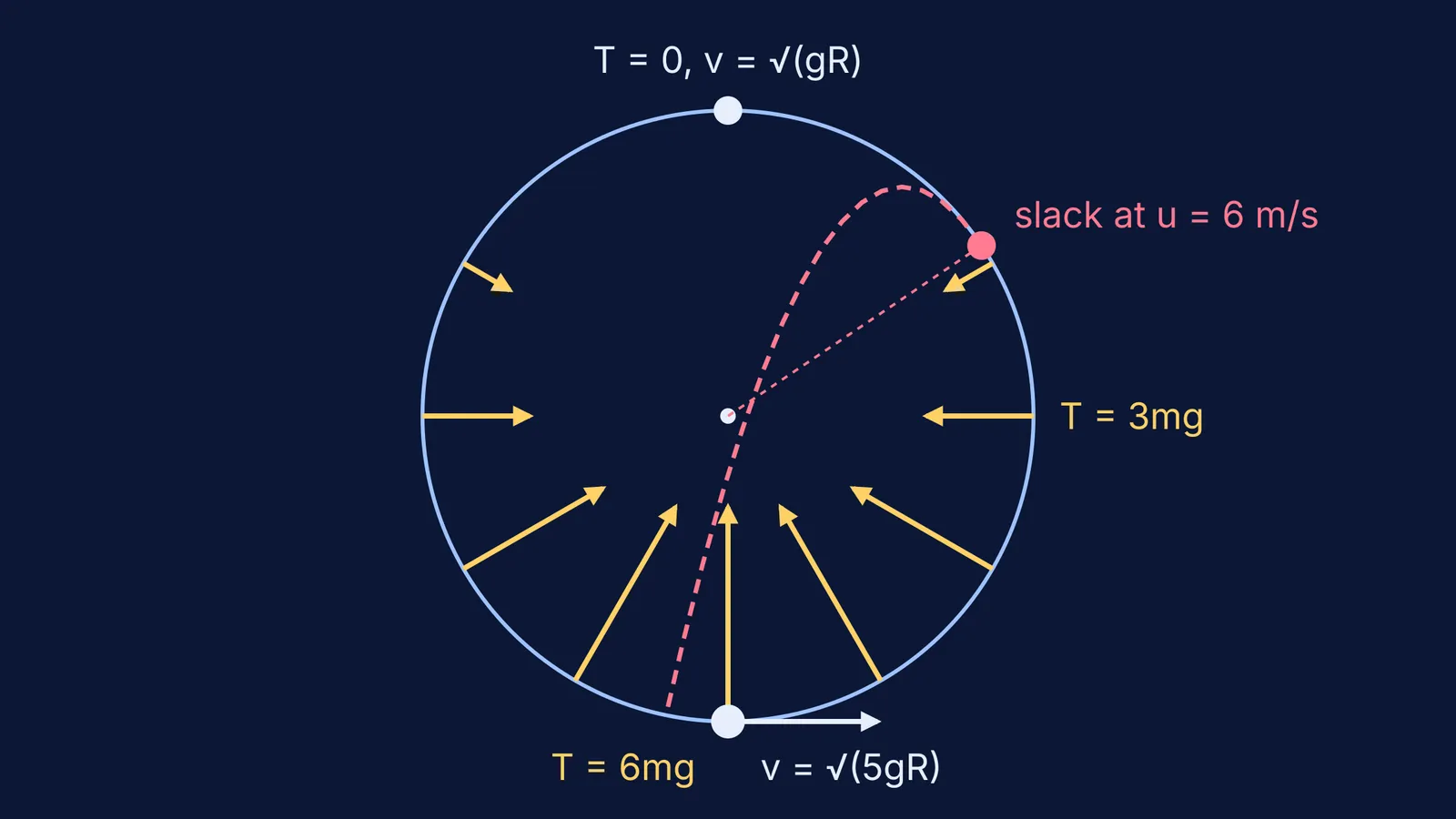
At exactly the critical speed, with θ measured from the bottom, the tension is T = 3mg(1 + cos θ). That is 6mg at the bottom, 3mg level with the centre and zero at the top. If a string is going to snap, it snaps near the bottom. The same idea gives string tension in a pendulum at any angle.
What happens to the string if the speed is too low?
Call the bottom speed u. There are three cases:
u ≤ √(2gR): the mass never rises above the centre. It swings back and forth like a pendulum and the string stays taut.
√(2gR) < u < √(5gR): the mass climbs above the centre, but tension reaches zero before the top. The string goes slack and the mass flies on as a projectile inside the circle until the string jerks taut again.
u ≥ √(5gR): the mass completes the circle.
In the middle case, the string goes slack at height h = (u² + gR)/(3g) above the bottom. You get this by setting T = mu²/R − 2mg + 3mg cos θ equal to zero.
A four-run simulation plan
Set m = 0.2 kg, R = 1 m and g = 9.8 m/s², so mg = 1.96 N. Write each prediction down before you run it, and check the values against the HyperPhysics calculator.
u = 4 m/s, below √(2gR) ≈ 4.43 m/s. Predict: the mass rises to h = u²/2g ≈ 0.82 m and swings back. Bottom tension 5.16 N.
u = 6 m/s, between the limits. Predict: the string goes slack at h ≈ 1.56 m, about 124° round from the bottom, with the mass moving at about 2.34 m/s. Watch the path cut inside the circle. Bottom tension 9.16 N.
u = 7 m/s, the critical speed. Predict: the mass just completes the circle with zero tension at the top. Bottom tension 11.76 N, exactly 6mg.
u = 8 m/s. Predict: top speed √(64 − 39.2) ≈ 4.98 m/s, top tension 3.0 N, bottom tension 14.76 N. The difference is 11.76 N again.
Run 2 is the one to replay slowly. The Fermi Simulation Lab has interactive simulations for ideas like this one, which are easier to see than to read.
Which mistakes cost marks on vertical circle problems?
Using √(gR) as the bottom speed. It is the top speed; the bottom needs √(5gR).
Forgetting mg in the bottom tension. The string holds up the weight as well as turning the mass.
Treating a rod like a string. A light rod can push, so the mass may pass the top at almost zero speed, and the bottom minimum drops to √(4gR).
For practice, try our circular motion problems on banking and vertical circles, and tangential and radial acceleration in non-uniform circular motion. If your working breaks at one step, the Fermi Problem Library has worked problems with a step-by-step solver that explains the reasoning rather than printing an answer.
Run the four predictions above, then change R and check that √(5gR) still holds.


