On this page
Hold a yo-yo by its string and let go of the body. It drops, but slowly, spinning faster and faster as the string unwinds. That slowness is the whole lesson: some of the pull of gravity goes into spinning the yo-yo, not into dropping it.
Why does a yo-yo fall slower than g?
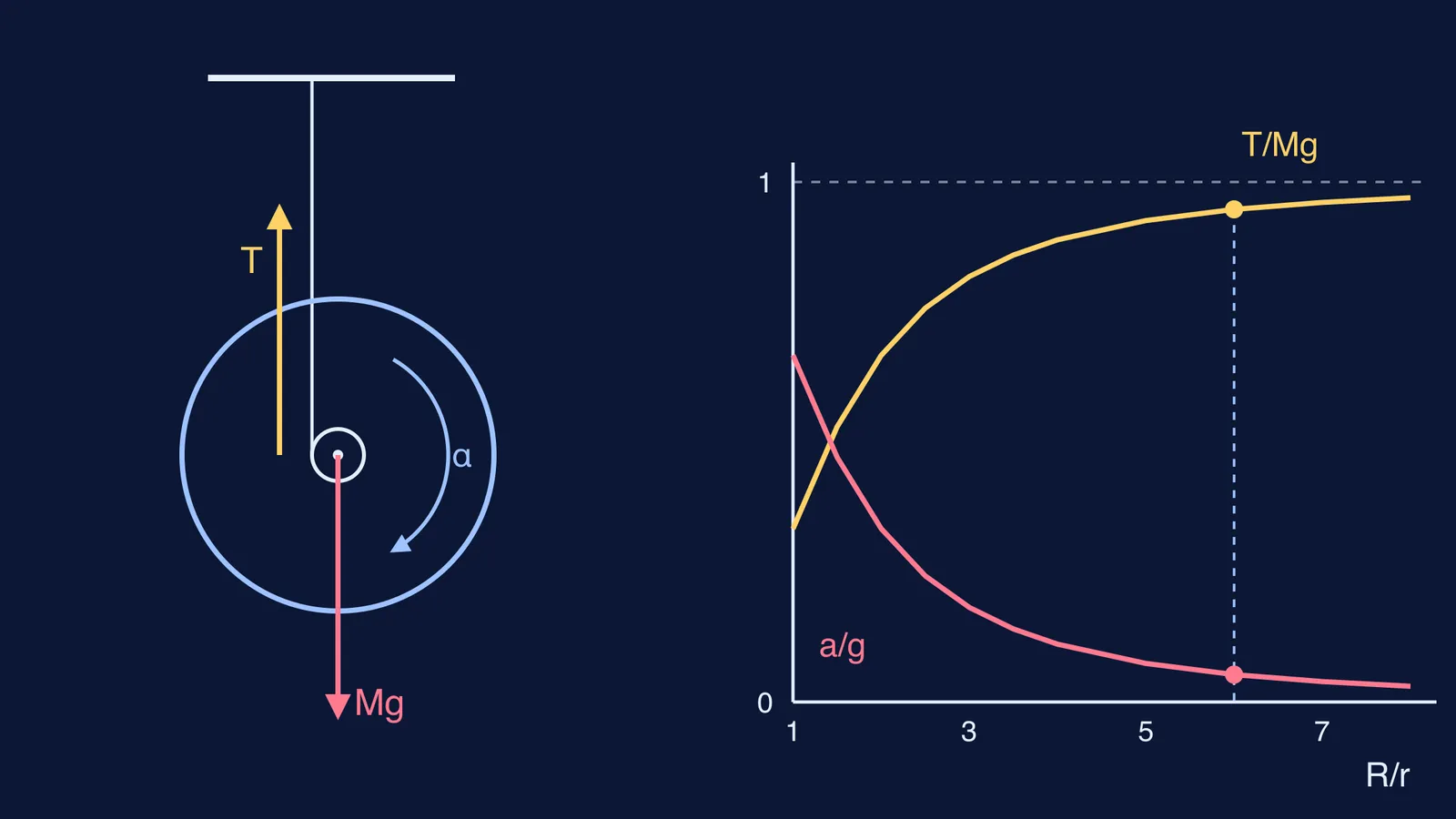
Two forces act on a falling yo-yo: its weight Mg pulling down at the centre, and the string tension T pulling up at the edge of the axle. The UC Santa Barbara physics lecture-demonstration notes on Maxwell's yo-yo put it plainly: since the wheel accelerates downward, T is less than Mg.
The tension does a second job. Because it pulls at distance r from the centre, it gives a torque Tr that spins the yo-yo up. A string that does not slip ties the two motions together: the centre drops by one axle circumference for every turn, so a = αr. The same three equations appear in the worked yo-yo problem in LibreTexts' Introductory Physics/12%3A_Rotational_Energy_and_Momentum/12.06%3A_Sample_problems_and_solutions).
How do you predict a yo-yo's acceleration from torque?
Write the three equations side by side:
Translation: Mg − T = Ma.
Rotation about the centre: Tr = Iα.
No slipping: a = αr.
From 2 and 3, T = Ia/r². Put that into 1 and solve. The falling yo-yo's acceleration is a = g/(1 + I/Mr²), the result given in the UCSB demonstration notes. The tension is then T = Mg − Ma, which is always less than Mg as long as the yo-yo has any moment of inertia at all.
The whole answer sits in one ratio, I/Mr². A heavy rim and a thin axle make it large, so the yo-yo creeps down. A small ratio lets it fall fast.
A worked example: a 60 g yo-yo
Model the yo-yo as a uniform disc of outer radius R = 3 cm, winding on an axle of radius r = 0.5 cm. For a uniform disc about its centre, I = ½MR², as derived in OpenStax University Physics, Volume 1. The axle's own small mass is ignored here.
I/Mr² = ½(R/r)² = ½ × 36 = 18.
a = g/(1 + 18) = 9.8/19 ≈ 0.52 m/s², about one-nineteenth of g.
T = Mg × 18/19 ≈ 0.95 Mg. With M = 0.06 kg, the weight is 0.59 N and the tension about 0.56 N.
Over 0.8 m of string, the fall takes t = √(2L/a) ≈ 1.8 s. Dropped freely, the same yo-yo would take about 0.4 s.
At the bottom it moves at about 0.9 m/s but spins at about 180 rad/s, nearly 29 turns a second. That is where most of the energy went.
Now change one thing at a time and predict before you calculate:
Double the axle to r = 1 cm: I/Mr² falls to 4.5, so a ≈ 1.8 m/s² and T ≈ 0.82 Mg.
Wind the string round the outer rim, so r = R: I/Mr² = ½, so a = 2g/3 and T = Mg/3.
Make it twice as heavy with the same shape: nothing changes, because M cancels in I/Mr².
The last one is the surprise. For the same shape, a heavier yo-yo does not fall faster.
Where does the yo-yo's energy go?
As the yo-yo drops a height h, Mgh is shared between ½Mv² and ½Iω², as in OpenStax's section on rolling motion. With ω = v/r, the spinning share is (I/Mr²)/(1 + I/Mr²), which is 18/19, about 95%, for the example above. Rolling down a slope works the same way; our post on which way friction acts on a ball rolling down an incline uses the same link between a = αr and torque.
If choosing the axis is the step that trips you, read which axis to take torque about, and how an AI tutor can check it.
How can you check the prediction yourself?
Try this order:
Write down a and T for the example before you measure anything.
Predict whether a thicker axle or a heavier rim makes the yo-yo fall faster or slower.
Time a real yo-yo over a measured drop and compare with t = √(2L/a). Expect some difference: a real yo-yo is not a uniform disc.
The Fermi Simulation Lab has interactive simulations for ideas that are easier to see than to read; its classical mechanics set covers forces, oscillators, orbits and rotating frames. For more practice, our rotational motion simulation post with three predictions to test uses the same predict-then-check method.
If you get T = Mg, or a = g, go back to step 2 of the equations above: the torque equation is the one that went missing.