On this page
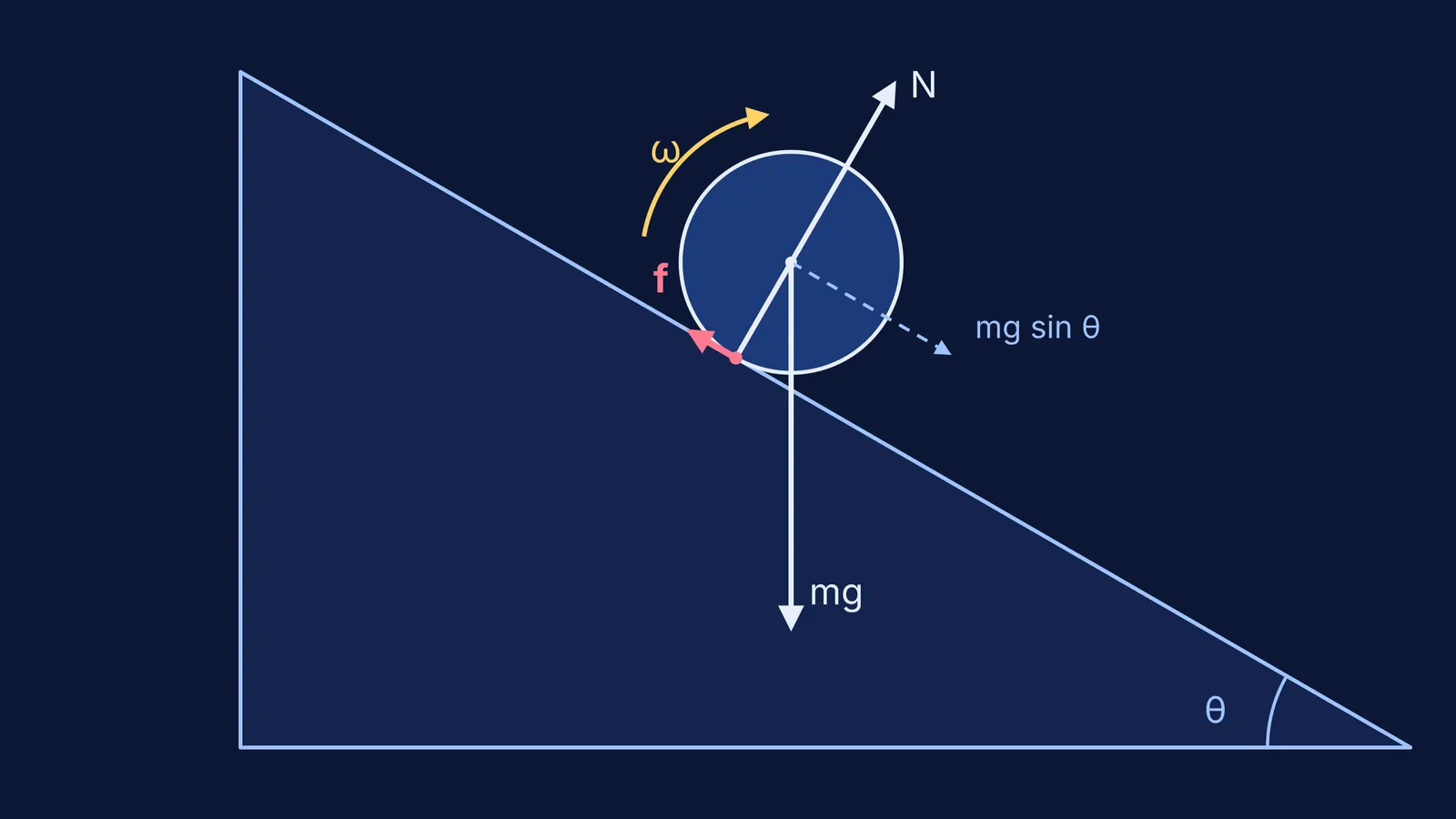
Before you read on, make a guess. A solid ball is let go on a rough ramp and rolls down without slipping. Does friction on the ball point up the slope or down the slope? Write your answer down with one line of reasoning.
"Up, because friction opposes motion" is the right answer for a shaky reason. The rule that settles it is narrower: friction opposes the slipping of the contact point, or its tendency to slip.
Which way does friction act on a ball rolling down a slope?
Up the slope. When a body rolls without slipping, the point touching the surface is at rest relative to it, so the friction is static and does no work (OpenStax University Physics, section 11.1).
Picture the ramp as ice. Gravity acts through the centre, so it has no torque about the centre: the ball would slide down without spinning, its bottom skidding downhill. Friction resists that skid, pointing uphill, and that push at the bottom is what spins the ball.
For a body of moment of inertia I and radius r rolling without slipping, OpenStax gives a = g sin θ / (1 + I/mr²), with a static friction force f = mg I sin θ / (mr² + I) acting up the incline (OpenStax, section 11.1). For a uniform solid sphere, I = (2/5)mR² (University of Illinois Physics Van). Put that in and you get a = (5/7) g sin θ and f = (2/7) mg sin θ.
Worked example: a 1 kg ball on a 30° ramp
With g = 9.8 m/s² and the OpenStax section 11.1 formulas:
Weight along the slope: mg sin 30° = 4.9 N, down the slope.
Friction: f = (2/7) × 4.9 = 1.4 N, up the slope.
Net force: 4.9 − 1.4 = 3.5 N, so a = 3.5 m/s², which is 5/7 of g sin θ.
Normal force: mg cos 30° ≈ 8.49 N.
Friction needed ÷ normal force = 1.4 ÷ 8.49 ≈ 0.165, the smallest μs that works. That matches OpenStax's condition μs ≥ tan θ / (1 + mr²/I), which for a sphere becomes μs ≥ (2/7) tan θ.
We work through how that minimum changes for rings, discs and shells in minimum friction for pure rolling on an incline, shape by shape.
What changes when the ball slips?
If the ramp is too smooth, static friction cannot supply the 1.4 N needed, and the bottom of the ball skids downhill. Friction becomes kinetic, still points up the slope, with size fk = μk mg cos θ, so the centre accelerates at a = g(sin θ − μk cos θ) (OpenStax, section 11.1).
Take the same 1 kg ball with μk = 0.1. Then fk = 0.1 × 8.49 ≈ 0.85 N up the slope, and a = 9.8 × (0.5 − 0.0866) ≈ 4.05 m/s². That beats pure rolling's 3.5 m/s², and the spin lags the speed. On a frictionless ramp, a = g sin θ = 4.9 m/s² and a ball released from rest never spins.
On level ground, friction keeps acting on a skidding ball until speed and spin match; see when a sliding ball starts pure rolling.
Does friction still point up the slope when the ball rolls uphill?
Yes. Rolling uphill, gravity slows the centre, the spin must slow to match, and uphill friction at the bottom gives that slowing torque. The equations are unchanged, so f = (2/7) mg sin θ up the slope for a solid sphere, whichever way it moves.
Friction points down the slope only if the bottom skids uphill, for example a ball launched downhill with heavy topspin. Friction can even point forward on level ground, as in a cylinder pulled at the top.
How do you test your guess in a simulation?
Treat each run as a prediction. Before pressing play, write down the direction of friction, whether it is static or kinetic, and whether the acceleration beats 3.5 m/s² on a 30° ramp. Use a ramp simulation where you can set μ and the angle, or a real ball on a tilted board. The Fermi Simulation Lab has interactive simulations for the ideas that are easier to see than to read. Expected results follow the OpenStax rolling formulas above.
Rough ramp at 30°, ball from rest. Predict: up the slope, static, a ≈ 3.5 m/s².
Lower μ below 0.165. Predict: slipping, friction still up the slope but kinetic, a above 3.5 m/s².
Set μ to zero. Predict: no spin at all, a = 4.9 m/s².
Keep μ = 0.2 and raise the angle. Predict: slipping starts once tan θ passes 0.7, about 35°.
Push the ball up the slope. Predict: friction up the slope the whole way.
If a result surprises you, redo the worked example. The Fermi Problem Library has worked problems with a step-by-step solver that explains the reasoning rather than printing an answer. Then check the guess you wrote at the top: your reason, not just your answer.