

On this page
Put a ball, a disc and a ring on the same rough ramp and let go. Some may roll cleanly while others skid. One inequality decides which, and once you can derive it, a whole family of JEE rolling questions becomes routine.
What is the minimum coefficient of friction for pure rolling on an incline?
For rolling without slipping down an incline of angle θ, the coefficient of static friction must satisfy μs ≥ tan θ/(1 + mr²/I), as derived in OpenStax University Physics, section 11.1.
Write the moment of inertia as I = mk², where k is the radius of gyration. The condition then becomes μ min = tan θ/(1 + R²/k²).
The same OpenStax section works out the solid-cylinder case as μs ≥ (1/3) tan θ. It also explains that static friction does no work in pure rolling, because the contact point is momentarily at rest. Friction is needed, but no energy is lost to it. Our explainer on energy and friction in rolling without slipping goes through that energy side in more detail.
How do you derive μ min = tan θ/(1 + R²/k²)?
Take the incline direction as positive downhill. Friction f acts up the slope at the contact point. If you are unsure about the components, our guide to resolving forces on an inclined plane covers the sin-cos choice.
Translation: mg sin θ − f = ma.
Rotation about the centre: fR = Iα = mk²α.
Rolling condition: a = Rα, so f = m(k²/R²)a.
Substitute into step 1: a = g sin θ/(1 + k²/R²). This matches the OpenStax result for a rolling body's acceleration.
So the friction needed is f = mg sin θ/(1 + R²/k²).
Static friction can supply at most μN, and N = mg cos θ. Requiring f ≤ μ mg cos θ gives μ ≥ tan θ/(1 + R²/k²).
Which shape needs the most friction to roll?
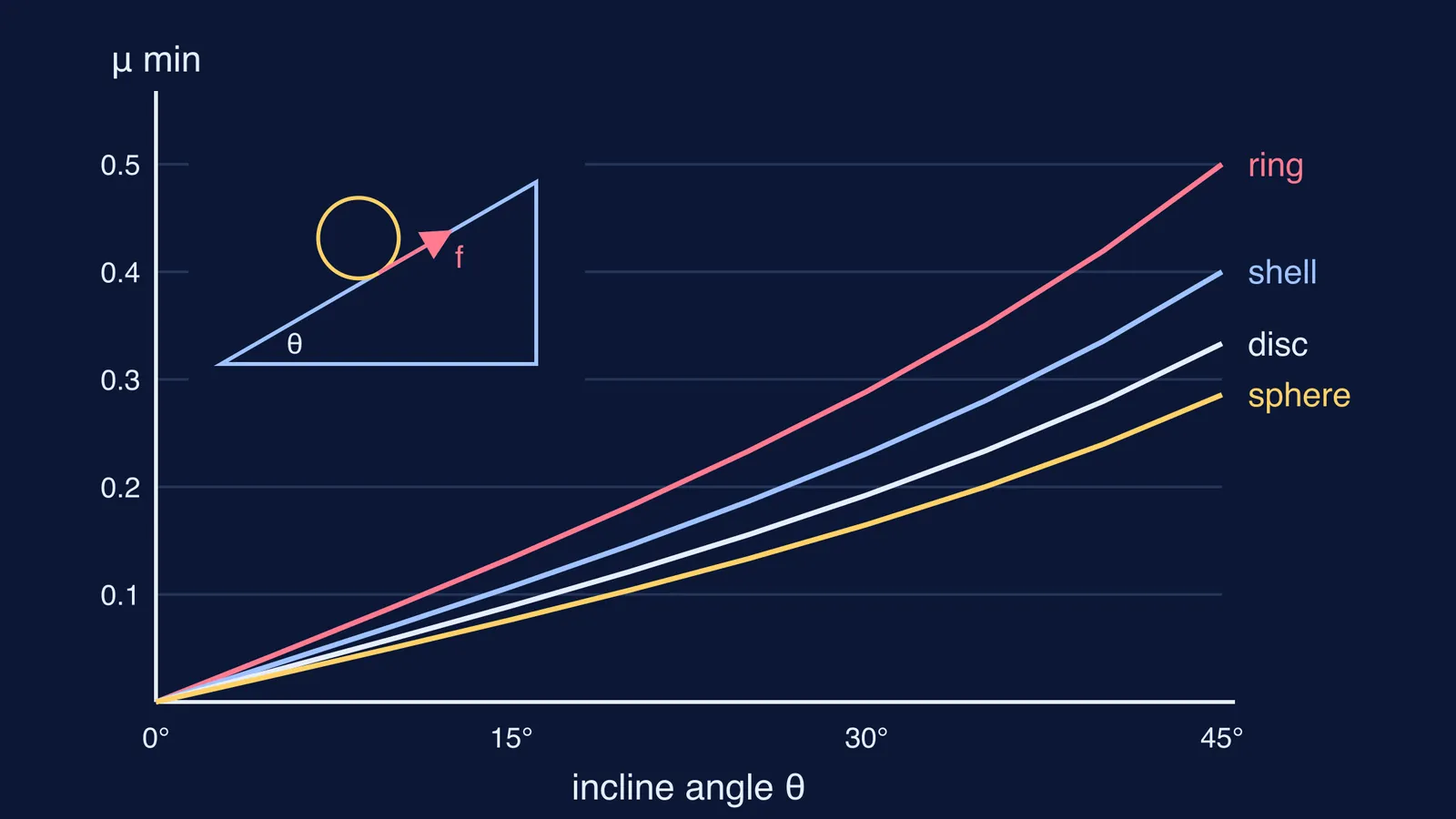
The standard moments of inertia in OpenStax Figure 10.20 are 2/5 MR² for a solid sphere, 2/3 MR² for a thin spherical shell, 1/2 MR² for a solid cylinder or disc and MR² for a hoop. Putting each k²/R² into the formula gives:
Solid sphere: k²/R² = 2/5, so μ min = tan θ/(1 + 5/2) = (2/7) tan θ.
Disc or solid cylinder: k²/R² = 1/2, so μ min = (1/3) tan θ.
Thin spherical shell: k²/R² = 2/3, so μ min = (2/5) tan θ.
Ring or hoop: k²/R² = 1, so μ min = (1/2) tan θ.
The further a body's mass sits from its axis, the more torque it needs to keep its spin in step with its speed, so the more friction it needs. Of these four shapes, the ring needs the most friction and the solid sphere needs the least.
Worked example: which bodies roll on a 30° ramp with μ = 0.18?
Take tan 30° = 0.577 and compare each body's requirement with the available μ = 0.18.
Solid sphere: (2/7)(0.577) = 0.165. That is below 0.18, so it rolls without slipping.
Disc: (1/3)(0.577) = 0.192. That is above 0.18, so it slips.
Spherical shell: (2/5)(0.577) = 0.231, so it slips.
Ring: (1/2)(0.577) = 0.289, so it slips.
Now turn the question round: what is the steepest ramp on which each body still rolls, with μ = 0.18? Rearranging gives tan θ max = μ(1 + R²/k²). That is 0.63 for the sphere (about 32.2°), 0.54 for the disc (about 28.4°), 0.45 for the shell (about 24.2°) and 0.36 for the ring (about 19.8°).
Once a body slips, friction becomes kinetic, μk N, and you must find a and α separately. Exam questions can test this switch.
What mistakes do students make with this result?
Writing f = μN in a pure-rolling problem. In pure rolling, friction is whatever value the rolling condition demands, up to μN. Find it from the equations, not from μ.
Flipping k²/R² and R²/k², which gives 5/7 tan θ for a sphere instead of 2/7.
Assuming friction always acts up the slope. It does here, but a body pulled at the top can feel friction forward. Our worked case of a cylinder pulled at the top shows why.
Memorising four separate answers. Memorise the one formula and the four k²/R² values instead.
If a step in the derivation still feels shaky, the Fermi Problem Library has worked problems with a step-by-step solver that explains the reasoning rather than printing an answer. For a gap in the underlying idea, such as radius of gyration or torque, the Fermi Concept Library gives each physics concept its own lesson.
Try it yourself next: redo the worked example for a hollow cylinder on a 37° ramp before you look at any solution.


