

On this page
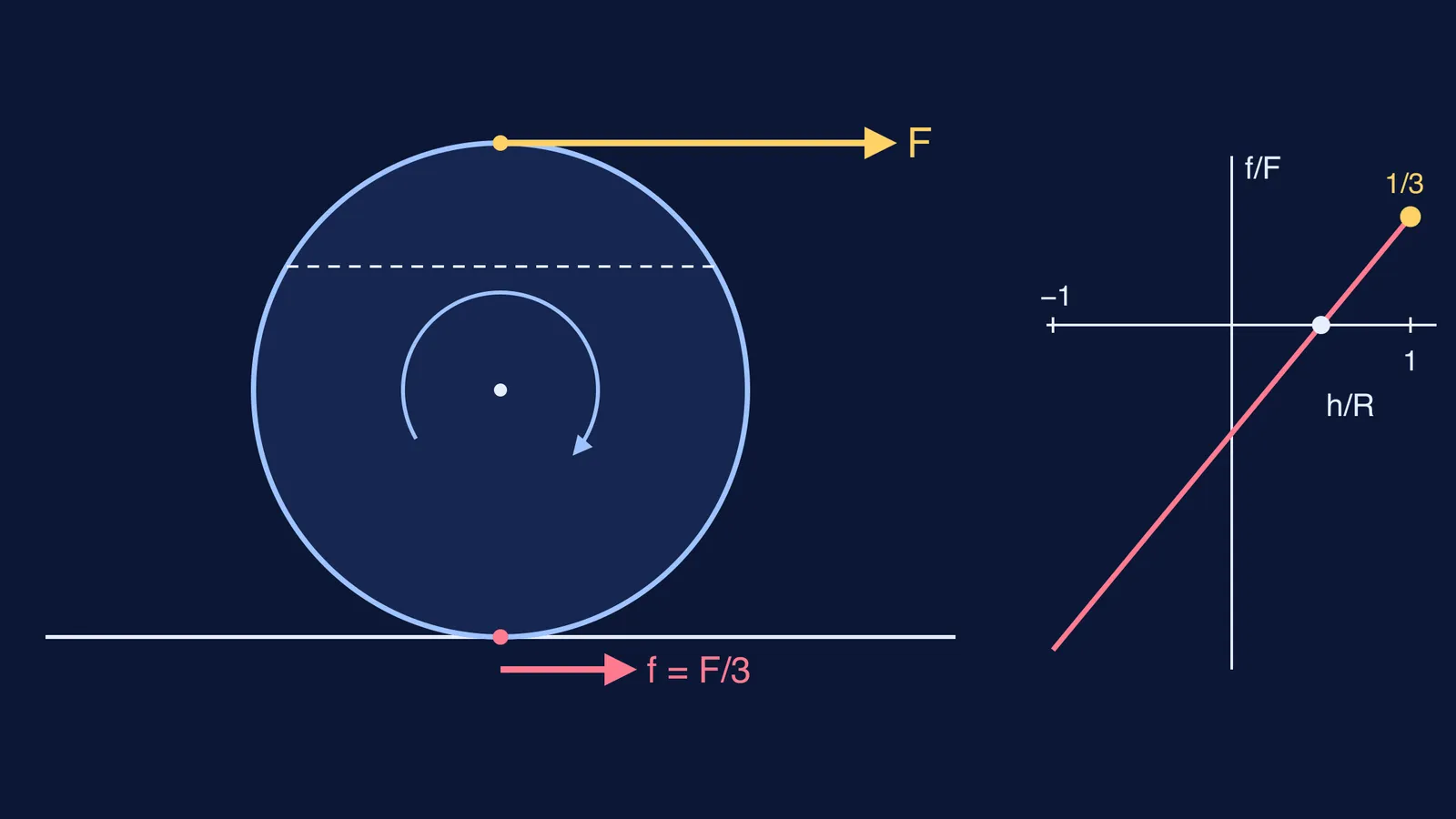
A string is wound over a solid cylinder and you pull it horizontally from the very top. The cylinder rolls without slipping. Which way does friction act? A common first answer is "backwards, because friction opposes motion". Here it acts forwards, and once you see why, this whole family of problems becomes one method.
Which way does friction act when you pull a cylinder at the top?
Start with what rolling without slipping demands: the centre's acceleration equals the radius times the angular acceleration, a = Rα (OpenStax University Physics, section 11.1).
Now imagine the floor were ice. A force F at the top does two jobs. It pushes the centre forward, giving a = F/M. It also has a lever arm R about the centre, so it spins the cylinder with α = FR/I. For a solid cylinder I = MR²/2 (the value OpenStax uses in the same section), so Rα = 2F/M. The rim wants to turn twice as fast as the centre moves, and the bottom point would slide backwards over the floor.
Static friction opposes that slide, so on the cylinder it points forwards. Forward friction adds to the push on the centre, and its torque about the centre opposes the spin. Both bring a and Rα back into step.
In his MIT 8.01 lecture on a yo-yo pulled by a string, Peter Dourmashkin notes that, unlike a wheel rolling freely on a level floor, the static friction is not zero, and "static friction depends on everything else that's happening in the system" (MIT OpenCourseWare 8.01, lecture 36 transcript). That is why you cannot fix its direction before writing the equations.
How do you find the acceleration and the friction?
Take friction f as forward, mass M, radius R.
Forces on the centre: F + f = Ma.
Torques about the centre (F spins it forward, f spins it back): FR − fR = (MR²/2)(a/R), so F − f = Ma/2.
Rolling condition a = Rα, already used in step 2.
Add the first two: 2F = (3/2)Ma, so a = 4F/3M. Put that back into the first: f = F/3, forwards. Had you guessed backwards, you would get f = −F/3, and the minus sign would tell you to flip it. That is the safe habit: pick a direction, solve, and let the sign correct you.
What does a worked example with numbers look like?
A solid cylinder of mass 2 kg and radius 0.1 m is pulled at the top with F = 6 N. Take μs = 0.2 and g = 9.8 m/s².
Acceleration: a = 4(6)/(3 × 2) = 4 m/s², so α = a/R = 40 rad/s².
Friction: f = 6/3 = 2 N, forwards.
Check: F + f = 8 N = Ma. Torque (6 − 2)(0.1) = 0.4 N m, and Iα = ½(2)(0.1)²(40) = 0.4 N m.
Will it slip? Static friction can supply at most μs times the normal force, here μsMg, the same limit the MIT lecture uses. That is 0.2 × 2 × 9.8 = 3.92 N, more than the 2 N needed, so it rolls. Since f = F/3, slipping begins only once F exceeds 3μsMg, about 11.8 N.
Notice friction is 2 N, not 3.92 N; our post on why static friction is not always equal to μsN explains that difference.
What changes if you pull at the centre, or use a ring?
Same equations, different numbers. Let h be the height above the centre where F acts.
Solid cylinder pulled at the centre (h = 0): f = F/3 backwards and a = 2F/3M. This was a JEE Main question on 10 April 2015 (online), with the answer F = (3/2)ma (question and solution).
Solid cylinder pulled at h = R/2: friction is zero. In general f = F(2h − R)/3R, so it changes sign exactly there.
Thin ring or hollow cylinder pulled at the top: with I = MR² (OpenStax uses this for a hollow-cylinder wheel), the equations give f = 0 and a = F/M. The force alone spins it at exactly the right rate.
The higher you pull, the more the force over-spins the body and the further friction swings forward. The same reasoning explains why friction acts forward on a car's driving wheels, and fixing friction's direction before solving is one of the five common rotational motion mistakes in JEE.
How should you practise these?
Solve one problem from each case above with friction's direction left unknown, and let the sign decide. Then change only h and predict the new direction before calculating. If torque signs keep tangling, the Fermi Problem Library has worked problems with a step-by-step solver that explains the reasoning rather than printing an answer. If rolling itself feels shaky, rebuild it with its lesson in the Fermi Concept Library before your next mock test.


