

On this page
The friction on the wheels of a moving car is one of the most common spots where students get their force vectors backward. You might assume friction always points opposite to a vehicle's motion. But for a car to accelerate from a stop, the friction on the driving wheels must push it forward.
Why does friction act forward on the driving wheels of a car?
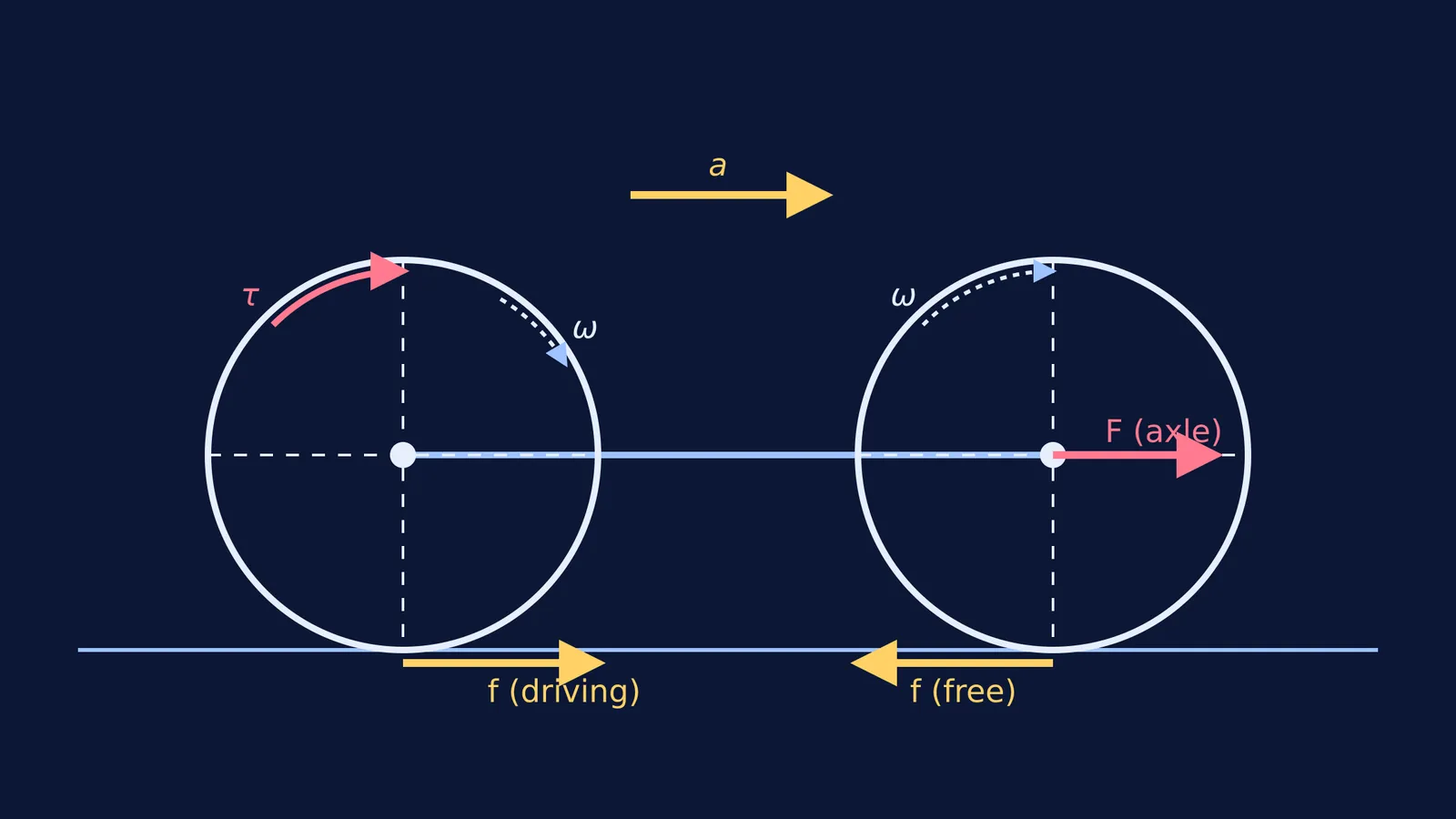
The engine does not push the car directly; it applies a torque to the driving wheels, making them rotate. As the tire turns, the bottom of the tire pushes backward against the road. Friction always opposes relative motion or the tendency to slip. Because the contact patch of the tire attempts to slip backward, the road exerts a static friction force that points forward. According to Boston University Physics, this forward static friction is the actual external force that accelerates the vehicle.
If you parked on frictionless ice and stepped on the accelerator, the wheels would simply spin in place. The tires would kick ice backward, but the car would go nowhere because there is no forward friction from the ground to propel it.
Why does friction act backward on free wheels?
The front wheels of a rear-wheel-drive car are not connected to the engine. They are free-spinning wheels pulled forward by the car's chassis and axle. Without friction, these wheels would simply skid forward along the ground without rotating at all.
To prevent this forward slipping, static friction must act in the backward direction. This backward friction provides the torque necessary to make the free wheel spin and roll smoothly. The car spends some of its forward driving force dragging these free wheels along, which is why a backward frictional force appears on them.
What happens when the car reaches a constant speed?
When a vehicle accelerates, the friction forces must be large. But what happens when you hit cruising speed on the highway? Once the vehicle is moving at a constant speed, the net force must be zero. The forward friction on the driving wheel only needs to be large enough to overcome opposing resistance forces, such as air resistance and rolling resistance.
Similarly, the friction on the non-driving wheel drops significantly. It only needs to provide enough torque to maintain the wheel's constant rotation against the friction in the axle bearings.
Is the friction static or kinetic?
As long as the tire rolls smoothly without skidding, the friction at the contact patch is static friction. This is because the specific point on the tire touching the ground is instantaneously at rest relative to the road. The velocity of any point on a rolling tire is the vector sum of the car's linear velocity and the wheel's rotational velocity. At the bottom of the tire, these two velocities are equal and opposite, resulting in a net velocity of zero.
Kinetic friction only takes over if the wheel locks up during a hard stop and skids, or if the driver accelerates so hard that the tires spin out. You can explore a similar balancing act in rotational dynamics when calculating the tension of pulling a spool by its string to see which way it rolls. We also see this strict distinction between static and kinetic forces when finding the angle of repose and angle of friction for an object resting on an incline.
How can you use this in your exam prep?
Rotational motion problems love to test whether you know which way friction points. A classic trap in JEE Main, JEE Advanced and NEET-UG exams is presenting a bicycle with pedalled rear wheels and asking for the friction directions on both tires. If you just memorise "friction points backward," you will lose marks.
If you are struggling to picture why the contact point is at rest or how the forces balance, try the Fermi Problem Library. You can drop in your textbook problem, and Fermi's AI tutor will help you work out the free-body diagram step by step. Instead of just handing you the answer, it asks you to identify the slipping tendency first, ensuring you understand the physics behind the forces.
Here is a quick checklist for solving wheel friction problems:
Identify the driving wheels (pedalled or engine-driven) versus the free wheels.
For driving wheels, friction points in the direction of the vehicle's acceleration (forward).
For free wheels, friction points opposite to the vehicle's acceleration (backward).
Verify that the point of contact is at rest to confirm you should use the coefficient of static friction.
In constant velocity problems, balance the forward friction with drag and rolling resistance.


