

On this page
Push a ball along a rough floor with no spin and it does not roll straight away. Its bottom skids, kinetic friction acts, and the ball's speed falls while its spin rises. Pure rolling begins when the two meet, at v = ωR. It is a classic rotational-mechanics problem for JEE Main and JEE Advanced, and you can solve it two ways that must agree.
What does friction do to a ball that slides without spinning?
At the start the centre moves forward at v₀ and ω = 0, so the contact point slides forward over the floor. Kinetic friction opposes that sliding, so it points backward. OpenStax University Physics makes the distinction: rolling without slipping involves static friction, while rolling with slipping involves kinetic friction (OpenStax, Rolling motion).
That one backward force does two jobs:
It slows the centre: ma = −μmg, so the deceleration is μg.
It gives a torque μmgR about the centre, in the forward-rolling sense. A solid sphere has I = (2/5)mR² about its centre (OpenStax, Calculating moments of inertia), so α = 5μg/(2R).
Weight and the normal force both pass through the centre, so they add no torque.
How long until a sliding ball starts pure rolling?
Write both equations as functions of time:
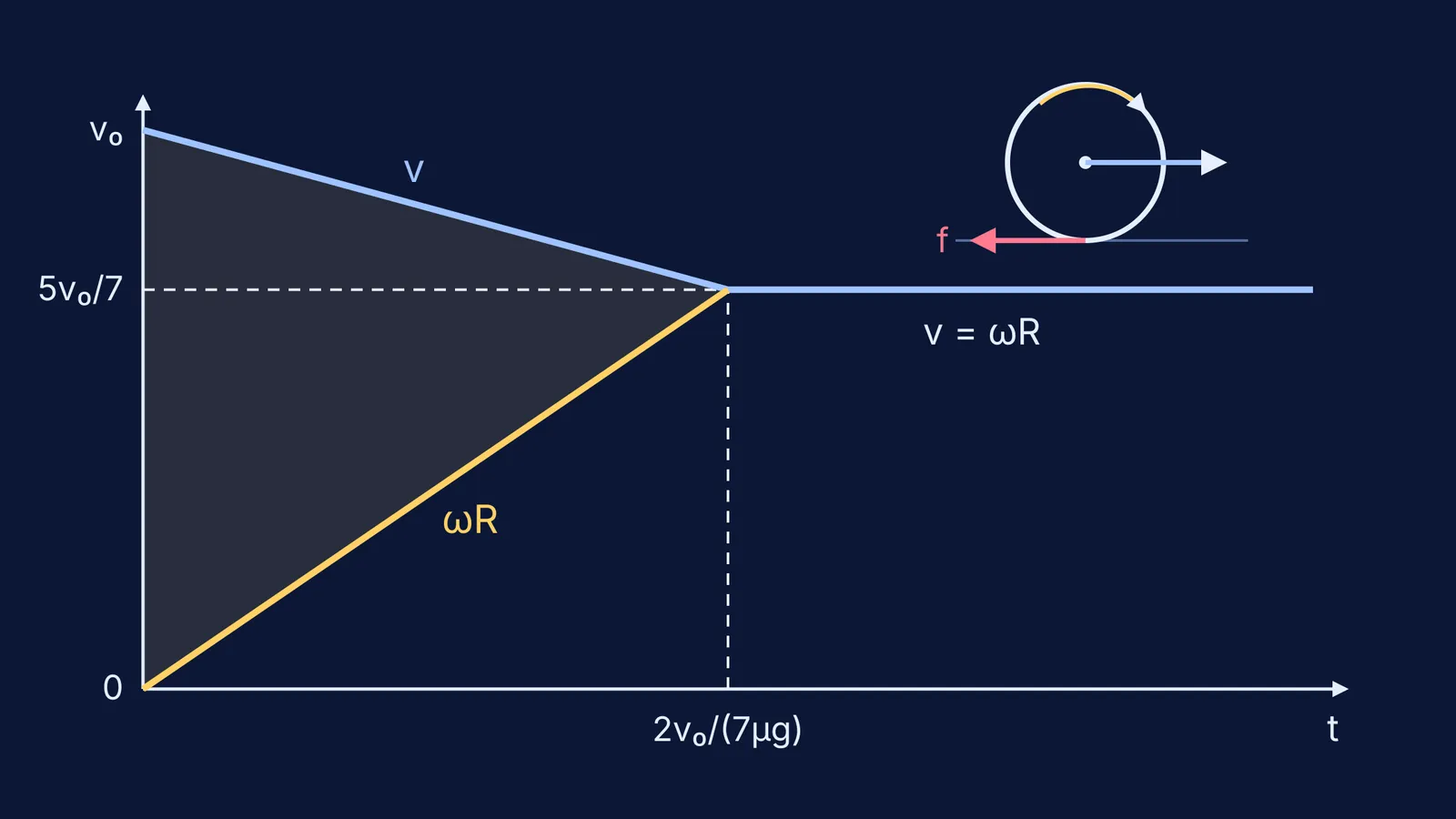
Translation: v = v₀ − μgt
Rotation: ωR = (5/2)μgt
Set v = ωR, the rolling condition (OpenStax). Then v₀ = (7/2)μgt, so t = 2v₀/(7μg).
Put that time back in and v = v₀ − 2v₀/7 = 5v₀/7. The μ cancels: a rougher floor gets the ball rolling sooner, but the final speed is the same.
The distance covered while slipping is s = v₀t − ½μgt² = 12v₀²/(49μg).
TU Delft physicist Timon Idema's open textbook derives the general version for any round body: the final speed is v₀/(1 + I/mR²) and the time is v₀/[μg(1 + mR²/I)] (Idema, Rolling and slipping motion). With I/mR² = 2/5 these give 5v₀/7 and 2v₀/(7μg), the same as above. The same page gives 2v₀/3 for a solid cylinder.
Can you find the final speed without the time?
Yes, with angular momentum about a point on the floor. Choose a fixed point on the line the ball touches. Friction acts along that line, so its torque about the point is zero, and the torques of weight and normal force cancel. Angular momentum about that point is conserved.
Before: L = mv₀R (moving, no spin).
After: L = mvR + Iω = mvR + (2/5)mR²(v/R) = (7/5)mvR.
Set them equal and v = 5v₀/7 in two lines. Use this route when a question asks only for the final speed; use forces and torques when it asks for time or distance.
A worked example with numbers
A solid ball is launched along a rough floor at v₀ = 7 m/s with no spin, with μ = 0.2 and g = 10 m/s². Find the time, distance, final speed and energy lost.
μg = 2 m/s², so t = (2 × 7)/(7 × 2) = 1 s.
Final speed = 5 × 7/7 = 5 m/s.
Distance = 7 × 1 − ½ × 2 × 1² = 6 m. The formula agrees: 12 × 49/(49 × 2) = 6 m.
Kinetic energy at the start is ½m(7²) = 24.5m J (m in kg). Rolling kinetic energy at the end is (7/10)mv² = 17.5m J. So 7m J, which is 2/7 of the starting energy, is lost.
Where did it go? The slip speed v − ωR falls steadily from 7 m/s to 0 over 1 s, so the ball slides 3.5 m against friction, and μmg × 3.5 = 7m J. The books balance.
Once the ball rolls on level ground, there is no slip left for friction to oppose. Our post on why pure rolling at constant speed needs no friction picks up the story from that moment.
Where do students usually go wrong?
Drawing friction forward because friction makes it roll. It opposes the slip of the contact point, which is forward here.
Keeping f = μN after rolling starts. Once v = ωR on level ground, friction drops to zero.
Using energy conservation from start to finish. Energy is lost while the ball slips; angular momentum about the floor point is what stays fixed.
Assuming every ball starts with no spin. A strike well above the centre can give so much topspin that ωR exceeds v, and then friction points forward. Our guide to where to strike a ball so it rolls at once finds the height that skips the sliding phase, and the common mistakes in rotational motion lists more traps.
If you get stuck on the direction of friction or the sign of a torque, the Fermi Problem Library has worked problems with a step-by-step solver that explains the reasoning rather than printing an answer. For ideas that are easier to see than to read, the Fermi Simulation Lab has interactive simulations.
Try it now: redo the worked example with μ = 0.1 and check that only the time and distance change.


