

On this page
When you roll a ball across a flat floor, it eventually stops. It is tempting to blame friction. However, in the physics of ideal rigid bodies, a ball in pure rolling at a constant speed on a level surface experiences zero static friction force. To understand why, we must look at the torques acting on the ball, separating ideal theory from the real world.
Why does pure rolling need no friction?
Pure rolling, or rolling without slipping, means that the instantaneous velocity of the point of the ball in contact with the ground is zero. The ball moves forward with a linear velocity v, and rotates with an angular velocity ω, perfectly matched so that v = Rω (where R is the radius).
At a constant velocity on a level surface, linear acceleration is zero (a = 0), and angular acceleration is zero (α = 0). Newton's first law states an object maintains its velocity unless acted upon by a net force (OpenStax). Similarly, Newton's second law for rotation (τ = Iα) dictates that with zero angular acceleration, the net torque must be zero.
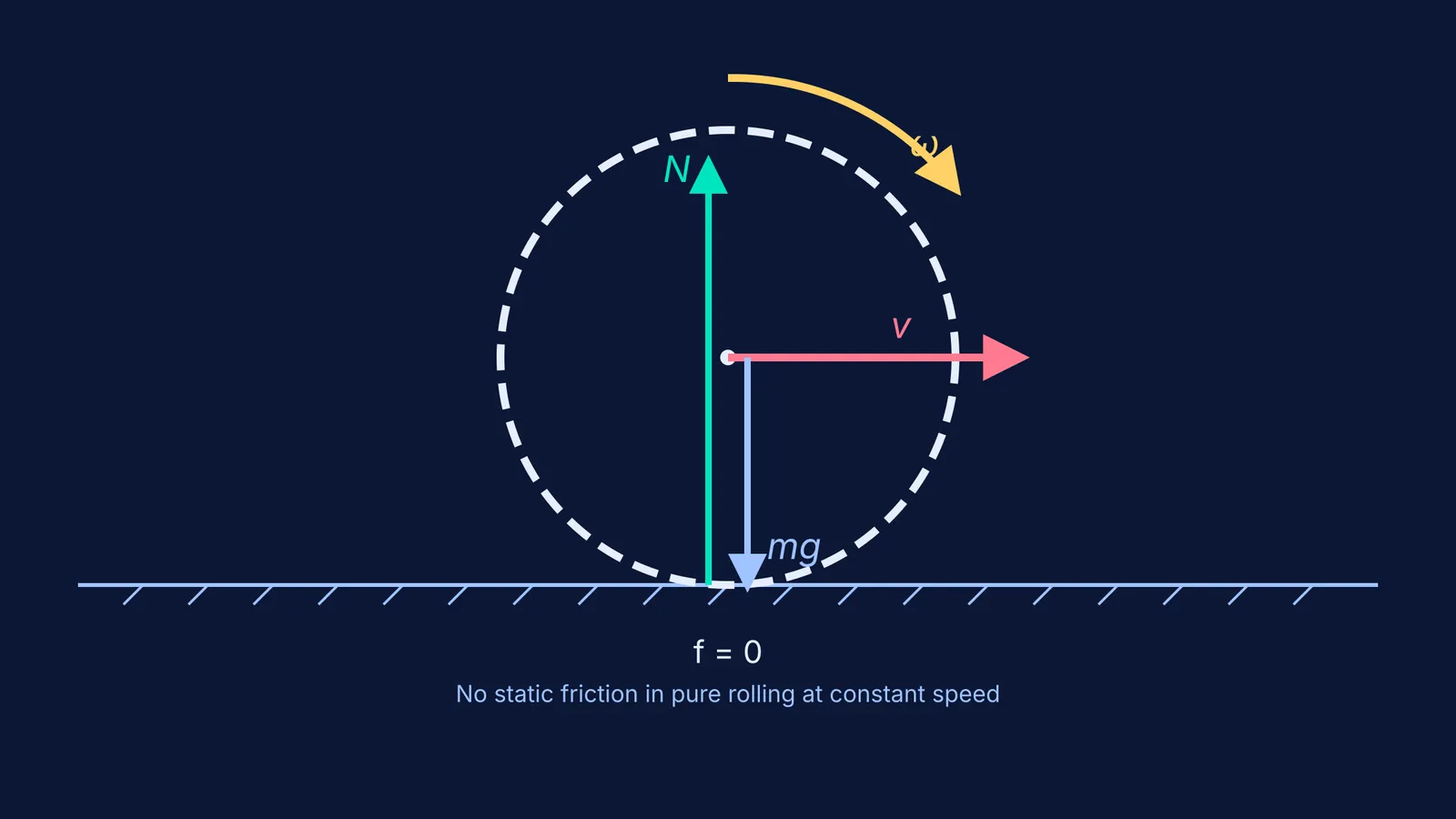
Let's map the forces acting on this ideal ball:
Gravity (mg) pulls straight down from the centre of mass.
Normal force (N) pushes straight up from the contact point, passing exactly through the centre of mass.
Neither vertical force creates a torque, because their line of action passes through the centre.
What if there were a static friction force at the contact point? Acting at distance R from the centre, friction would create a torque (τ = f × R). A net torque would cause angular acceleration. Since the ball rolls at a constant speed, angular acceleration is zero. Therefore, the static friction force must be zero (OpenStax).
The ball doesn't need friction to keep rolling, just as an asteroid in space doesn't need a push. Friction is only necessary to change its rotational state, such as when it rolls down a hill, which you can explore in Rolling without slipping: energy and friction on inclines.
What happens when you apply a force?
Things change when you push the ball or place it on a slope. If a horizontal force is applied to the centre, the ball tries to accelerate linearly. Without friction, it would slide. To maintain the "no-slip" condition, static friction steps in.
This friction provides the torque to spin the ball faster, ensuring angular acceleration matches linear acceleration (a = Rα). The amount and direction depend entirely on the external force, similar to the logic in Friction problems: static vs kinetic friction and blocks on blocks. For example, striking a billiard ball near the top creates a different frictional response than striking its centre.
Why do real balls stop?
If friction is zero, why doesn't a bowling ball roll forever? The answer is rolling resistance, which is entirely different from static sliding friction.
In reality, no ball or floor is perfectly rigid. As the ball rolls, its weight compresses the material at the contact point. This is why car tires bulge slightly where they meet the road.
Because of a property called hysteresis, materials take more energy to compress than they return when they expand (Wikipedia). As the ball rolls forward, the material at the front of the contact patch compresses, while the back recovers slowly.
This delay makes the pressure distribution asymmetrical. Consequently, the aggregate upward normal force shifts slightly forward of the ball's centre (Wikipedia).
Because the normal force N is no longer aligned with downward gravity mg, it creates a small backward torque. This retarding torque gradually bleeds the ball's kinetic energy into heat until it stops.
How do you approach rolling problems in exams?
When tackling rotational mechanics in the JEE or NEET, checking the acceleration is your first step. If a rigid sphere is rolling at constant velocity on a horizontal plane with no driving forces, immediately set static friction to zero. Only introduce friction for applied forces, slopes, or when finding an Angle of repose and angle of friction: the tan θ = μ result.
Use this quick checklist:
Identify the surface (horizontal or inclined).
Identify applied forces.
Check the velocity (constant or accelerating).
Apply τ = Iα and F = ma to solve for friction.
If you find these diagrams difficult to picture, the Fermi Concept Library has every concept in physics, chemistry, biology, mathematics and computing, each with its own lesson and its place in the map. For active practice, the Fermi Problem Library has worked problems with a step-by-step solver that explains the reasoning rather than printing an answer, helping you see when friction appears.


