

On this page
Push a ball along a rough floor with a sharp horizontal hit and it usually skids first, then settles into rolling. At one height the skid never happens. The same idea gives a bat its centre of percussion, one candidate for its sweet spot.
At what height should you hit a ball for pure rolling?
Take a solid ball of mass m and radius R on a rough floor. You give it a quick horizontal blow of impulse J at height h above the floor, which is a distance (h − R) above the centre. During the blow, floor friction is too small to matter, so only J acts.
Linear impulse gives the centre a speed v = J/m. Angular impulse about the centre gives a spin Iω = J(h − R), with I = (2/5)mR² for a solid sphere. Pure rolling needs v = ωR. Put the two together:
J/m = J(h − R)R / ((2/5)mR²)
h − R = (2/5)R
h = 7R/5
A horizontal blow at h = 7R/5, which is 7/10 of the ball's diameter above the floor, makes a solid ball roll without slipping immediately, as David Alciatore sets out in his technical proof on the centre of percussion of the cue ball.
For any round body, h = R + I/(mR): a ring needs h = 2R, a uniform disc h = 3R/2.
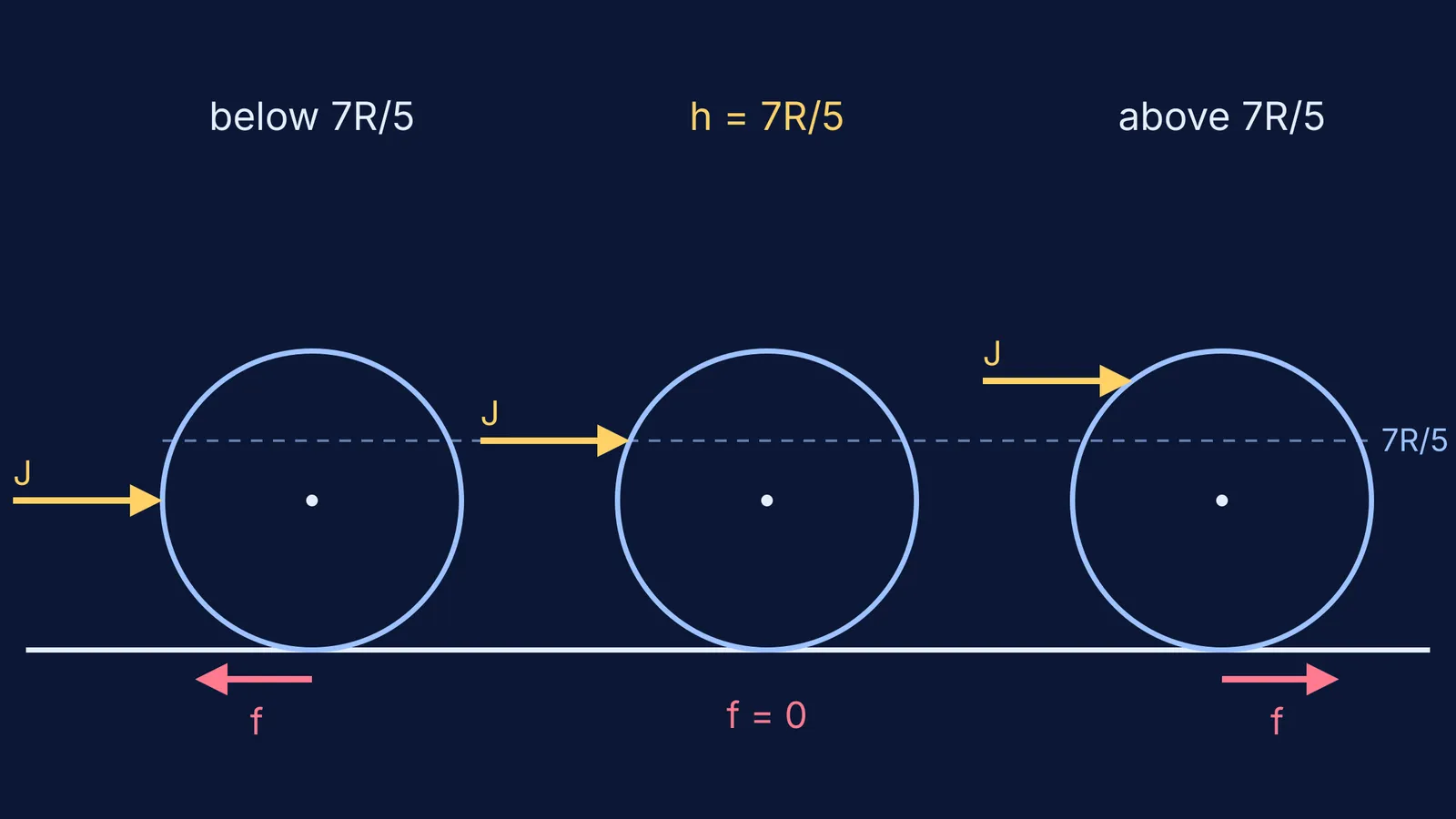
Which way does friction act above and below 7R/5?
Just after the blow, the contact point moves at v − ωR. Using the results above, this equals (J/m)(1 − 5(h − R)/(2R)). Kinetic friction acts against that sliding until it stops.
Hit below 7R/5 (including dead centre): v is larger than ωR, so the bottom of the ball skids forward. Friction acts backwards. It slows the ball and adds forward spin.
Hit exactly at 7R/5: v = ωR, there is no sliding, and friction is zero. The ball rolls on at the speed you gave it.
Hit above 7R/5: ωR is larger than v, so the bottom spins backwards against the floor. Friction acts forwards. It speeds the ball up and slows the spin.
Remember the last case: friction on a rolling body can point the way it moves.
Worked example: how fast does it end up rolling?
A solid ball of radius 3 cm is hit with J = 0.5 N s. Where should you hit it, and what is its final rolling speed if you hit at the centre instead? Take m = 0.2 kg.
Pure rolling height: h = 7R/5 = 1.4 × 3 cm = 4.2 cm above the floor.
Hit at 4.2 cm: v = J/m = 2.5 m/s, and it stays 2.5 m/s.
Hit at the centre (h = 3 cm): friction acts at the contact point, so it exerts no torque about that point. Angular momentum about the contact point is conserved: Jh = (7/5)mR v_final.
That gives v_final = 5Jh/(7mR) = (5/7)(J/m) = 1.79 m/s. Friction traded speed for spin.
Check the high hit: at h = 2R = 6 cm, v_final = (10/7)(J/m) = 3.57 m/s. The ball ends up faster than the 2.5 m/s it started with, because forward friction pushed it.
This "conserve angular momentum about the contact point" step is the same trick used in our guide to rolling without slipping on inclines and in angular impulse problems where a struck rod spins and moves.
Where is the sweet spot of a bat?
Now hold a bat at the handle and let a ball hit the barrel. The impact pushes the bat's centre of mass back and spins the bat about it. At one impact point, the push and the swing cancel at your hands: the centre of percussion.
For a uniform rod of length L pivoted at one end, the same algebra gives a distance from the pivot of I/(m × L/2) = (mL²/3)/(mL/2) = 2L/3. Daniel Russell of Penn State explains in his notes on the centre of percussion of bats that at this point the translational and rotational accelerations cancel at the pivot, so the hands feel no net force.
Real swings are less tidy: Russell notes the bat then pivots about a point beyond the handle's end, not under the hands, so this textbook point is not a reliable sweet spot. Rod Cross measured the forces on the hands and found that the vibration node and the centre of percussion together form a sweet spot zone where those forces are smallest, reported in the American Journal of Physics in 1998.
How should you practise this for JEE?
Use this checklist on any rotational-motion problem that starts with a sharp hit:
Write v = J/m and Iω = J × (distance of the line of the blow from the centre).
Compare v with ωR to find the direction of slip.
Draw friction against the slip, not against the motion.
For the final speed, conserve angular momentum about the contact point.
For more practice, the Fermi Problem Library has worked problems with a step-by-step solver that explains the reasoning rather than printing an answer. If moment of inertia or angular impulse still feels shaky, the Fermi Concept Library gives each physics concept its own lesson and its place in the map.


