

On this page
Put a pH meter's probe in lemon juice and a number appears within seconds. But the meter is not counting hydrogen ions. It is a voltmeter, reading a voltage in millivolts across a piece of glass, and turning that voltage into pH using two numbers it learnt from buffers a few minutes earlier. That explains both the calibration step in your practical and the 0.059 in your textbook.
How does a glass electrode pH meter work?
The probe ends in a thin bulb of special glass. According to Harvey's Analytical Chemistry 2.1 on LibreTexts/11:_Electrochemical_Methods/11.02:_Potentiometric_Methods), the first commercial glass electrodes used Corning 015 glass, roughly 22% Na2O, 6% CaO and 72% SiO2. The same source says that after several hours in water, the outer approximately 10 nm of the glass becomes hydrated and forms negatively charged sites.
The Analytical Sciences Digital Library module on pH electrodes/Analytical_Sciences_Digital_Library/Courseware/Analytical_Electrochemistry:_Potentiometry/05_pH_Electrodes) explains that metal ions near the surface can diffuse out while H+ ions pair with oxygen atoms near the glass surface. If the H+ activity outside differs from the H+ activity inside, the two surfaces end up with different charge, and a voltage appears across the glass.
Inside the bulb is a solution of fixed pH, 0.1 M HCl, with a silver/silver chloride wire; a second Ag/AgCl reference sits in KCl (Harvey/11:_Electrochemical_Methods/11.02:_Potentiometric_Methods)) and touches your sample through a porous frit (ASDL/Analytical_Sciences_Digital_Library/Courseware/Analytical_Electrochemistry:_Potentiometry/05_pH_Electrodes)). The glass itself barely conducts: its resistance is around 100 MΩ, according to the same ASDL module/Analytical_Sciences_Digital_Library/Courseware/Analytical_Electrochemistry:_Potentiometry/05_pH_Electrodes).
Why does the voltage change by 59 mV per pH unit?
The membrane obeys the Nernst equation. Harvey writes the cell as E = K + 0.05916 log aH+ at 25 °C, valid over a pH range of approximately 0.5 to 9 (Harvey/11:_Electrochemical_Methods/11.02:_Potentiometric_Methods)). Since pH = −log aH+, every one-unit rise in pH lowers the voltage by 59.16 mV.
The 0.05916 V is just 2.303RT/F at 298 K, which we unpack in where the 0.059 in the Nernst equation comes from. Because T sits in that term, the slope grows with temperature: put in 273 K and you get about 54.2 mV per pH. That is why many meters measure temperature and correct for it.
The ideal response has limits. At very high pH, generally above 10, most glass electrodes start responding to Na+ as well as H+, so the reading comes out lower than the true pH (ASDL/Analytical_Sciences_Digital_Library/Courseware/Analytical_Electrochemistry:_Potentiometry/05_pH_Electrodes)).
Why does a pH meter need calibration with buffers?
The slope is predictable; the constant K is not. The measured voltage also contains small junction potentials at the porous frit and asymmetry potentials from differences between the inner and outer glass surfaces, and the ASDL module says these are corrected by frequent calibration in standard solutions covering the pH range you plan to measure (ASDL/Analytical_Sciences_Digital_Library/Courseware/Analytical_Electrochemistry:_Potentiometry/05_pH_Electrodes)). A real electrode's slope can also differ a little from 59.16 mV, so two buffers are better than one.
The IUPAC recommendations on measurement of pH (Buck and colleagues, Pure and Applied Chemistry, 2002) treat pH as a conventional quantity. Primary standards are measured in a Harned cell, secondary standards are set from them, and the uncertainty of every later measurement is linked back to the primary standards by an unbroken chain of comparisons. A buffer is your link in that chain. For why buffers hold their pH so firmly, see how the bicarbonate buffer keeps blood pH at 7.4.
Worked example: a two-point calibration
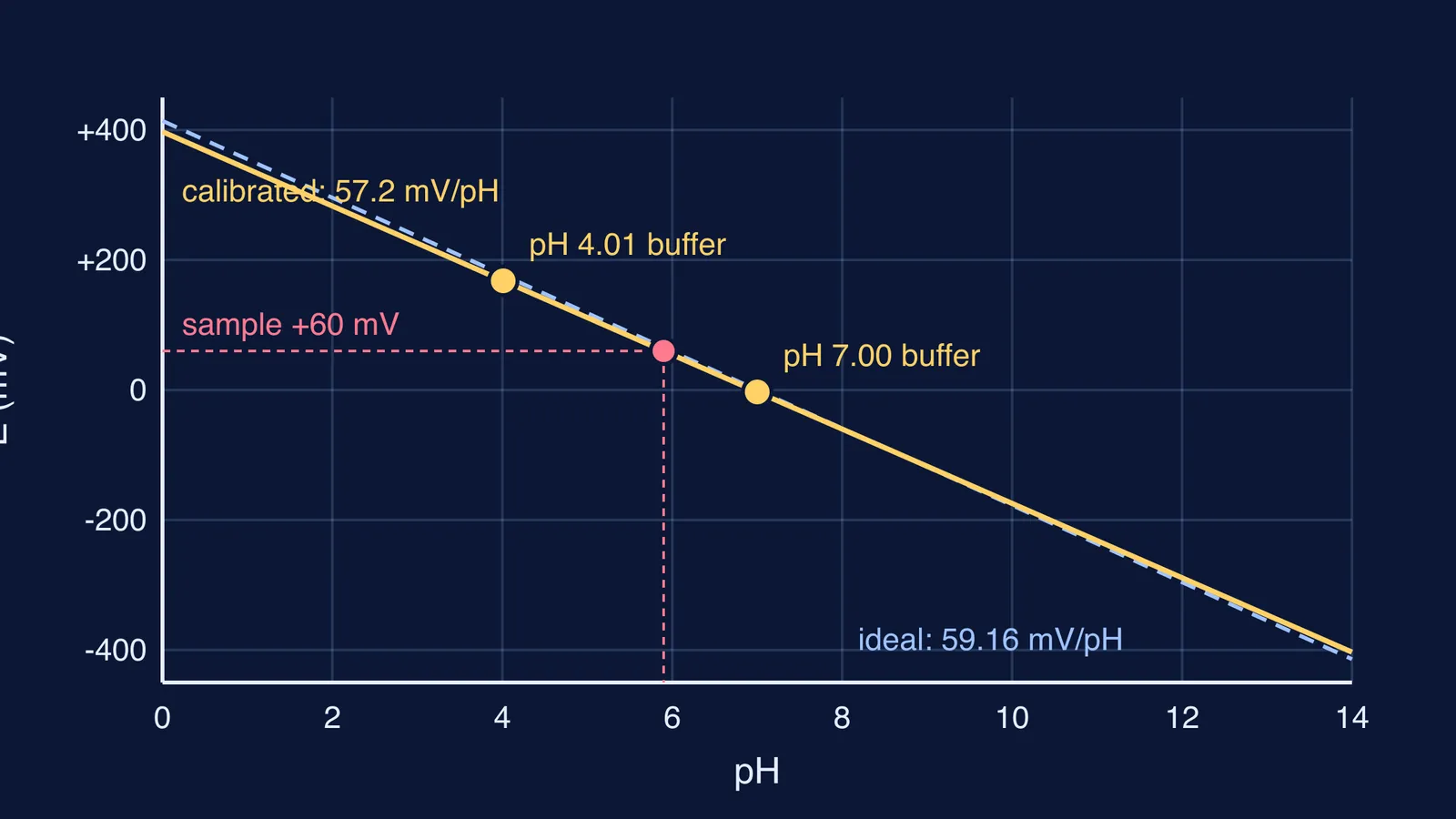
These readings are made up but typical. You dip the electrode in two buffers, then compare with the ideal 59.16 mV per pH from Harvey's Nernst equation/11:_Electrochemical_Methods/11.02:_Potentiometric_Methods):
pH 7.00 buffer: the meter reads −3 mV.
pH 4.01 buffer: the meter reads +168 mV.
Slope = (168 − (−3)) ÷ (4.01 − 7.00) = −57.19 mV per pH, which is 96.7% of the ideal 59.16.
Your sample reads +60 mV, so pH = 7.00 + (60 − (−3)) ÷ (−57.19) = 7.00 − 1.10 = 5.90.
If the meter had assumed the ideal slope and 0 mV at pH 7, it would have said 7.00 − 60 ÷ 59.16 = 5.99. Two buffers moved the answer by about 0.09 pH: calibration measures K and the real slope instead of trusting theory.
The same straight-line logic works for calculating pH from the EMF of a hydrogen electrode.
What should you check before measuring pH in the lab?
Keep the bulb wet; the hydrated layer is what responds.
Use two buffers that bracket your sample, with pH 7 as one of them.
Calibrate and measure at the same temperature, or use temperature compensation.
If the slope is far from 59 mV or the reading drifts, recalibrate before trusting it.
Expect readings above about pH 10 in sodium-rich samples to come out low (ASDL/Analytical_Sciences_Digital_Library/Courseware/Analytical_Electrochemistry:_Potentiometry/05_pH_Electrodes)).
If the Nernst equation itself is the shaky part, the Fermi Concept Library covers every concept in chemistry, each with its own lesson, from electrode potentials to buffers. For two-point EMF numericals, the Fermi Problem Library has worked problems with a step-by-step solver that explains the reasoning rather than printing an answer.


