

On this page
In electrochemistry problems for Class 12 and competitive entrance exams, the Nernst equation is nearly always introduced in a compact, pre-calculated form: E = E° − (0.059 / n) log₁₀ Q. For generations of students, this 0.059 V factor feels like a permanent physical constant, memorized alongside π or the speed of light. But treating 0.059 as an immutable law creates serious confusion the moment an exam question shifts the temperature away from room conditions.
Understanding exactly where this number originates transforms the Nernst equation from a rigid formula into an adaptable thermodynamic tool.
Where does 0.059 in the Nernst equation come from?
In 1889, German physical chemist Walther Nernst published his foundational paper on the electromotive activity of ions in Zeitschrift für Physikalische Chemie. By combining the laws of chemical thermodynamics with electrical work, Nernst established how electrode potential responds to reaction conditions:
E = E° − (RT / nF) ln Q
Here, E is the cell electromotive force, E° is the standard cell potential, n is the number of moles of electrons transferred in the balanced redox equation, and Q is the reaction quotient. You can see how cell notation and half-cell potentials combine in the Nernst equation when setting up complete galvanic cells.
The equation contains three fundamental physical quantities:
The universal molar gas constant, R, defined exactly as 8.314462618 J mol⁻¹ K⁻¹ in the CODATA recommendations at NIST.
The Faraday constant, F, defined by NIST CODATA as 96,485.33212 C mol⁻¹, representing the electric charge carried by one mole of electrons.
The absolute temperature, T, measured in Kelvin.
Because calculations in textbooks and lab manuals historically relied on common base-10 logarithm tables rather than natural logarithms, chemists converted the natural logarithm (ln) using the modulus factor ln(10) = 2.302585. Substituting ln Q = 2.302585 × log₁₀ Q rewrites the equation:
E = E° − (2.302585 RT / nF) log₁₀ Q
When standard bench experiments run at 25 °C (298.15 K), the constants bundle together into a single multiplier:
(2.302585 × 8.314463 J mol⁻¹ K⁻¹ × 298.15 K) / 96,485.33 C mol⁻¹ = 0.05916 V
Rounded to three significant figures, this yields 0.0592 V, and rounded to two significant figures, the familiar 0.059 V.
How does the pre-factor change if the temperature is not 25 °C?
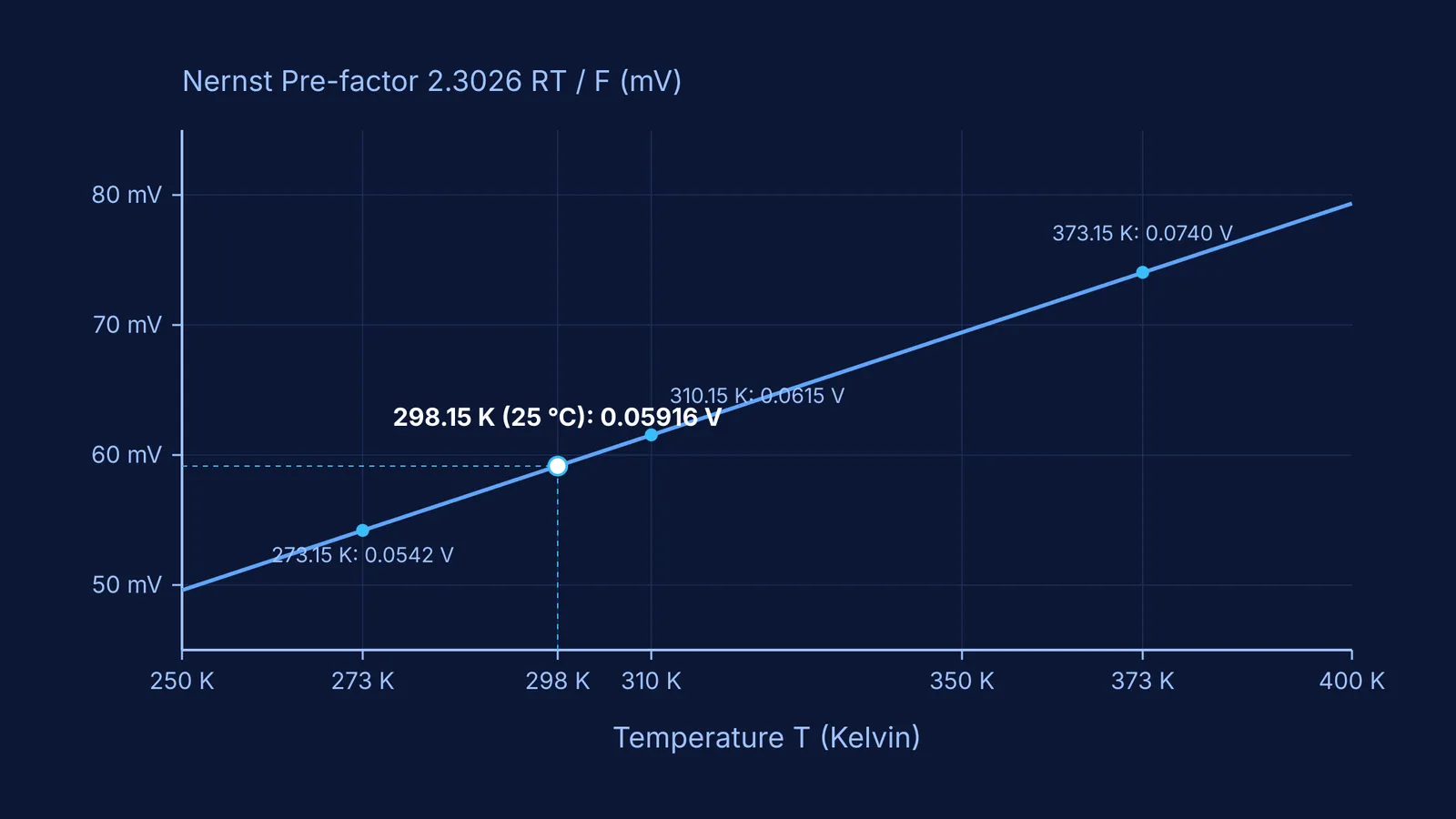
The term k_N(T) = (2.3026 RT / F) is directly proportional to temperature. Expressed as a slope per Kelvin using the values from NIST CODATA, the slope equals:
(2.302585 × 8.314463) / 96,485.33 = 1.9842 × 10⁻⁴ V K⁻¹ = 0.19842 mV K⁻¹
When a system operates away from 298.15 K, the pre-factor shifts predictably across different conditions:
At 0 °C (273.15 K, ice-water equilibrium): k_N = 0.0542 V (54.2 mV).
At 20 °C (293.15 K, cool laboratory conditions): k_N = 0.0582 V (58.2 mV).
At 25 °C (298.15 K, standard thermodynamic state): k_N = 0.05916 V (59.2 mV).
At 37 °C (310.15 K, human physiological body temperature): k_N = 0.0615 V (61.5 mV).
At 100 °C (373.15 K, boiling water bath): k_N = 0.0740 V (74.0 mV).
Relying on the standard 0.059 V factor at body temperature (37 °C) introduces an error of 3.9%, which distorts membrane potential calculations in biophysical chemistry. At 100 °C, using 0.059 V produces an error of over 20%.
What mistakes do students make on exams with this shortcut?
In a study of chemical education, researcher Ali Rıza Özkaya documented extensive confusion among prospective chemistry educators when interpreting electrochemical variables and standard states in the Journal of Chemical Education. Similarly, work by Shun Yu Tan and colleagues highlighted that rote memorization of electrochemical formulas prevents students from grasping how electrolyte concentrations and potentials interact (Journal of Chemical Education).
Three specific traps regularly cost students marks:
Applying 0.059 V to non-standard temperatures. Advanced questions frequently specify 300 K or 350 K. Rounding 2.303RT/F to 0.059 V produces numerical deviations that trigger automated rejections on integer-type or numerical-range questions.
Mixing natural and base-10 logarithms. If an equation uses ln Q, the coefficient is simply RT / nF, which evaluates to 0.02569 V (25.69 mV) at 298.15 K. Writing 0.059 with ln Q multiplies the concentration term by 2.303 twice.
Overlooking the temperature dependence of E°. Students often remember to adjust the Nernst slope but forget that standard potential E° also shifts with temperature according to the entropy change of the cell reaction, as explored in linking standard cell potential to Gibbs free energy and equilibrium constants.
This distinction is especially crucial when calculating voltage in concentration cells where only ionic molarity differs, where E° is zero and the entire observed voltage depends on the Nernst slope.
How do you solve non-standard temperature problems step by step?
When tackling numerical problems where temperature is not explicitly fixed at 25 °C, use this four-step sequence:
Identify the operating temperature in Kelvin. Look for temperature indicators in the problem statement. Convert degrees Celsius to Kelvin by adding 273.15.
Calculate the specific Nernst slope. Rather than evaluating every constant from scratch, scale the standard coefficient linearly: k_N = 0.05916 × (T / 298.15). At 310.15 K, this gives 0.05916 × (310.15 / 298.15) = 0.0615 V.
Write the balanced half-reactions to confirm n and Q. Count the transferred electrons n carefully, ensuring that stoichiometric coefficients are correctly placed as powers in Q.
Verify the physical direction of voltage change. If Q < 1 (reactants dominate), log₁₀ Q is negative, meaning E must be greater than E°. If Q > 1 (products dominate), log₁₀ Q is positive, so E drops below E°.
When practicing numerical problems with varying temperatures and reaction quotients, the Fermi Problem Library offers worked problems with a step-by-step solver that explains the reasoning rather than printing an answer. To see how electrochemical cell potentials connect to reaction spontaneity and free energy across physical chemistry, explore the Fermi Concept Library.


