

On this page
The bottle of white vinegar in your kitchen is a chemistry practical waiting to happen. It is mostly water with a small, known amount of one weak acid, and you can measure that amount yourself with a burette, some sodium hydroxide and a few drops of indicator.
How much acetic acid is in vinegar?
Vinegar is acetic acid (CH3COOH) in water, with small amounts of flavour from whatever was fermented. Distilled vinegar is diluted to a colourless solution of 5 to 8 percent acetic acid in water. Food laws set a floor rather than one fixed value:
In India, the FSSAI standard requires vinegar acidity of not less than 3.75 percent (m/v), calculated as acetic acid, and synthetic vinegar must say so on the label.
In the United States, the FDA notes that natural vinegars normally contain more than 4 grams of acetic acid per 100 mL, and diluted vinegar should never be below 4 percent.
Canada's Food and Drug Regulations require vinegar to contain between 4.1 and 12.3 percent acetic acid.
What does "5 percent acidity" on the label mean?
It means mass per volume: about 5 grams of acetic acid in every 100 mL of vinegar. The FDA describes vinegar strength in exactly these units, grams of acetic acid per 100 mL, and the FSSAI figure is also written as m/v. So 5 percent vinegar holds 50 grams of acetic acid per litre.
How do you convert vinegar percent to molarity?
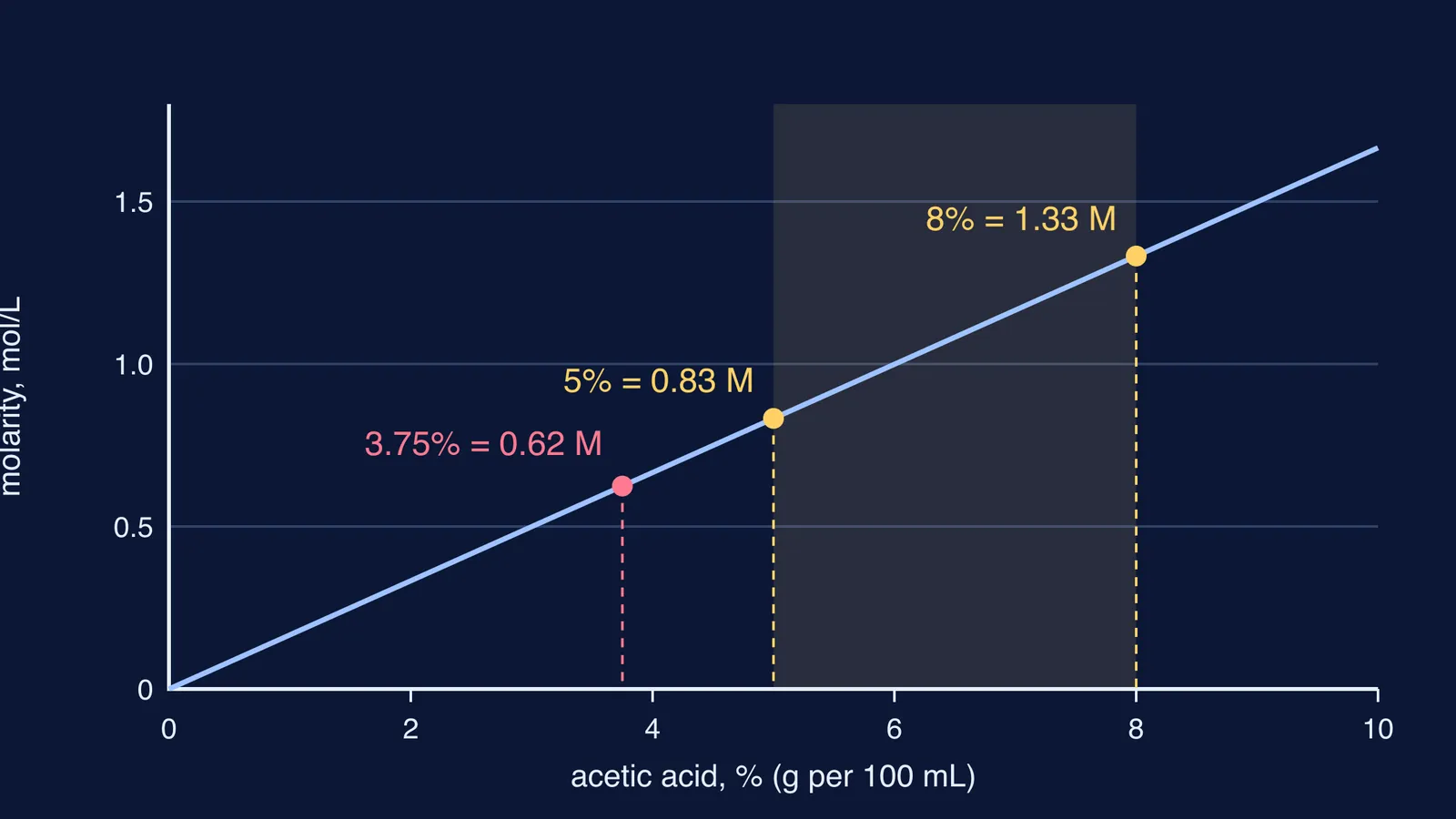
Acetic acid has a molar mass of 60.05 g/mol. Molarity is moles per litre, so:
Molarity = (percent × 10) ÷ 60.05
The × 10 turns grams per 100 mL into grams per litre.
3.75 percent (the FSSAI minimum): 37.5 ÷ 60.05 = 0.62 mol/L
4 percent: 40 ÷ 60.05 = 0.67 mol/L
5 percent (a typical white vinegar): 50 ÷ 60.05 = 0.83 mol/L
8 percent: 80 ÷ 60.05 = 1.33 mol/L
How do you check it by titration with NaOH?
Acetic acid reacts with sodium hydroxide one to one: NaOH + CH3COOH → CH3COONa + H2O. Phenolphthalein is the usual indicator because it is colourless in acidic solutions like vinegar and pink in basic ones, and the end point of a weak acid with a strong base sits on the basic side. Lab manuals such as this one use about 0.1 M NaOH.
Plan your volumes first. Undiluted 5 percent vinegar is about 0.83 M, so a 5.00 mL sample would need roughly 41.6 mL of 0.100 M NaOH, most of a 50 mL burette. Diluting ten times keeps each titre near 8 mL, which is quicker and lets you repeat it. Do this in a school lab with goggles and a teacher present.
Pipette 10.00 mL of vinegar into a 100 mL volumetric flask and make it up to the mark with distilled water. Mix well.
Pipette 10.00 mL of this diluted solution into a conical flask and add two or three drops of phenolphthalein.
Fill the burette with standardised NaOH (about 0.100 M) and note the reading.
Add NaOH while swirling, slowing to drops near the end, until the first faint pink stays.
Repeat until you have three titres that agree closely, then take the mean.
A worked example
Say your mean titre is 8.45 mL of 0.100 M NaOH.
Moles of NaOH = 0.100 × 0.00845 = 8.45 × 10^-4 mol.
One to one, so the 10.00 mL aliquot held 8.45 × 10^-4 mol of acetic acid.
Diluted concentration = 8.45 × 10^-4 ÷ 0.01000 L = 0.0845 mol/L.
Undo the tenfold dilution: original vinegar = 0.845 mol/L.
Grams per litre = 0.845 × 60.05 = 50.7 g/L, which is 5.07 percent. The label's 5 percent checks out.
What mistakes throw the answer off?
Forgetting the dilution factor. An answer of 0.08 M for kitchen vinegar is a tenfold slip, not a weak bottle.
Leaving volumes in mL. Moles = molarity × volume in litres.
Mixing up percent types. The label is mass per volume. If your teacher asks for mass percent, many lab manuals, including this vinegar titration procedure, assume vinegar's density is 1.000 g/mL; say so in your answer.
Overshooting the end point. A deep pink means you went past it. Stop at the first faint pink that lasts while you swirl.
If the arithmetic keeps tripping you up, try a few similar titration problems in the Fermi Problem Library, where the step-by-step solver explains the reasoning rather than printing an answer. If molarity or weak acids still feel shaky, the Fermi Concept Library gives every chemistry concept its own lesson.
Next time you see "5% acidity" on a bottle, read it as 0.83 mol/L, then go and prove it.


