On this page
Add water to acetic acid and the solution gets less acidic, so its pH goes up. Yet the textbook says the acid is now *more* ionised. Both are true, and two lines of algebra show why.
What does percent ionisation measure?
Percent ionisation (NCERT calls it percent dissociation) is the fraction of acid molecules that have given up a proton, times 100: [HA]dissociated / [HA]initial × 100, as defined in the NCERT Class 11 Chemistry unit on Equilibrium.
The same NCERT unit writes the ionisation constant of a weak acid HX, at starting concentration c and degree of ionisation α, as Ka = cα²/(1 − α). At a given temperature, Ka is fixed; α depends on how much water you have added.
The OpenStax Chemistry 2e chapter on acid strength states: "Unlike the Ka value, the percent ionization of a weak acid varies with the initial concentration of acid, typically decreasing as concentration increases."
Why does percent ionisation increase when a weak acid is diluted?
For a weak acid, α is small, so 1 − α is close to 1. NCERT uses this same simplification in its worked ammonia problem (Problem 6.23). Then:
Ka = cα²/(1 − α) becomes Ka ≈ cα².
So α ≈ √(Ka/c). Since Ka is constant, α grows as c shrinks.
And [H⁺] = cα ≈ √(Ka·c). Since Ka is constant, [H⁺] shrinks as c shrinks.
So α varies as 1/√c and [H⁺] as √c. A tenfold dilution multiplies α by √10, about 3.16, and divides [H⁺] by the same factor. A bigger share of molecules ionise, but each litre holds ten times fewer molecules, so H⁺ per litre still drops.
What does Le Chatelier's principle say about dilution?
Picture diluting the solution n times in an instant. In Q = [H⁺][A⁻]/[HA], each concentration is divided by n. Two factors on top, one below, so Q becomes Q/n, less than Ka. The forward reaction runs until Q climbs back to Ka, and that means more ionisation. The side with more dissolved particles is favoured when you add water, a pattern explained further in our post on how dilution shifts an aqueous equilibrium.
Worked example: acetic acid at three concentrations
NCERT's table of weak-acid constants gives acetic acid Ka = 1.74 × 10⁻⁵ at 298 K (NCERT Equilibrium unit, Table 6.6). Using α ≈ √(Ka/c):
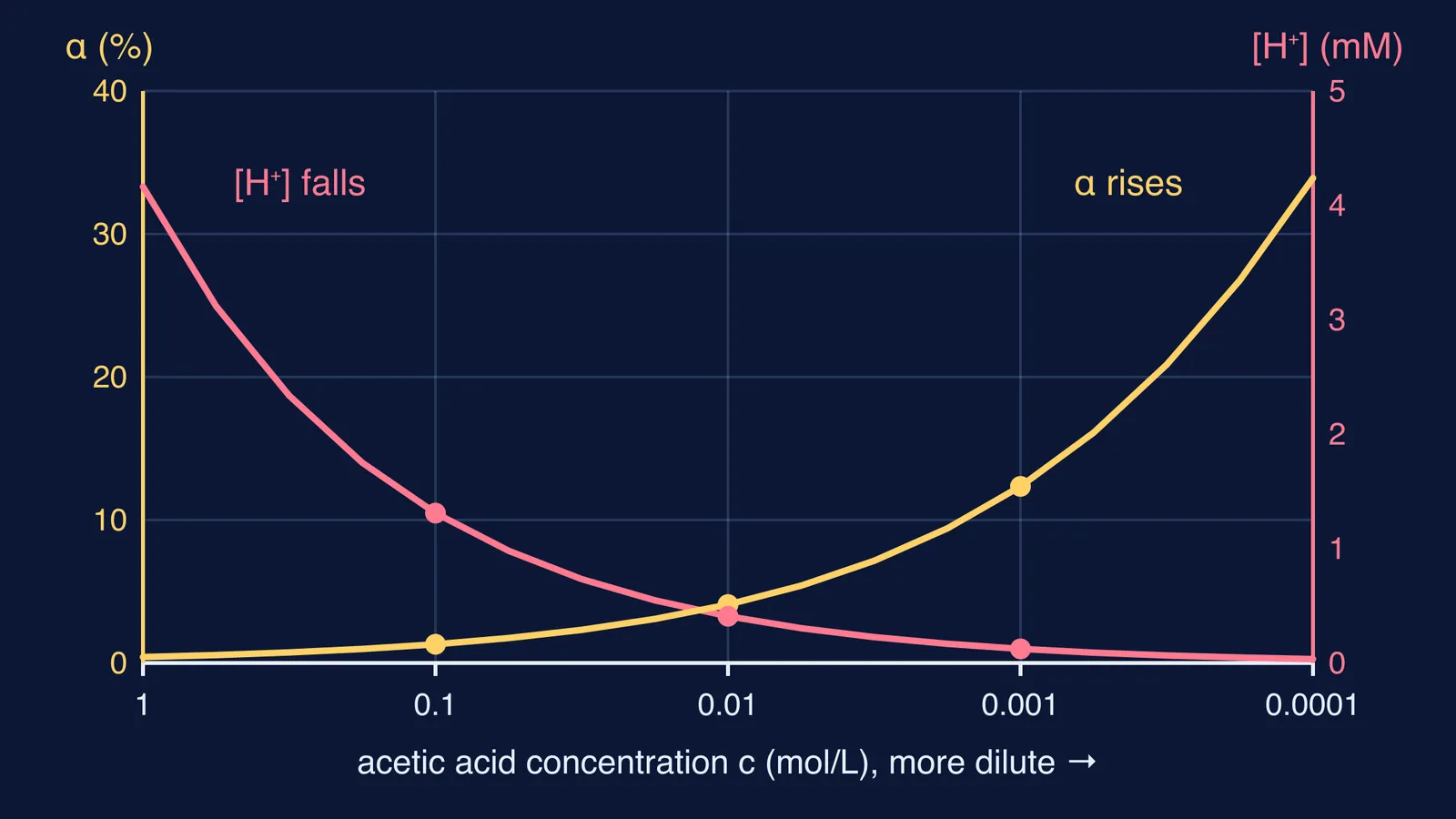
0.1 M: α ≈ √(1.74 × 10⁻⁴) = 0.0132, so 1.32% ionised; [H⁺] = 1.32 × 10⁻³ M; pH ≈ 2.88.
0.01 M: α ≈ √(1.74 × 10⁻³) = 0.0417, so 4.17% ionised; [H⁺] = 4.17 × 10⁻⁴ M; pH ≈ 3.38.
0.001 M: α ≈ √(1.74 × 10⁻²) = 0.132, so 13.2% ionised; [H⁺] = 1.32 × 10⁻⁴ M; pH ≈ 3.88.
At each step α rises about 3.2 times, [H⁺] falls about 3.2 times, and pH rises by about 0.5.
Now check the shortcut. OpenStax gives the usual test: the approximation is valid when the amount ionised is less than 5% of the starting concentration (OpenStax Chemistry 2e). At 0.1 M and 0.01 M it passes. At 0.001 M, 13.2% fails, so solve the full quadratic cα² + Ka·α − Ka = 0. That gives α = 0.123, or 12.3% ionised, and pH 3.91. The trend holds; the shortcut just overestimates α once α stops being small.
How is this different from diluting a strong acid?
A strong acid such as HCl is already almost fully ionised, so a tenfold dilution cuts [H⁺] tenfold and pH = −log[H⁺] (NCERT) rises by about 1, as our post on how pH changes when a strong acid is diluted ten times shows. A weak acid partly makes up for the lost molecules by ionising more, so its pH rises by only about 0.5 per tenfold dilution, the square root at work.
The α ≈ √(Ka/c) relation is the dilution law; read more on Wilhelm Ostwald and the dilution law for weak electrolytes.
A three-step method for exam answers
When a JEE Main or NEET-UG question asks what happens to α, [H⁺] or pH on dilution, work through this:
Write Ka = cα²/(1 − α) and say that Ka does not change at constant temperature.
If α is under 0.05, use α ≈ √(Ka/c); if not, solve the quadratic.
State both results: α rises as 1/√c, while [H⁺] = √(Ka·c) falls, so pH rises.
A one-line answer you can write: "On dilution, Q falls below Ka, so the acid ionises further; α increases as 1/√c, but [H⁺] decreases as √c, so pH increases."
If you keep mixing up α and [H⁺], practise on a few numericals in the Fermi Problem Library, where a step-by-step solver explains the reasoning rather than printing an answer. If the gap is in the idea of an equilibrium constant itself, the Fermi Concept Library has a lesson for every concept in chemistry, each with its place in the map.