

On this page
Why does adding water shift the equilibrium?
When you add water to an aqueous solution at equilibrium, you increase its volume and lower the concentration of every dissolved species. According to Le Chatelier's principle, the system responds by shifting toward the side with the greater number of moles of dissolved particles to counteract the decrease in concentration (Wikipedia).
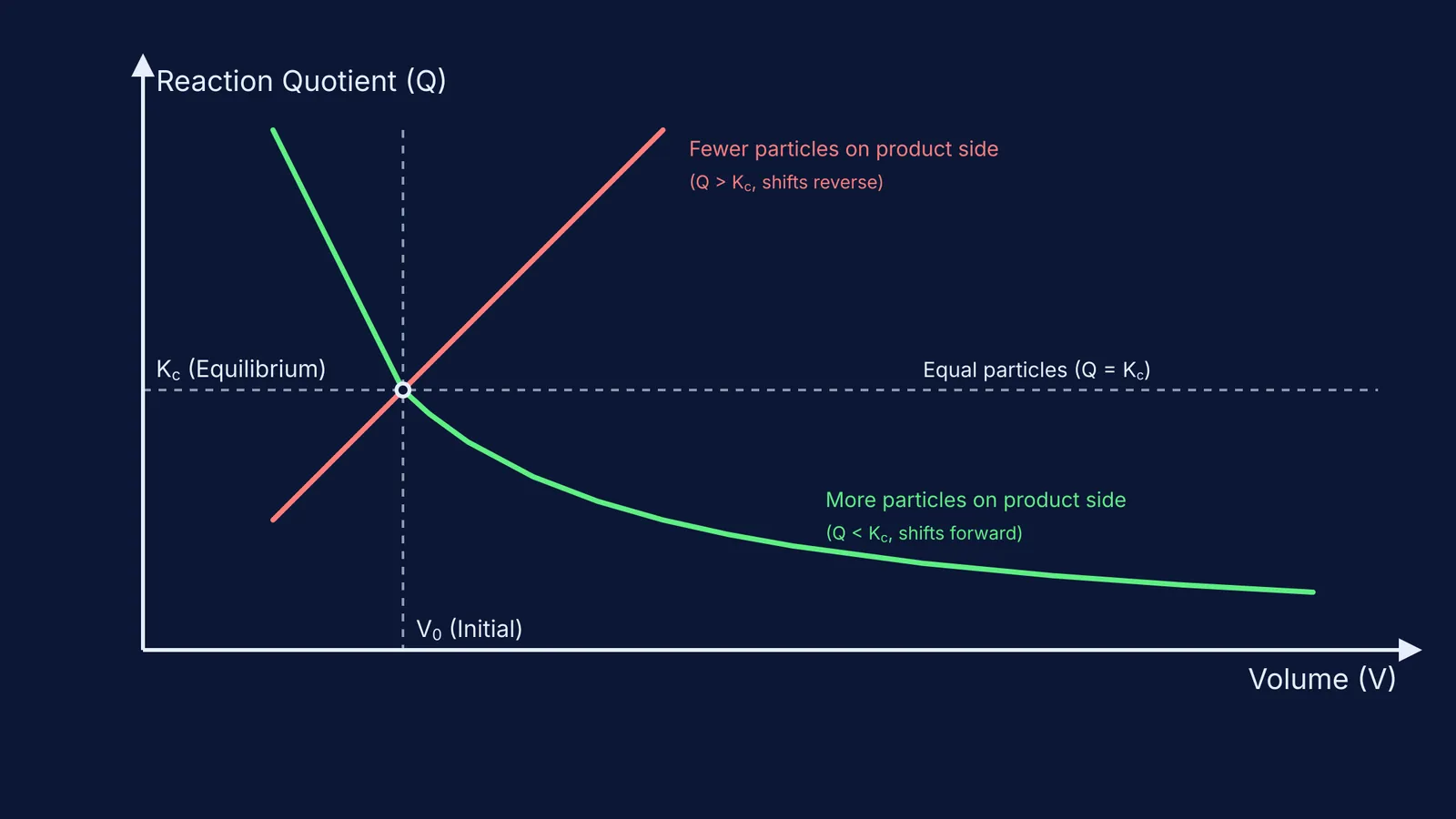
We can see why this happens using the reaction quotient, Q. When a reaction has a different number of dissolved particles on the reactant and product sides, changing the volume (V) affects the numerator and denominator of Q differently. The system must then shift forward or backward to bring Q back into equality with the equilibrium constant, K_c. If the number of moles of solute is identical on both sides, dilution has no effect on the equilibrium.
The collision theory behind the shift
Why does concentration change the equilibrium on a molecular level? We can understand this through collision theory. When the concentration of a reactant is increased, the frequency of successful collisions between those reactant molecules also increases. This increased collision rate allows for an increase in the forward reaction rate, generating more product until a new equilibrium is established (Wikipedia).
When you dilute a solution, you do the opposite: you decrease the concentration of all solutes, which drops the collision frequency. To restore equilibrium, the system will shift in whichever direction counteracts this loss of collisions the most efficiently, typically favouring the side that yields more particles.
The iron(III) thiocyanate equilibrium
A classic example is the formation of a blood-red complex when iron(III) ions (Fe³⁺) react with thiocyanate ions (SCN⁻). The reaction forms the complex [Fe(NCS)(H₂O)₅]²⁺, often written simply as FeSCN²⁺ (Wikipedia):
Fe³⁺ (aq) + SCN⁻ (aq) ⇌ FeSCN²⁺ (aq)
Here, there are two moles of dissolved particles on the left side and only one mole on the right. The equilibrium constant expression is:
K_c = [FeSCN²⁺] / ([Fe³⁺][SCN⁻])
If you double the volume by adding water, the concentration of each ion is halved. Let's see how this affects Q:
Q = (0.5 × [FeSCN²⁺]) / ((0.5 × [Fe³⁺]) × (0.5 × [SCN⁻])) = 2 × K_c
Because Q is now greater than K_c, the reaction shifts in the reverse direction (to the left) to reach equilibrium again. In the lab, this means the red color of the solution becomes much lighter than you would expect from simple dilution, which you can see in the ferric thiocyanate equilibrium shift practical.
How does dilution affect weak acids?
The rule also applies to the ionisation of a weak acid, such as acetic acid (HA):
HA (aq) ⇌ H⁺ (aq) + A⁻ (aq)
In this case, one dissolved particle dissociates into two. The reaction has more particles on the product side.
K_c = ([H⁺][A⁻]) / [HA]
If you double the volume, the concentration of each species is halved. Calculating Q gives:
Q = ((0.5 × [H⁺]) × (0.5 × [A⁻])) / (0.5 × [HA]) = 0.5 × K_c
Here, Q is less than K_c, so the reaction must shift forward (to the right) to restore equilibrium.
This mathematical relationship is the basis of Ostwald's law of dilution. Proposed by Wilhelm Ostwald in 1888, the law states that the degree of dissociation of a weak electrolyte is proportional to the inverse square root of the concentration, or the square root of the dilution (Wikipedia). In practical terms, this means a 0.001 M solution of acetic acid will have a higher percentage of its molecules split into ions than a 0.1 M solution. However, this law only holds true for weak electrolytes; strong electrolytes dissociate almost completely regardless of how much water you add.
How does volume affect gases?
The same principle governs gas-phase reactions when the volume of their container changes. If you increase the volume (which decreases the pressure), the equilibrium shifts toward the side with more moles of gas. The system attempts to fill the newly available space and increase the partial pressure by producing more gas molecules (Wikipedia).
Conversely, if you decrease the container's volume, the equilibrium shifts toward the side with fewer moles of gas to reduce the total number of particles. If the number of moles of gas is identical on both sides of the equation, changing the volume has no effect. Adding an inert gas at constant volume also does not shift the equilibrium because it does not change the partial pressures of the reacting species.
A checklist for exam questions
If you encounter a question about dilution and equilibrium in a JEE or NEET-UG exam, follow these steps:
Count the moles of dissolved aqueous species on the reactant side. Do not count solids, pure liquids or the solvent itself (like water).
Count the moles of dissolved aqueous species on the product side.
Apply the rule: dilution shifts the reaction toward the side with the higher count.
If the counts are equal, dilution causes no shift.
For step-by-step guidance on setting up equilibrium expressions or solving concentration numericals, you can use the Fermi Problem Library. It walks through the reasoning rather than just printing the answer. To explore how concentration, pressure and volume interact across different systems, the Fermi Concept Library connects all these ideas in one map.
Read more:


