

On this page
When you have a single weak acid in a flask, calculating its pH is a straightforward matter of writing down one equilibrium and solving for the unknown. But when you mix two weak acids together in the same container, they compete with one another.
Both acids release hydrogen ions (H⁺) into the same volume of water, and that shared pool of H⁺ fundamentally changes how each individual acid behaves. Because they are weak, neither dissociates completely, and the maths requires us to handle them together rather than in isolation.
Why do we need a special formula?
The key to solving a mixture of weak acids is the common ion effect. When two acids, let's call them HA₁ and HA₂, are in the same solution, they both dissociate to produce H⁺ ions. According to the charge balance of the solution, the total concentration of hydrogen ions must equal the sum of the conjugate bases, [A₁⁻] + [A₂⁻], assuming the contribution from the autoionisation of water is negligible.
Because HA₁ pushes H⁺ into the solution, it suppresses the dissociation of HA₂ (and vice versa). You cannot simply calculate the H⁺ from HA₁ and add it to the H⁺ from HA₂ as if they were in separate beakers. The presence of one acid forces the other's equilibrium backwards, meaning both acids dissociate significantly less than they would if they were left alone in water.
If you are confused by how multiple equilibria push each other around, the Fermi Concept Library maps out every acid-base concept so you can see exactly where the common ion effect fits into the bigger picture of chemistry.
What is the pH of a mixture of two weak acids formula?
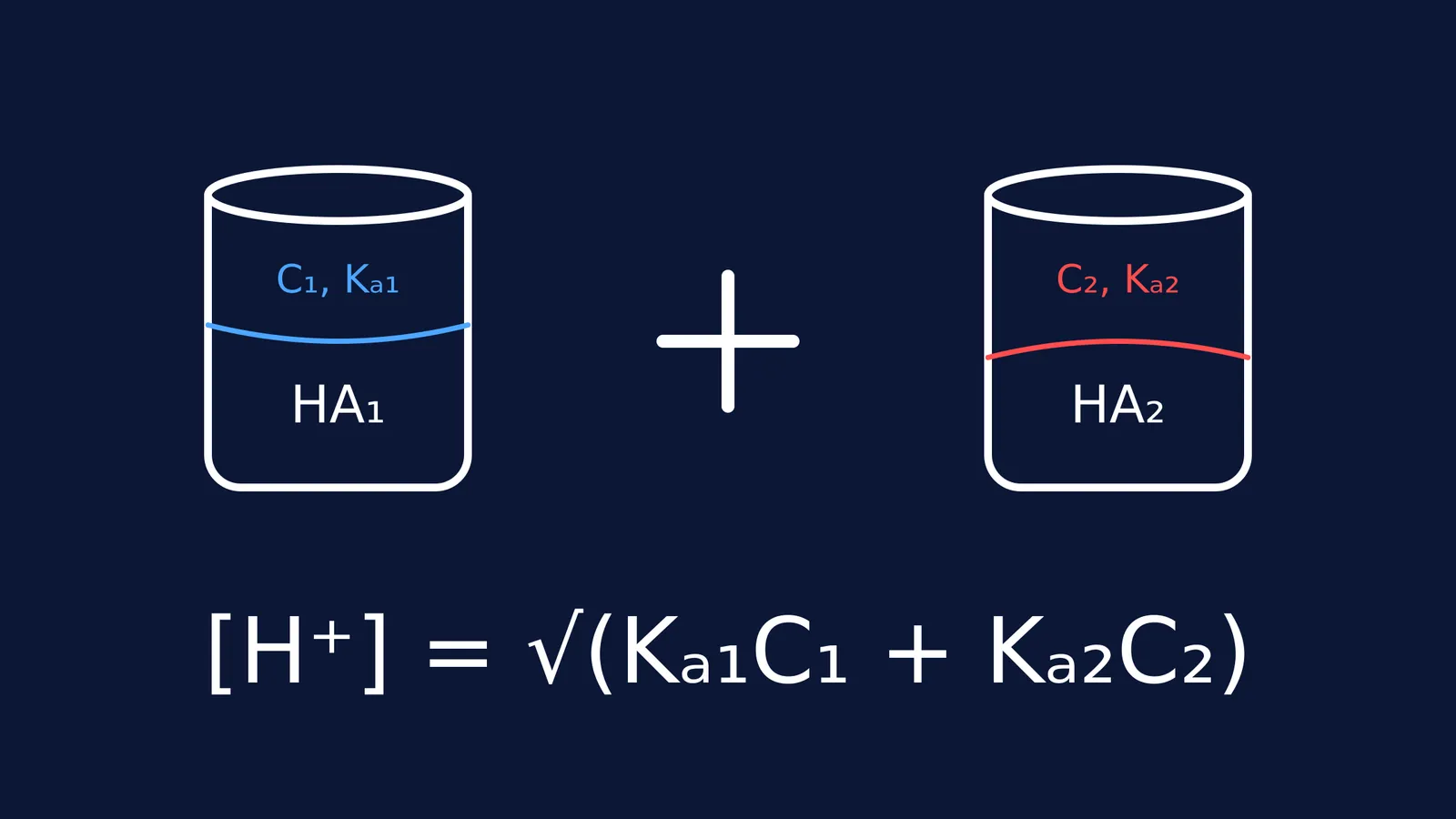
If you assume that both acids are weak enough that their initial concentrations (C₁ and C₂) barely change when they lose a proton, you can combine their individual equilibrium expressions into one clean mathematical result. The total hydrogen ion concentration [H⁺] is the square root of the sum of their individual Ka × C terms:
[H⁺] = √(Ka₁C₁ + Ka₂C₂)
Once you have the total [H⁺] expressed in moles per litre, finding the final pH of the mixture is a straightforward logarithmic calculation:
pH = −log₁₀[H⁺]
This formula relies on the assumption that the degree of dissociation for both acids is very small. It also assumes the H⁺ coming from the water itself is negligible, which is almost always true unless the acids are extremely dilute. If you are dealing with very low concentrations, you would need to add water's Kw under the square root, a situation similar to calculating the pH of 10⁻⁸ M HCl.
When can you ignore the weaker acid?
You do not always need to reach for the full square-root formula. If one acid is significantly stronger or much more concentrated than the other (typically when the Ka₁C₁ product is much larger than the Ka₂C₂ product), the stronger acid dictates the pH almost entirely.
The stronger acid produces so much H⁺ that it suppresses the weaker acid entirely through the common ion effect. In that case, the Ka₂C₂ term becomes a tiny rounding error. You can drop it completely and treat the solution as if the weaker acid is not even there:
[H⁺] ≈ √(Ka₁C₁)
If you want to understand how equilibrium constants relate to each other in these mathematical approximations, reading about conjugate acid-base pairs and Kw can clarify why these constants are so rigid.
Worked example: Acetic acid and formic acid
Let's say you have a laboratory mixture containing 0.1 M acetic acid and 0.1 M formic acid after mixing. According to OpenStax Chemistry 2e, the Ka of acetic acid is 1.8 × 10⁻⁵ and the Ka of formic acid is 1.8 × 10⁻⁴.
Since their Ka values are relatively close (separated by a factor of 10), we must use the full formula to get an accurate pH for the mixture.
Calculate the terms for each acid: Acetic acid gives Ka₁C₁ = (1.8 × 10⁻⁵) × 0.1 = 1.8 × 10⁻⁶, and formic acid gives Ka₂C₂ = (1.8 × 10⁻⁴) × 0.1 = 1.8 × 10⁻⁵.
Add them together under the root: Total = 1.8 × 10⁻⁶ + 1.8 × 10⁻⁵ = 1.98 × 10⁻⁵.
Take the square root to find [H⁺]: [H⁺] = √(1.98 × 10⁻⁵) = 0.00445 M.
Calculate pH: pH = −log₁₀(0.00445) = 2.35.
If you had only calculated the pH of the stronger formic acid on its own, you would get 2.37. The addition of the weaker acetic acid barely nudged the pH down to 2.35, proving just how strongly the common ion effect suppresses the weaker acid. For step-by-step guidance on how to set up problems like this from scratch, the Fermi Problem Library explains the reasoning behind each approximation rather than just printing a final answer.


