

On this page
Wilhelm Ostwald was a Baltic German chemist and philosopher who helped establish the field of physical chemistry. He was awarded the Nobel Prize in Chemistry in 1909 for his work on chemical equilibria, reaction velocities, and catalysis. One of his most enduring contributions to the classroom is a principle every chemistry student learns today: the Ostwald dilution law.
In the late 19th century, chemists were trying to understand how substances behave when dissolved in water. Ostwald applied the law of mass action to the dissociating ions in a solution. Wilhelm Ostwald proposed the dilution law in 1888, linking the dissociation constant of a weak electrolyte to its degree of dissociation.
What is the Ostwald dilution law?
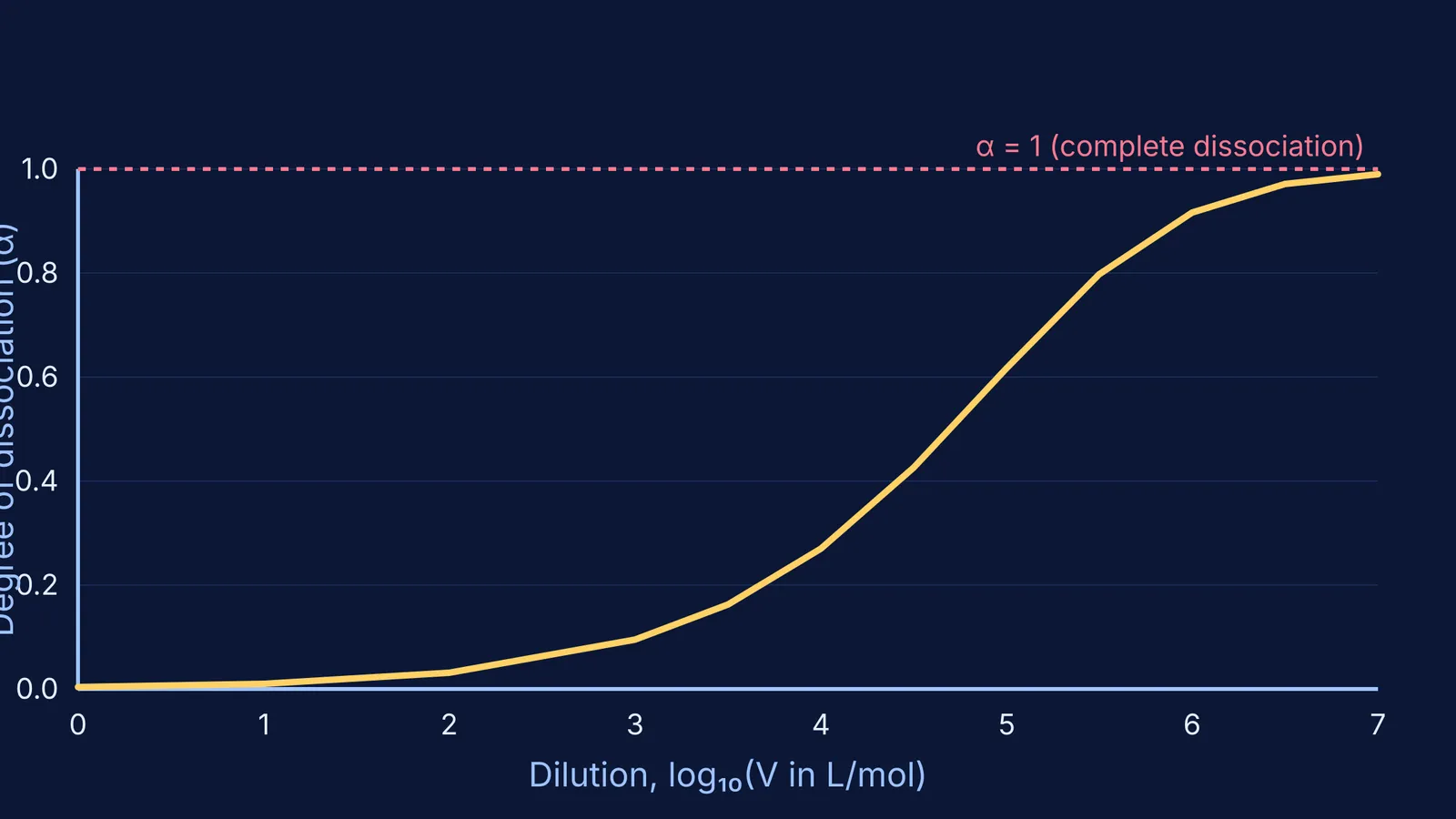
For a weak electrolyte that dissociates into two ions, the equilibrium constant (Kd) depends on the concentration (c₀) and the degree of dissociation (α). The Ostwald dilution law states that Kd = α² c₀ / (1 − α).
Because weak electrolytes ionise very little at normal concentrations, the fraction that dissociates (α) is much less than 1. This allows us to approximate (1 − α) as 1. The equation simplifies to Kd ≈ α² c₀, or α = √(Kd / c₀).
This mathematical relationship reveals a profound physical truth. The degree of dissociation of a weak electrolyte is proportional to the inverse square root of the concentration, or the square root of the dilution. In plain terms: the more you dilute a weak acid, the greater the fraction of it that breaks apart into ions. At infinite dilution, even a weak electrolyte becomes completely dissociated.
Why does the law fail for strong electrolytes?
The Ostwald law of dilution provides a satisfactory description of the concentration dependence of the conductivity of weak electrolytes like CH₃COOH and NH₄OH. However, it does not work for everything.
For strong electrolytes, the supposed equilibrium constant is actually far from constant. Strong acids and bases are completely dissociated into ions even at high concentrations. When you dilute a strong electrolyte, its molar conductivity still changes, but not because more molecules are breaking apart. The decrease in molar conductivity is actually due to attraction between ions of opposite charge, which restrict each other's movement.
How do you solve dilution problems in exams?
In JEE and NEET chemistry, ionic equilibrium problems frequently test your ability to use Ostwald's law. The key is knowing when to use the shortcut and when to solve the full equation.
Consider a hypothetical weak acid with a dissociation constant of 1.0 × 10⁻⁵. At a concentration of 0.1 M, we try the shortcut first:
α = √(10⁻⁵ / 10⁻¹)
α = √(10⁻⁴) = 0.01
Because 0.01 is much smaller than 1 (typically, anything under 0.05 is safe), the approximation is valid. The fraction dissociated is 0.01. However, if the acid is more concentrated or has a higher Kd such that the shortcut gives an α greater than 0.05, you must solve the full quadratic equation: c₀ α² + Kd α − Kd = 0.
If you struggle to spot which assumption to make during mock tests, Fermi's AI tutor can help. Instead of just printing the final answer, the tutor works out what you already know and builds a plan for the session, noticing where you get stuck on the algebra. You can also explore the Fermi Problem Library for a step-by-step solver that explains the reasoning behind equilibrium approximations.
To see how these principles apply across other chemical systems, read how Ka × Kb = Kw governs conjugate acid-base pairs, why you cannot ignore water when finding the pH of very dilute acids, or why pure liquids are left out of heterogeneous equilibria.


