On this page
Watch a grandparent read a WhatsApp message: phone at arm's length, a frown, then the glasses. One page of your Class 10 science book explains why.
Why do people need reading glasses after forty?
Your eye focuses on near things by making its lens thicker. NCERT's Class 10 Science, Chapter 10 explains it like this: the eye lens is made of "a fibrous, jelly-like material". When you look at something close, the ciliary muscles contract, the lens becomes thicker, and its focal length gets shorter.
Accommodation is the ability of the eye lens to adjust its focal length (NCERT Class 10 Science).
For a young adult with normal vision, the near point, the closest distance you can see clearly without strain, is about 25 cm (NCERT Class 10 Science). Our explainer on the power of accommodation and the ciliary muscles walks through that mechanism step by step.
The US National Eye Institute says everyone gets presbyopia with age, usually after 45, because the lens "gets harder and less flexible". Even when the ciliary muscles contract, a stiff lens no longer thickens enough. NCERT names two causes: weaker ciliary muscles and a lens that becomes less flexible.
How much stiffer does the eye lens get with age?
A lot. In a 2004 study in Molecular Vision, Karl Heys, Sandra Cram and Roger Truscott measured the stiffness of human lenses from donors aged 14 to 78. The centre of the lens (the nucleus) became roughly 450 times stiffer across that range, and the biggest change happened between the ages of 20 and 60. The outer layer (the cortex) became only about 20 times stiffer.
Their title ends with a question mark ("the basis for presbyopia?"), so scientists still study how much other parts of the eye contribute. The authors conclude that the stiffening "may be a major contributing factor to presbyopia".
How far away does the near point move? A worked example
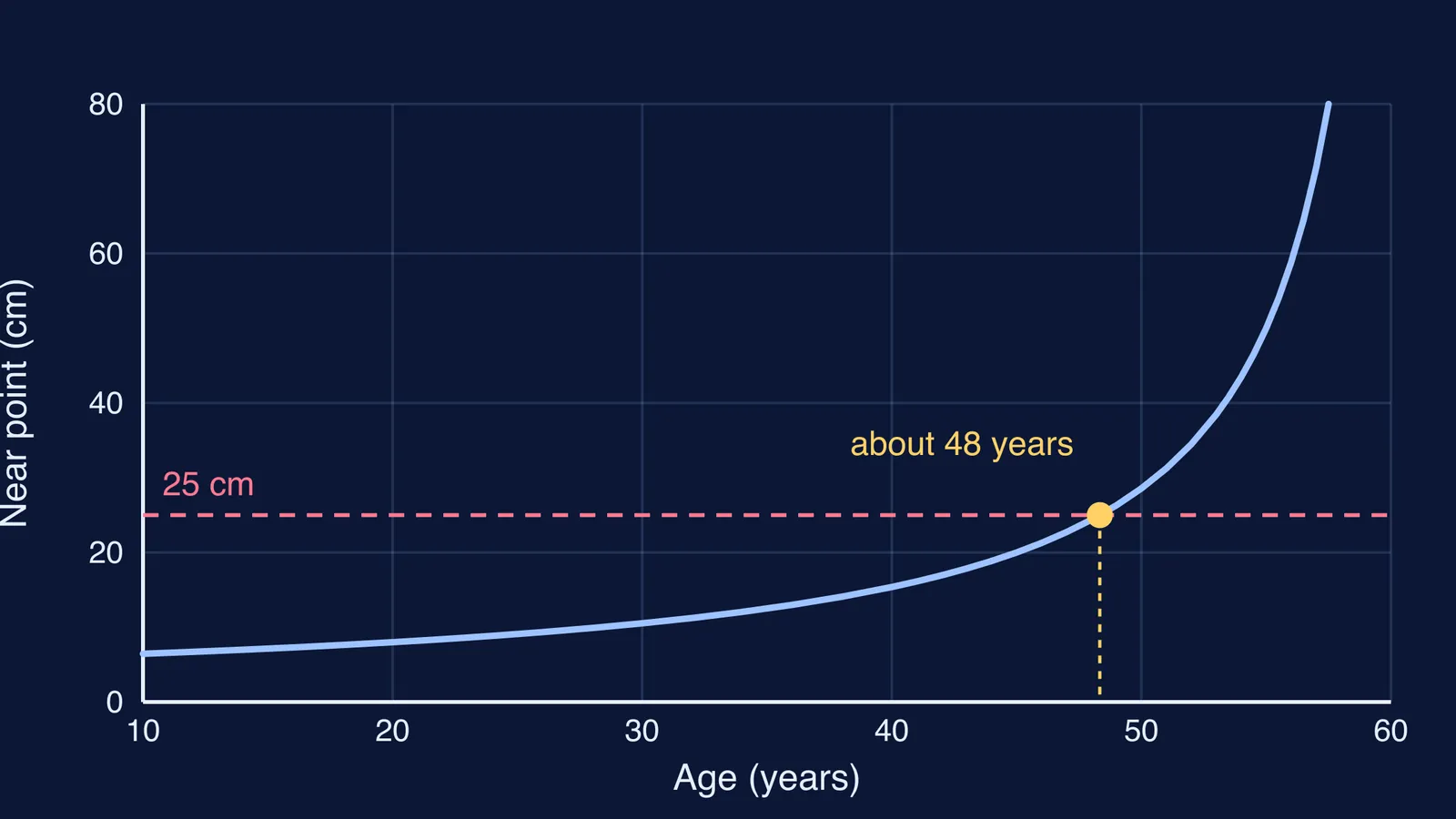
Optometrists use a rule of thumb for the average amplitude of accommodation (the extra focusing power the eye can add) at a given age. It is called Hofstetter's formula: 18.5 minus 0.3 times your age, measured in dioptres (D). A 2019 study in PLOS ONE by Sun-Mi Park and colleagues says this formula gives the approximate expected values. The same study notes that accommodation is highest in childhood and falls to its lowest at about 55 to 60.
For an eye that sees distant objects clearly without glasses, the near point in centimetres is 100 divided by that accommodation. Try it:
Age 20: 18.5 - 6 = 12.5 D, so the near point is 100 / 12.5 = 8 cm.
Age 40: 18.5 - 12 = 6.5 D, so the near point is about 15 cm.
Age 50: 18.5 - 15 = 3.5 D, so the near point is about 29 cm, already beyond 25 cm.
Age 55: 18.5 - 16.5 = 2 D, so the near point is 50 cm, which is arm's length.
To read at 25 cm, an eye focused for distance must add 4 D of power (100 / 25). Our post on why the eye lens power changes by 4 D from far to near shows where that number comes from. By this average formula, accommodation drops below 4 D at about 48, the point marked on the graph at the top of this post.
The convex lens makes up the difference: power needed = 4 D minus the accommodation left. At 50 that is +0.5 D, and at 55 it is +2 D.
Is presbyopia the same as hypermetropia?
No, though both are corrected with a convex lens. NCERT says hypermetropia happens when the eye lens's focal length is too long or the eyeball has become too small. Presbyopia is the loss of accommodation that comes with age. For a board answer, give NCERT's cause, "gradual weakening of the ciliary muscles and diminishing flexibility of the eye lens", then the remedy: a convex lens, or bifocals if the person is also short-sighted. Our worked example on presbyopia and finding both powers of a bifocal lens covers the numericals.
The Fermi Simulation Lab has interactive simulations for the ideas that are easier to see than to read. If the whole chapter feels shaky, the Fermi Concept Library gives each concept in physics and biology its own lesson.
How common is presbyopia, and what should a family do?
It is very common. A 2018 analysis in Ophthalmology led by Timothy Fricke estimated that 1.8 billion people had presbyopia in 2015. Of those, 826 million had poor near vision because they had no glasses or the wrong ones.
The National Eye Institute lists signs: holding reading material farther away, eye strain and headaches. If a parent shows them, suggest an eye test together: "You keep holding your phone far away. My science book says that happens to everyone. Shall we get your eyes checked this week?"