On this page
Look at a half moon, then again a week later at the full moon. The lit area has only doubled, but the night feels far brighter. That is not your eyes playing tricks, and the reason is a lesson in how rough surfaces reflect light.
Why is the full moon so much brighter than the half moon?
Measurements show the full moon is typically about ten times brighter than the quarter (half) moon, and sometimes as much as fifteen times, writes James Palmer, research professor emeritus of optical sciences at the University of Arizona. Astronomers quote different figures depending on how they measure: Professor Jonti Horner of the University of Southern Queensland, writing in Australian Geographic, puts the full moon at roughly six times brighter than the half moon. Every estimate agrees on the main point: far more than twice.
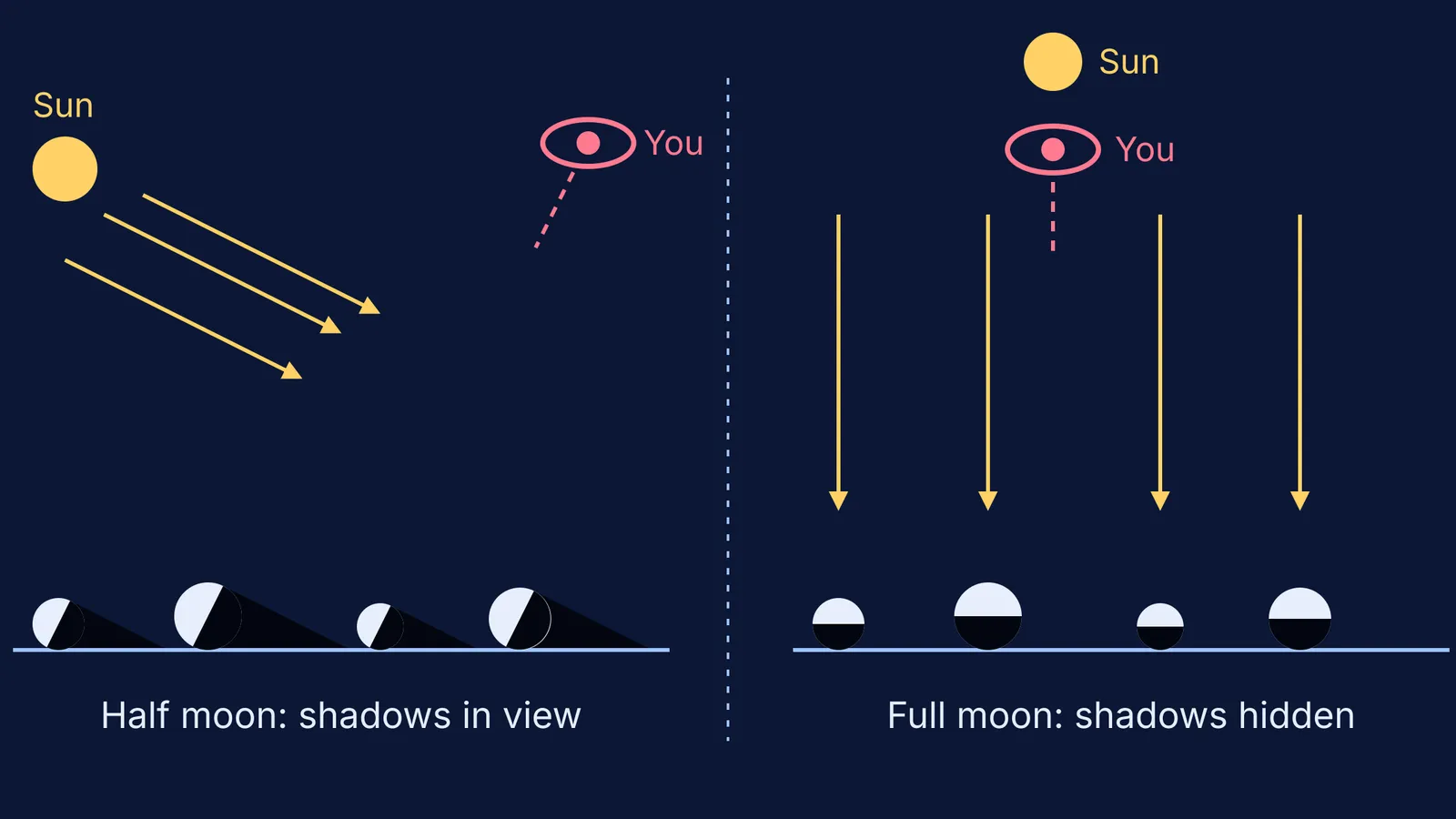
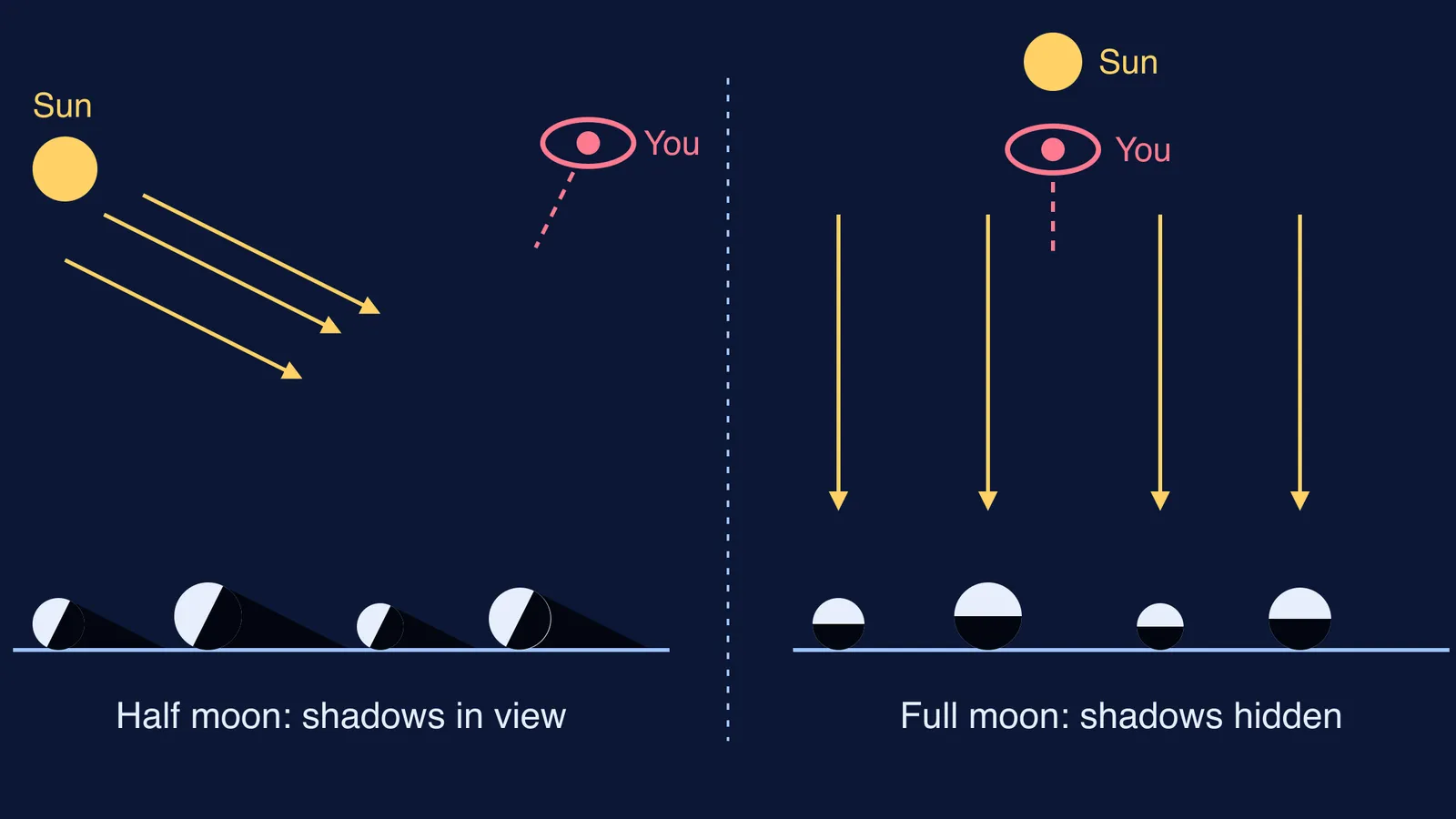
Horner's explanation is shadows. The Moon is covered in craters, mountains, rocks and pebbles. At half moon, sunlight arrives from the side, so each bump throws a shadow you can see. At full moon, Earth sits between the Sun and the Moon, the sunlight comes from behind you, and the shadows point away from you, out of view.
Why isn't the Moon just twice as bright?
Here is a worked example that splits the factor of ten into three parts. The figures come from Palmer's page on lunar brightness.
Area. A half moon shows half the disc lit, so area alone predicts the full moon is 2 times brighter.
Slanting light. Even a perfectly smooth, matte ball (what physicists call a Lambertian surface) would give a ratio of pi, about 3.14, not 2. At half moon much of the lit part you see is struck by sunlight at a low, glancing angle, so it is dimmer per square kilometre. That adds a factor of 3.14 ÷ 2, about 1.6.
Roughness. The measured ratio is about 10. Dividing 10 by 3.14 leaves a factor of about 3.2 that no smooth ball can produce. That part belongs to the Moon's rough, dusty surface.
What is the opposition surge?
The opposition surge is the sharp rise in brightness of a rough, airless surface when the Sun is almost exactly behind the observer. The Moon shows it strongly. In 1994 NASA's Clementine spacecraft made the first multispectral observations of the lunar surge at Sun-Moon-observer angles below a few degrees, and Buratti, Hillier and Wang reported in Icarus in 1996 that the Moon's brightness increases by more than 40% between an angle of 4 degrees and 0 degrees.
The team's results suggest that the main cause is shadow hiding: the surface's grains and bumps hide their own shadows when lit from straight behind you. A second effect, coherent backscatter, in which light waves bouncing back along the same path reinforce each other, makes only a minor contribution if it is present at all, according to the Clementine paper's abstract on NASA's technical reports server. The surge was about 10% greater in the bright highlands than in the darker plains, which the authors attribute to differences in surface texture.
The Moon is not even shiny. The Clementine team put its Bond albedo, the fraction of all sunlight it reflects, at about 0.11, so it sends back only around a tenth of the sunlight that reaches it. It looks dazzling at full moon because its rough, dusty surface is very good at returning that light towards the Sun, which is roughly where you stand. To see what that dust is like up close, read why moon dust is so sharp and clingy.
How can you check this yourself?
You need one clear evening at half moon, one at full moon, and binoculars if you have them. It makes a good project for a parent and child.
At half moon, look along the terminator, the line between the lit and dark parts. Craters there have long black shadows and look sharply three-dimensional. These are the same kind of shadows Galileo used to measure mountains on the Moon.
At full moon, look at the same region. The craters look flat: you see light and dark rock rather than shape, because the shadows are hidden.
If your phone camera lets you lock exposure, set it on the half moon and keep the same settings for the full moon. The full moon should come out noticeably brighter, a direct sign that it sends back more light.
Write down what you expect before each look, then check.
What does this teach about reflection?
School optics splits reflection into mirror-like and diffuse. The full moon shows a third behaviour: a rough surface sending extra light straight back towards its source, so brightness depends on the angle between the light, the surface and you.
Angles between light, surface and viewer are hard to picture from words alone. The Fermi Simulation Lab has interactive simulations for ideas that are easier to see than to read. Start with our guide to predicting all eight moon phases in a simulation, then look up at the next full moon and count the shadows you cannot see.