On this page
If you could hold a pinch of Moon dust, it would feel like flour and behave like tiny pieces of broken glass that refuse to let go. Two simple facts explain it. Nothing on the Moon rounds the grains off, and sunlight keeps charging them. Both ideas are already in your syllabus: weathering in geography and the photoelectric effect in physics.
Why is moon dust so sharp?
NASA describes lunar grains as "as fine as powder and as sharp as tiny shards of glass", and explains that because the Moon has no real atmosphere, "there's no wind or weather to cause erosion, so the grains never lose their rough edges" (NASA Ames, 2020). Our post on why the Moon has no atmosphere explains where the air went.
Lunar dust is the part of the Moon's soil with particles smaller than 20 micrometres, and it makes up about 20% by weight of the soil samples Apollo missions brought back (Pohlen et al., npj Microgravity, 2022).
What breaks the rock in the first place is more than four billion years of meteorite impacts, the same review explains. It says most larger dust particles "have sharp, jagged edges, having been fractured but not melted as a result of repeated impacts", and that they stay irregular "due to the lack of consistent weathering". Where the heat of an impact melts soil particles, it forms small, glassy clumps called agglutinates.
On Earth, the story ends differently. Wind and running water tumble grains against each other for a very long time, chipping off corners, which is the erosion NASA says the Moon lacks. On the Moon, a grain keeps the shape it had the moment it was broken.
Why does moon dust stick to everything?
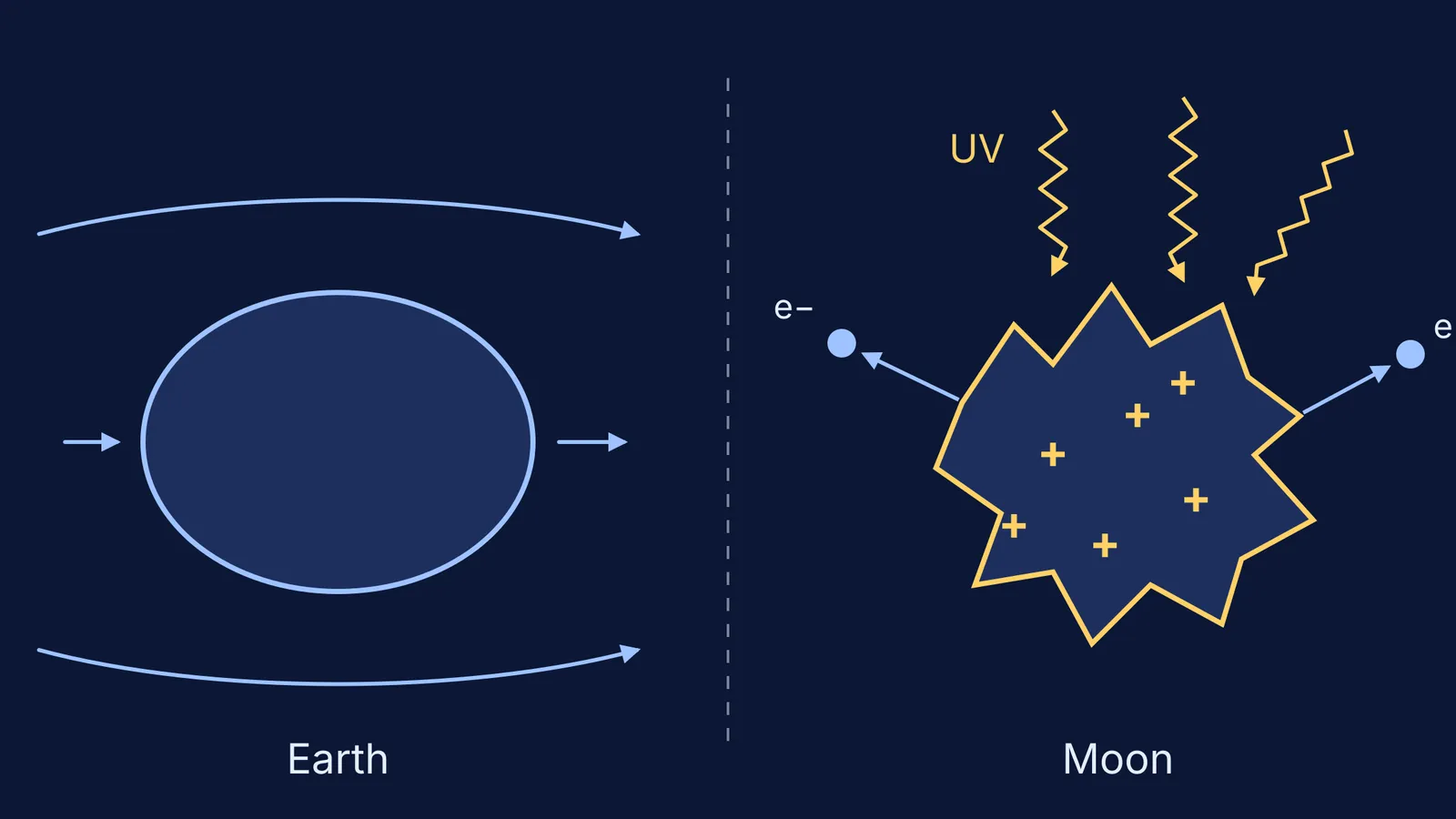
Sharp edges help grains catch on fabric, but electric charge matters too. Near the lunar surface, "photoemission due to solar UV radiation dominates the charging environment" (Poppe and Horányi, Journal of Geophysical Research, 2010).
This is the photoelectric effect from Class 12 physics. An ultraviolet photon hits a grain and knocks an electron out, so a grain in sunlight that keeps losing electrons ends up positively charged. Models of the lunar surface also include electrons arriving in the solar wind, so a grain's final charge depends on more than sunlight alone (Sana and Mishra, Physics of Plasmas, 2024).
The grains are insulators, so the charge has nowhere to drain away. That is the same reason a rubbed balloon sticks to a wall on a dry day. A 2022 review sums it up: "Due to its fineness, jagged edges, and electrostatic charge, LD adheres to and coats almost any surface it contacts" (Pohlen et al., 2022).
Charge can also make dust jump. In laboratory experiments, micron-sized insulating grains under ultraviolet light or plasma jumped several centimetres high, launching at about 0.6 m/s, a speed that would carry them roughly 0.11 m high in the Moon's weaker gravity (Wang et al., Geophysical Research Letters, 2016). The team found that electrons emitted and reabsorbed inside the tiny gaps between neighbouring grains build up unexpectedly large negative charges, and the grains push each other off the surface. The University of Colorado lab behind the work says this may help explain the "lunar horizon glow" seen in Surveyor 5, 6 and 7 images (LASP, 2016).
What did moon dust do to the Apollo astronauts?
On Apollo 17, the dust got into everything, "coating their spacesuits and jamming the shoulder joints" (NASA Ames, 2020).
When NASA scientists later examined the suits, 80% of the particles on Apollo 17 fabric were lunar soil, averaging 10.5 micrometres across (Christoffersen et al., NASA, 2008). On Apollo 12 fabric, the soil had separated and frayed the Teflon fibres. Apollo astronauts also reported mild, short-lived breathing symptoms, which is one reason planners of new Moon missions study the dust so closely (Pohlen et al., 2022).
How do you explain it in an exam answer?
A "give reasons" question on this topic rewards a chain of cause and effect. Use these five links in order:
The Moon has almost no atmosphere, so there is no wind or flowing water.
Without them there is no erosion, so grains are not rounded off.
Meteoroid impacts keep breaking rock, making fresh, jagged fragments.
Ultraviolet sunlight ejects electrons from the grains (photoemission), leaving them charged.
The grains are insulators, so they hold that charge and cling to suits, tools and each other.
Three mistakes to avoid:
Saying "low gravity makes it sticky". Gravity is not the reason.
Mentioning charge without saying where it comes from. Name ultraviolet light and photoemission.
Blaming magnetism for the cling. The answer here is electric charge.
For a quick test at home, rub a balloon on dry hair and hold it over torn tissue bits, then repeat on a humid monsoon day. The difference hints at why charge lasts on the bone-dry Moon.
The photoelectric step is easier to see than read. The Fermi Simulation Lab has interactive simulations for ideas like this, and our guide to five predictions to test in a photoelectric effect simulation shows what to try.