

On this page
The fuzz on a tennis ball is not decoration. The felt adds air drag that slows the ball in flight, and it supplies the friction that lets the ball grip the court and the strings. Both are syllabus physics: air resistance and friction.
Why do tennis balls have fuzz on them?
First, the rules require it. Appendix I of the International Tennis Federation's Rules of Tennis says the ball "shall have a uniform outer surface consisting of a fabric cover" (ITF ball approval procedures for 2026). The same appendix sets a standard ball's mass at 56.0 to 59.4 grams and the diameter of fast and medium balls at 6.54 to 6.86 cm.
How does the fuzz slow a tennis ball down?
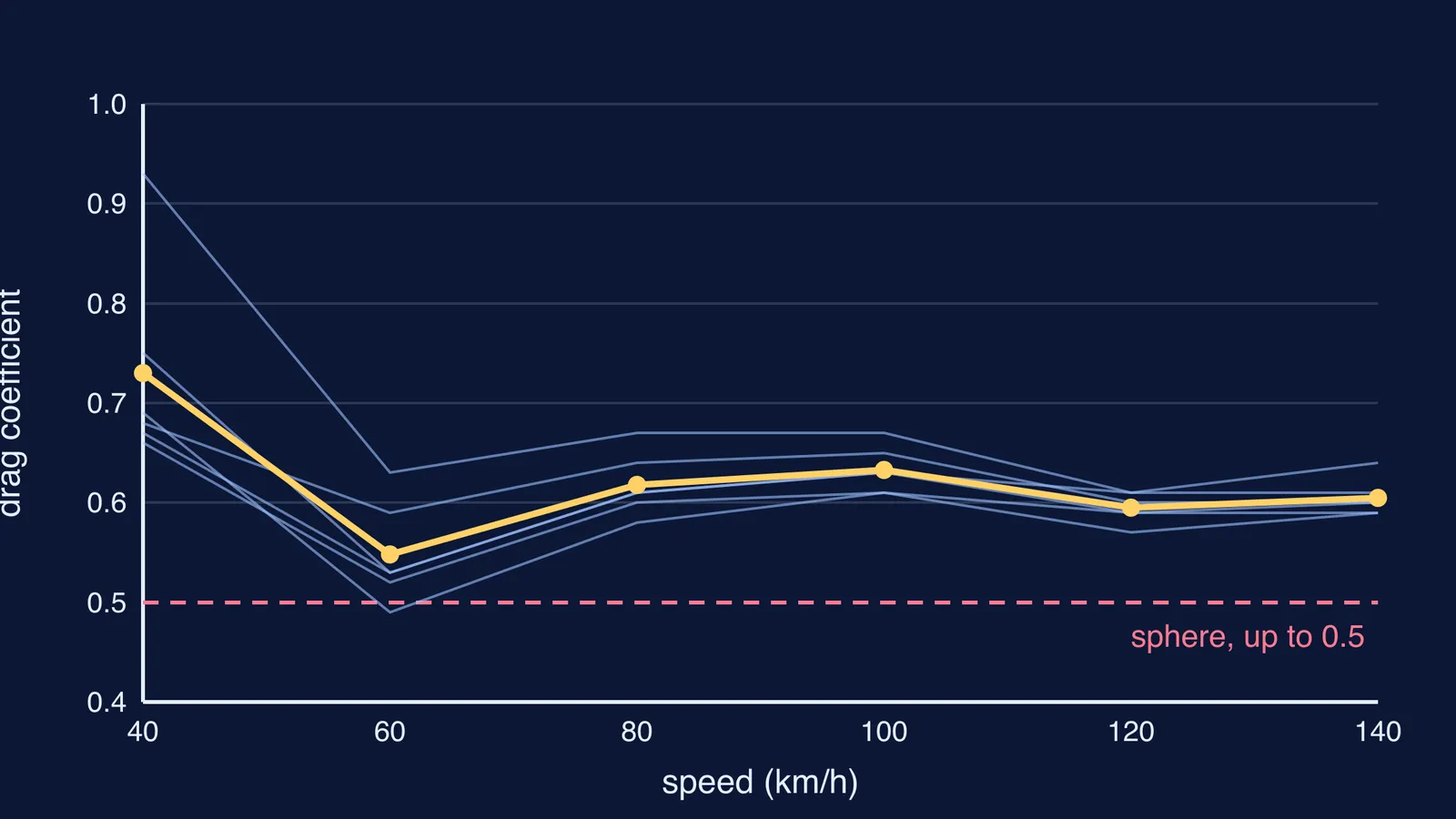
Air resistance is written as D = Cd × ρV²A / 2, where ρ is air density, V is speed, A is frontal area and Cd, the drag coefficient, captures how shape and surface disturb the air (NASA Glenn, the drag equation). NASA gives a sphere's drag coefficient as 0.07 to 0.5, depending on the flow (NASA Glenn, shape effects on drag).
A new tennis ball sits above that range. In RMIT University wind-tunnel tests on six new Australian Open balls, each ball's drag coefficient, averaged over 40 to 140 km/h, was between 0.59 and 0.69 (Alam, Watkins and Subic, 2004). A review by Rabindra Mehta, Firoz Alam and Aleksandar Subic explains such high values with a flow model that includes the drag of the fuzz itself (Mehta, Alam and Subic, 2008, Sports Technology).
Each fibre in the airflow acts like a tiny cylinder with its own drag; Mehta dubbed this "fuzz drag". As the ball speeds up, the fibres lie down on the ball and fuzz drag declines (Jani Macari Pallis, Tennis Server, 2001).
Wear changes the story. Steve Chadwick and Steve Haake found a heavily worn ball had lower drag than new ones; they estimated that a ball with much of its nap gone would travel about 1 m further when hit horizontally at 26.3 m/s without spin (Chadwick and Haake, 1998).
How hard does the air push on a tennis ball?
Try it with a calculator. Take a 58 g ball, 6.6 cm across (inside the ITF limits), at 100 km/h, with Cd = 0.63, the average of the six RMIT balls at that speed. NASA's standard atmosphere model gives a sea-level air density of about 1.225 kg/m³ (NASA Glenn, Earth atmosphere model).
Speed: 100 km/h = 27.8 m/s, so V² ≈ 772 m²/s².
Area: A = πr² = π × (0.033 m)² ≈ 0.00342 m².
Drag: D = 0.63 × 1.225 × 772 × 0.00342 / 2 ≈ 1.02 N.
Weight: W = 0.058 kg × 9.8 m/s² ≈ 0.57 N.
So the air pushes back with almost twice the ball's weight, a deceleration of about 17.6 m/s². With Cd = 0.5, step 3 gives about 0.81 N, so the tennis ball feels roughly a quarter more drag than a sphere at the top of NASA's range would.
How does felt help a tennis ball grip and spin?
When a ball lands, it either slides throughout the bounce or its bottom comes to rest and grips the court. Rod Cross, a physicist at the University of Sydney, explains that a ball arriving at less than about 20° rebounds while still sliding, and that the coefficient of sliding friction can be as high as 0.9 on clay and is 0.5 to 0.6 on Wimbledon grass (Cross, Physics Today, 2008).
On the ball's side, the gripping surface is the felt. Cross measured friction for tennis ball cloth directly and gave the angle below which a tennis ball arriving without spin slides throughout the bounce: tan θ = 0.203/μ (Cross, American Journal of Physics, 2005). Plug in:
Grass, μ = 0.55: θ ≈ 20°.
μ = 0.75, Cross's example: θ ≈ 15°.
Clay, μ = 0.9: θ ≈ 13°.
More friction means the ball grips at shallower angles, and a ball that grips leaves the court with more spin for its speed than one that slides throughout. On the racket, Cross notes that strings return to their original position very quickly, at least when new, which adds to the spin of the outgoing ball (Cross, physics of bounce).
How can you use this in physics revision?
Write the drag equation and name the term the felt changes (Cd).
Redo the worked example at 150 km/h; with the same Cd, drag should rise about 2.25 times.
Draw a free-body diagram of a ball mid-bounce, marking friction at the contact point.
Use tan θ = 0.203/μ to explain why a slicker court lets the ball slide over a wider range of angles.
If grip versus slide is hard to picture, watch it happen: the Fermi Simulation Lab has interactive simulations for ideas that are easier to see than to read, and the Fermi Concept Library gives every physics concept, friction included, its own lesson.
Next time you open a fresh can, run your thumb over the felt: that is friction and air resistance you can hold.


