On this page
Try this tonight. Stand a pencil on its end on your fingertip, then a 30 cm ruler, then a broom with its brush end up. The pencil is gone almost at once, the ruler lasts a moment, and the broom stays up for a long time, even though it is the tallest and heaviest. It is about how fast each object falls, and how fast you can react.
Why is a long stick easier to balance on your finger?
A stick standing on your finger is an inverted pendulum: a mass above a pivot, in balance only when exactly upright. The Wikipedia article on the inverted pendulum gives its equation of motion, θ'' = (g/ℓ) sin θ, and sums it up: "Tall pendulums fall more slowly than short ones."
In plain English: the further the stick leans, the faster the lean grows, and a taller pendulum gets a smaller push for the same lean.
For small angles, the tilt of an inverted pendulum grows by a factor of e (about 2.7) every √(ℓ/g) seconds. For a weight on top of a light rod, ℓ is the rod's length. For a uniform stick of length L pivoted at one end, its moment of inertia gives ℓ = 2L/3.
The key is the square root. A stick four times longer falls only twice as slowly, but that can be the difference between impossible and easy.
How fast do a pencil, a ruler and a broom fall?
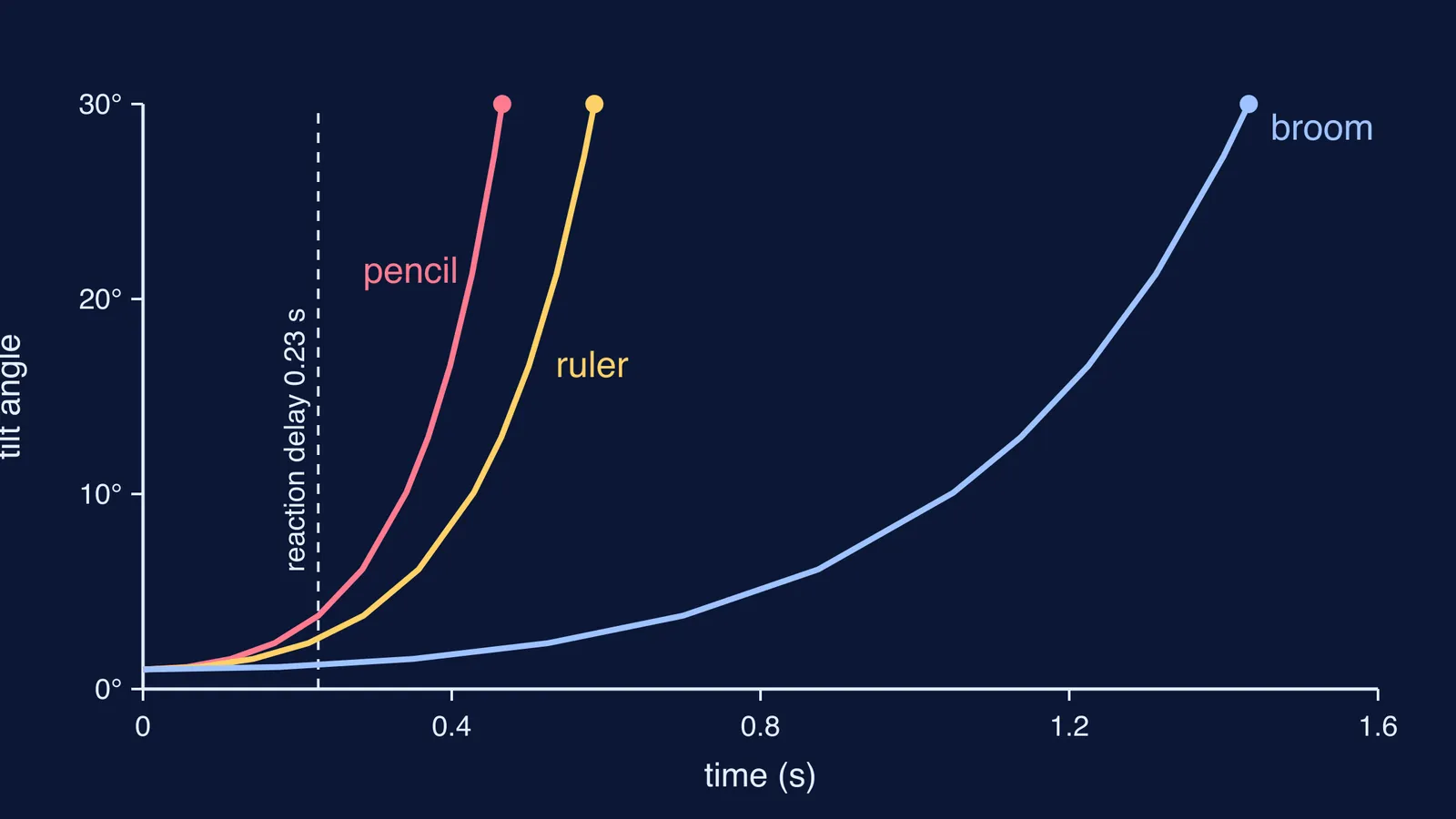
Here is our worked example, using the small-angle form of the inverted pendulum equation, g = 9.8 m/s² and a 1° starting lean, released from rest. The pencil (19 cm) and ruler (30 cm) are treated as uniform sticks. A brush-up broom has most of its mass near the top, so we treat it as a weight 1.2 m above your finger.
Pencil: time scale √(0.127/9.8) ≈ 0.11 s. It reaches 30° in about 0.47 s.
Ruler: time scale √(0.20/9.8) ≈ 0.14 s. It reaches 30° in about 0.59 s.
Broom: time scale √(1.2/9.8) ≈ 0.35 s. It reaches 30° in about 1.4 s.
These come from the small-angle solution (tilt = starting angle × cosh of time divided by the time scale). Real falls run a little slower at large angles, so treat them as estimates.
Why can't you balance a pencil on your finger?
You cannot correct a lean you have not noticed yet. In a 2019 study of virtual stick balancing in Royal Society Open Science, 27 people pressed a button as soon as a light flashed, and their average reaction delay was 227 ms; tests that involved a choice gave 258 to 270 ms. The paper shows that the shortest stick a person can balance grows with the square of their feedback delay, and states: "This relation explains why it is more difficult to balance a short pendulum than a long one."
Run our numbers through that 0.23 s delay. Before you can respond, a pencil's tilt grows nearly 4 times, a ruler's about 2.6 times and a broom's only about 1.2 times. With the broom, your correction arrives while the lean is still small. With the pencil, you are always chasing a fall that has already happened.
Try it: the three-object balancing test
You need a phone stopwatch, a pencil, a 30 cm ruler, a broom and a friend.
Balance each object on your fingertip, five tries each, while your friend times each try.
Write down the best and median time for each object.
Measure each length and work out the time scale √(ℓ/g) from the inverted pendulum equation, using ℓ = 2L/3 for the pencil and ruler.
Check whether the ranking of your times matches the ranking of the time scales.
Tape a small bag of coins to the top of the ruler and try again. Then move it to the bottom.
Expect the pencil to fall in under a second, the ruler to give short, frantic tries, and the broom to last as long as your attention does. The coins should help most at the top.
Where does this show up in physics class?
The upright stick is the standard example of unstable equilibrium; our explainer on stable, unstable and neutral equilibrium of rigid bodies shows how to tell the three apart. If the two balance points confuse you, read centre of gravity vs centre of mass. A long object that resists quick turns is also behind the tightrope walker's long pole.
If a growing tilt is hard to picture, the Fermi Simulation Lab has interactive simulations for the ideas that are easier to see than to read. If a step in the derivation does not click, Fermi's AI tutor works out what you already know, builds a plan for the session and teaches through it on a board.
Then go and find a broom.