

On this page
On 7 August 1974, Philippe Petit stepped off the south tower of the World Trade Center carrying a long pole, then crossed the gap eight times in about 50 minutes, 1,350 feet above the street, according to HISTORY. The pole is not something to lean on. What it changes is how fast you fall.
Why does a tightrope walker carry a long pole?
A walker on a rope is an upside-down pendulum: gravity turns any small lean into a bigger one. The walker cannot switch that off, but they can slow it down.
The quantity that sets the pace is the moment of inertia. Moment of inertia measures an object's resistance to being spun around an axis, as John D. Barrow writes in Plus magazine. Here the axis is the rope. A long pole places mass far from the body's centre line, so wobbles happen more slowly and the walker has more time to respond (Plus magazine).
How does moment of inertia slow down tipping?
For a set of point masses, the moment of inertia is I = Σmr², where r is each mass's distance from the axis (OpenStax University Physics). The square does most of the work. A kilogram 5 m from the rope counts 25 times as much as a kilogram 1 m away.
For a thin uniform rod turning about its centre, I = ML²/12 (OpenStax). Double a pole's length at the same mass, and its moment of inertia goes up four times.
If the walker leans by a small angle θ, gravity's torque about the rope is roughly Mghθ, where h is the height of the centre of mass. Newton's second law for rotation, Iα = torque, gives a lean that grows on a time scale τ = √(I/Mgh). Bigger I, longer τ, slower fall.
A smaller bonus: holding the pole below your centre of mass lowers the centre of mass of the whole system, as a Clemson University physics demonstration notes.
How much extra time does the pole buy? A worked example
The numbers below are round values we chose, not measurements of any real walker.
Walker: 70 kg, treated as a uniform rod 1.8 m tall pivoting at the feet, so I = ML²/3 = 75.6 kg m² and h = 0.9 m.
Long pole: 12 kg, 10 m long, held 1.0 m above the rope. About the rope, I = 12 × 10²/12 + 12 × 1.0² = 112 kg m² (the rod formula plus the parallel-axis term).
Short pole: the same 12 kg, but 2 m long and held at the same height, so I = 4 + 12 = 16 kg m².
Now work out τ = √(total I ÷ total mgh) for each case, with g = 9.8 m/s²:
No pole: τ = √(75.6 ÷ 617) ≈ 0.35 s.
Short pole: τ = √(91.6 ÷ 735) ≈ 0.35 s. No real gain: the extra mass adds toppling torque too.
Long pole: τ = √(187.6 ÷ 735) ≈ 0.51 s.
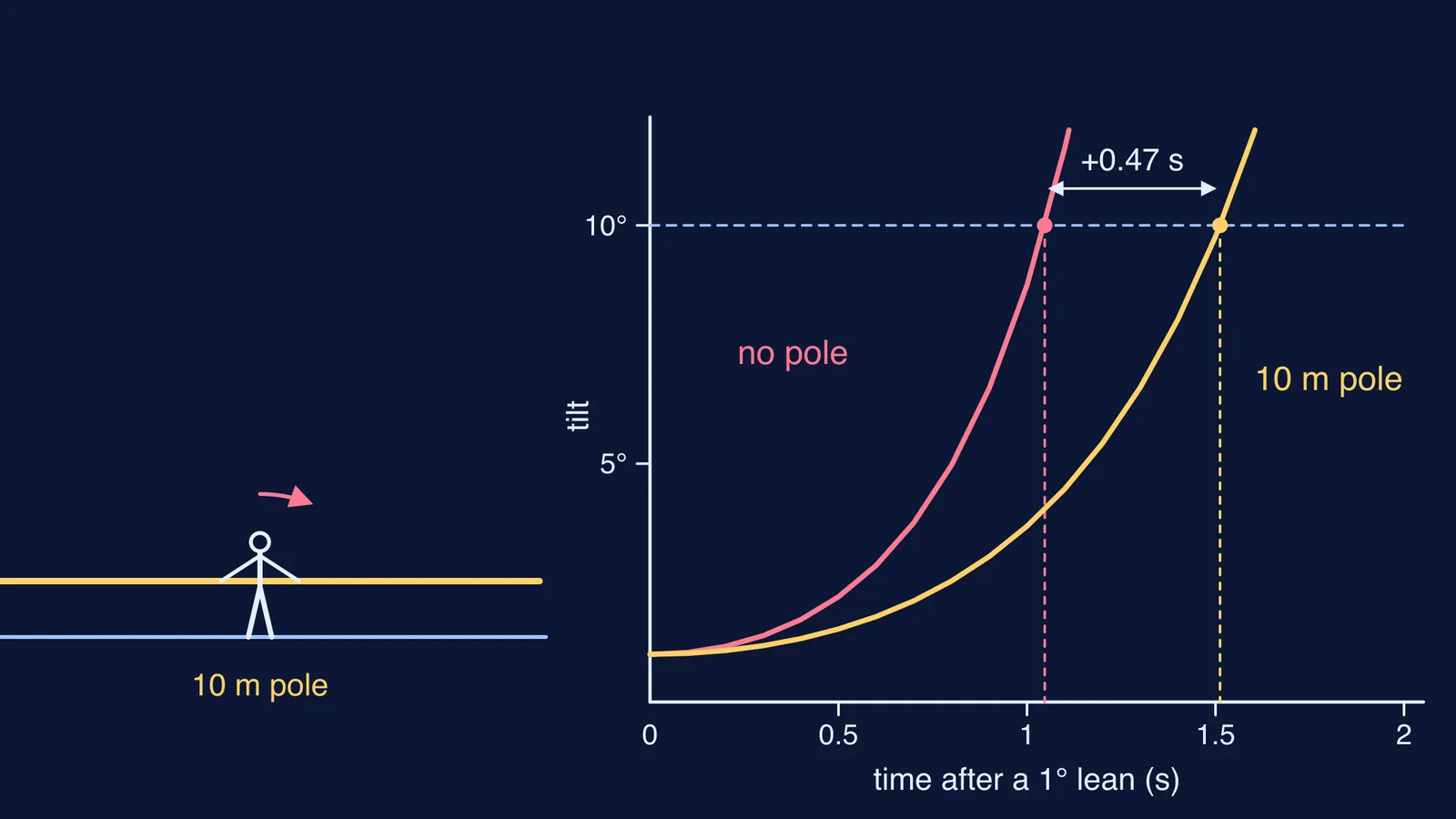
From rest at a 1° lean, the tilt follows θ = 1° × cosh(t/τ). It reaches 10° after about 1.05 s with no pole and 1.51 s with the long one: nearly half a second more, from mass spread far from the rope.
Why does that matter? In their model of tightrope balance, P. Paoletti and L. Mahadevan note that common estimates of the body's feedback delay range from 25 ms to 200 ms, and treat arms or a pole as the source of corrective torque (Journal of the Royal Society Interface, 2012). When your reaction lag is a real fraction of the fall time, slowing the fall makes correction possible.
Can you feel this effect at home?
Balance a ruler upright on your fingertip. Barrow suggests comparing a one-metre ruler with a ten-centimetre one (Plus magazine).
Walk heel-to-toe along a line on the floor, arms at your sides, then arms stretched out.
Repeat holding a broom horizontally by its middle.
Predict each result before you try it.
Where does this show up in JEE and NEET physics?
Many rotational motion questions run on the same idea: compare I, then compare angular acceleration. Our explainer on radius of gyration describes how far mass sits from an axis with a single length, and same torque on a ring and a disc is the tightrope argument in exam form. For the body's side, see how the semicircular canals in your inner ear sense rotation.
If moment of inertia still feels like a formula rather than an idea, the Fermi Concept Library gives every physics concept its own lesson and its place in the map. To practise, the Fermi Problem Library has worked problems with a step-by-step solver that explains the reasoning rather than printing an answer.
Next time you see a long pole on a high wire, read it as a slower clock for falling.


