

On this page
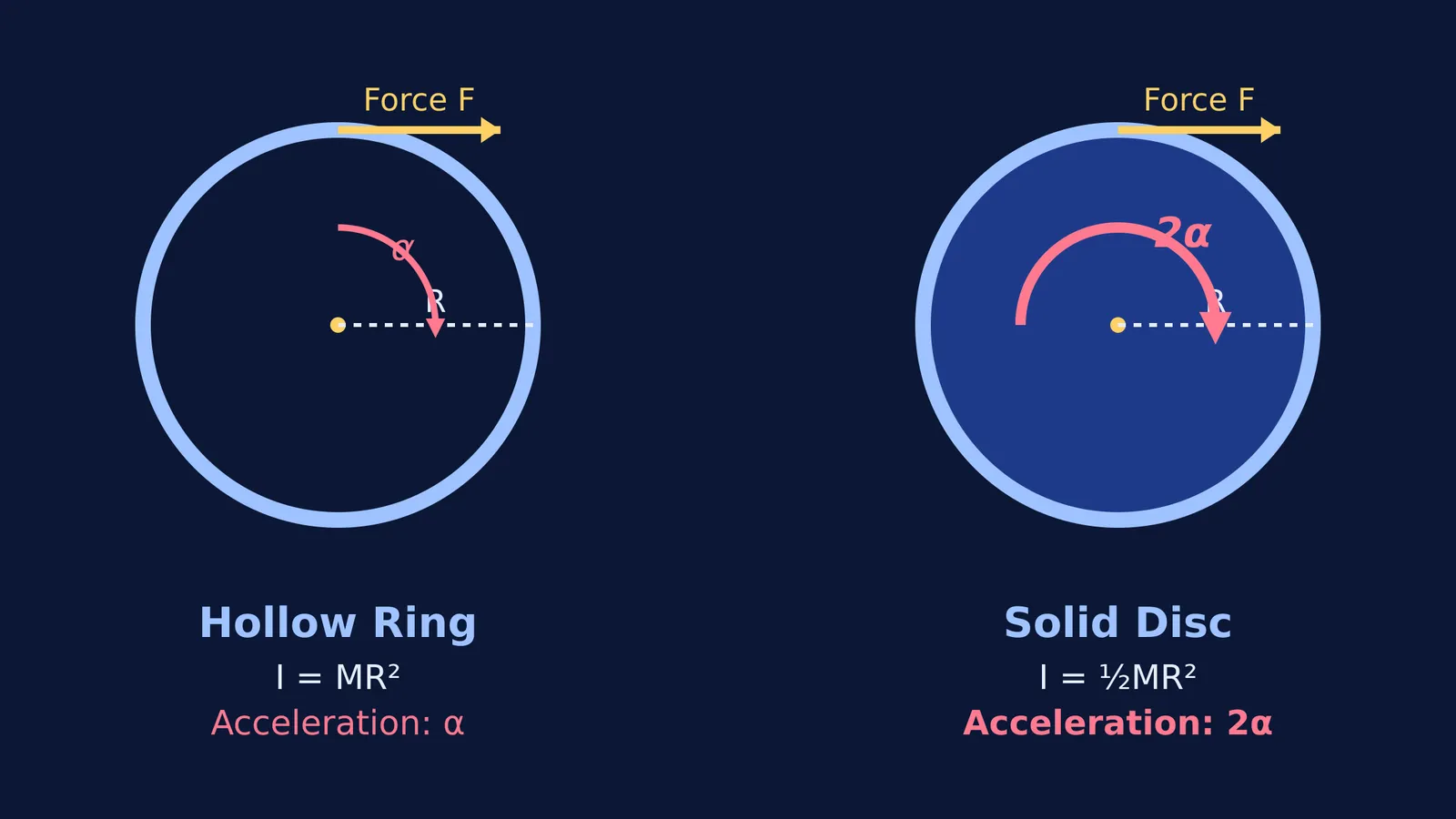
Imagine you have a solid disc and a hollow ring. They have the exact same mass (M) and the exact same radius (R). If you apply the exact same twisting force — or torque (τ) — to both of them, which one will spin faster?
The answer is the disc. Even though they weigh the same, the disc will accelerate twice as fast as the ring. To understand why, you have to look at how their mass is arranged.
Why does mass distribution matter?
In linear motion, mass tells you how hard it is to accelerate an object (F = ma). In rotational motion, the resistance to spinning is called the moment of inertia (I).
The moment of inertia depends not just on the total mass, but on how far that mass is from the axis of rotation. The further the mass is from the centre, the harder it is to start or stop the spin.
For a ring: All of its mass is concentrated at the very edge, at distance R. Its moment of inertia is I = MR².
For a solid disc: The mass is spread out evenly from the centre to the edge. Because much of the mass is closer to the centre, it is easier to turn. Its moment of inertia is exactly half that of the ring: I = ½MR².
What is the rotational equivalent of F = ma?
When you apply a torque (τ), you create an angular acceleration (α). This relationship is the rotational version of Newton's second law, written as τ = Iα.
Since we are applying the same torque to both objects, we can rearrange the formula to see how fast each one speeds up:
α = τ / I
Because the torque (τ) is constant, the angular acceleration is inversely proportional to the moment of inertia. The object with the smaller moment of inertia will have the larger angular acceleration.
How do their angular accelerations compare?
Let us compare the two side by side:
Ring: α(ring) = τ / MR²
Disc: α(disc) = τ / (½MR²) = 2τ / MR²
The disc has an angular acceleration that is exactly twice as large as the ring's (α(disc) = 2α(ring)). If you spin both from rest for the same amount of time, the disc will end up rotating twice as fast.
Where do we use this in the real world?
Engineers use these principles when designing machines. If you want an object to be easy to start and stop spinning, you design it like a disc or even concentrate the mass near the centre. For example, the wheels of a racing bicycle are made as light as possible at the rims. A lower moment of inertia allows the cyclist to accelerate the wheels with less effort.
On the other hand, if you want to maintain a steady rotation and resist sudden changes in speed, you design the object more like a ring. A flywheel in an engine is a heavy wheel with most of its mass pushed out to the outer rim. Because of its large moment of inertia, it takes a lot of torque to start it spinning. However, once it is moving, it is equally hard to stop. It stores rotational energy and keeps the engine running smoothly between power strokes.
Understanding the difference between a ring and a disc is not just a textbook exercise; it is the foundation for controlling rotational motion in everything from engines to spacecraft.
How should you study rotational dynamics for exams?
Rotational motion is a key mechanics topic in exams like JEE Main and NEET-UG. Questions frequently mix torque, angular momentum, and rolling motion into a single problem.
If you are finding these concepts hard to picture, you can explore the Fermi Concept Library. Fermi's AI tutor does not just hand you a formula sheet; it writes on a board, draws the figure, runs the simulation, and checks understanding as it goes, helping you build a solid physical intuition for why objects move the way they do.
If you are preparing for exams, make sure you also know how to apply these ideas to the radius of gyration and what happens when you deal with a spinning charged ring or disc. And if you want a real test of your intuition, try figuring out which way a spool rolls when pulled by its string.


